
😺 OpenAI's big day brought a disproof and Terra
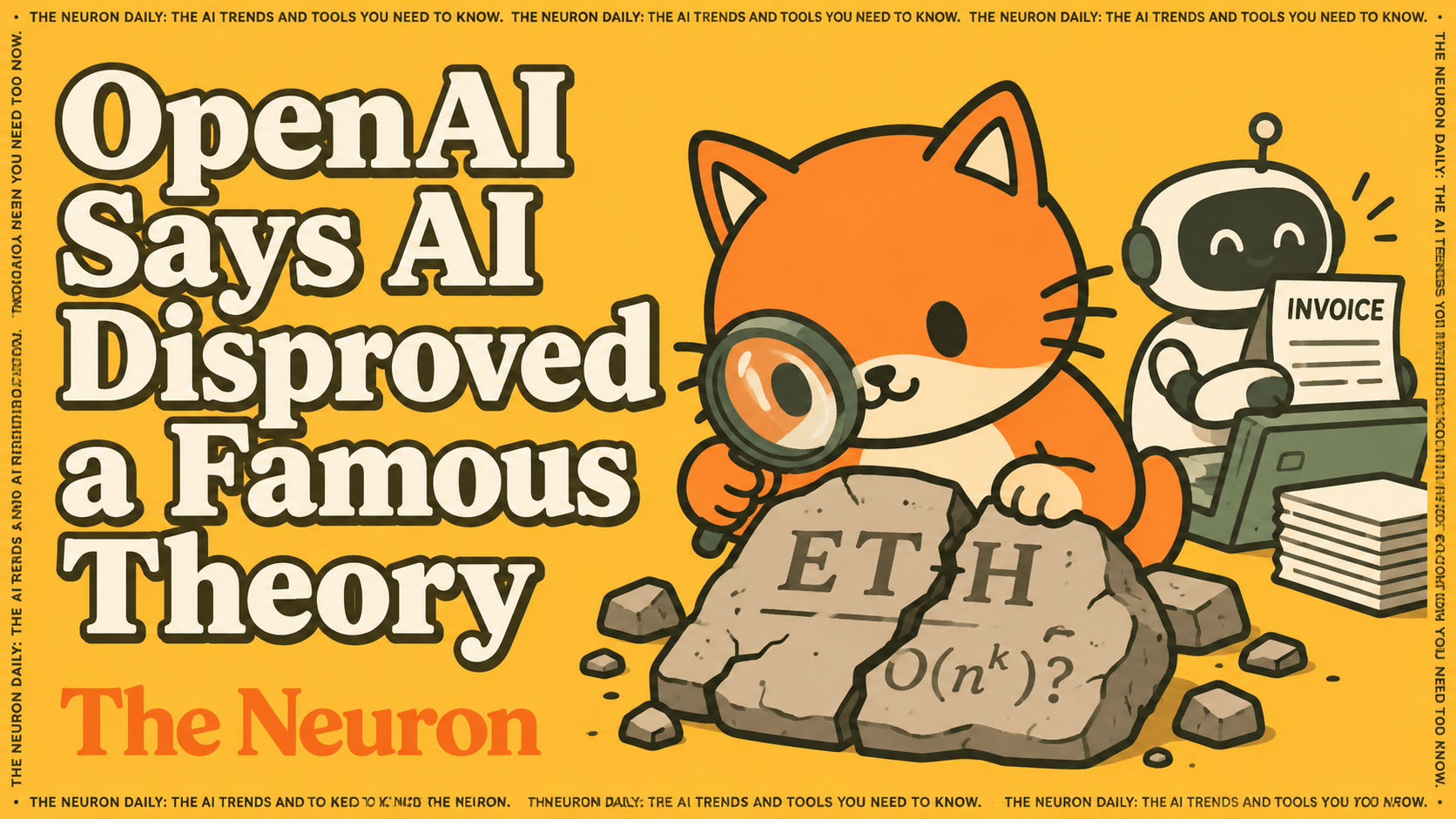
😸 OpenAI Says Its AI Disproved a Famous Computer Science Hypothesis, Then Launched GPT-6.1 Terra
On Monday, OpenAI made two announcements about very different things. One reported three new discoveries in mathematics, computer science, and physics. The other introduced GPT-6.1 Terra, a cheaper AI model designed to use office software by looking at screens, clicking buttons, and typing.
Here is what happened:
OpenAI says its models proved the local smoothing conjecture in every dimension. This is a mathematics problem from 1991 about how waves gather and become more concentrated.
OpenAI says its system disproved the Exponential Time Hypothesis, an important idea in computer science. A program called Lean checked the proof.
OpenAI says its models produced a strict mathematical proof that a solution exists for quantum chromodynamics, the theory that explains the strong force.
Terra costs $1 per million input tokens and $5 per million output tokens. That is half the price of GPT-6.1 Sol.
Let's start with the computer science result, because it involves an unusual mix of people and tools. The Exponential Time Hypothesis (ETH) is an idea about a problem called Boolean satisfiability. Imagine you have a group of switches, each of which can be set to true or false, and a list of rules. Can you choose settings that make every rule true? The best methods known today take exponentially more time as you add more switches. The ETH says that no fundamentally faster method exists.
Hundreds of research papers use the ETH as a starting assumption. These papers cover fields such as databases and computational biology. If the ETH is false, many results claiming that certain problems cannot be solved faster would need to be reconsidered. Those questions would become open problems again.
OpenAI says its system found the disproof on October 16, and Lean checked it the next day. Lean works a little like a spellchecker for logic: it checks that every step follows correctly from the steps before it. A group of experts must now check whether the claim really means what it appears to mean. The group is led by Russell Impagliazzo, Ramamohan Paturi, and Ryan Williams. Impagliazzo and Paturi are two of the three people who first proposed the ETH. So two people who helped create the hypothesis are now helping decide whether a robot has disproved it. That should make for an interesting group chat.
OpenAI says this work is still at an early stage. It describes the research papers as raw research data. It also says that using a disproved ETH to build faster software will require a lot more research. Meanwhile, a group led by Nobel laureate David Gross is holding back the physics result while it prepares its own account of the work.
A very different launch on the same day: GPT-6.1 Terra. Terra is the middle model in OpenAI's lineup. It is built for computer use, which means it can look at a screen, click buttons, type, and move between apps much like a person. OpenAI's example is reading incoming invoices and entering their details into accounting software. That may not sound exciting, but anyone who has typed invoice numbers by hand on a Friday afternoon knows why it could be useful.
OpenAI says Terra scores 15 points higher than its predecessor on its Agents' Last Exam benchmark while costing about one-third as much. It also says Terra performs as well as Astra at one-tenth the price per token and finishes tasks more than three times faster than Astra and Sol. An independent NerdsChalk test found a smaller difference: on three short tasks, Sol took about 1.8 times as long as Terra. An OpenAI engineer described Terra as a way to get more use within existing limits rather than a major breakthrough.
Both announcements raise the same question: how can we check whether the AI did its work correctly? Checking a completed form takes seconds. Checking a proof of a 35-year-old hypothesis could take months, require a group of experts, and involve a conference that OpenAI has agreed to fund. The expert group's decision on the ETH will be especially important. It may be the clearest test yet of whether AI-generated proofs hold up when people who know the field examine them closely.
