
Machine learning simulations reveal how plastic transforms into hard carbon
October 28, 2026
Edited by Sadie Harley, reviewed by Robert Egan
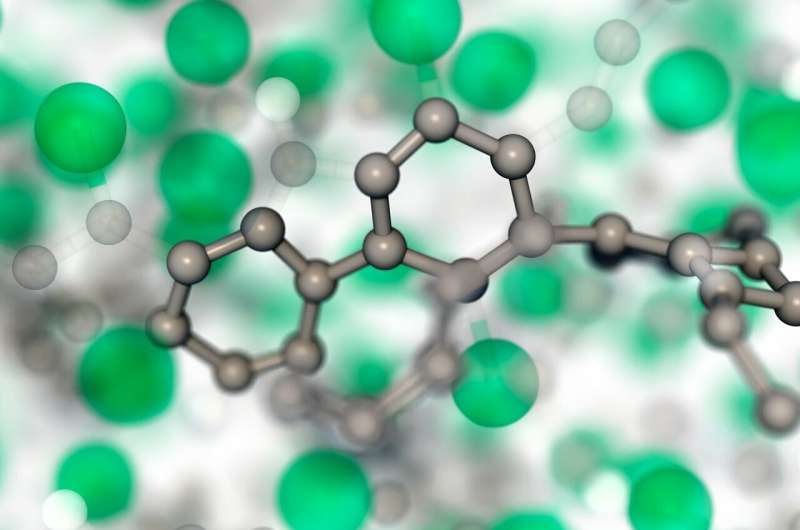
In a new study published in Chemical Science, researchers from the University of Oxford's Department of Chemistry used computer simulations powered by machine learning to track how a common plastic-like material changes into hard carbon. They discovered how atoms move and join together to create the material's uneven structure.
Hard carbon is an important material used in the negative electrodes, called anodes, of sodium-ion batteries. These batteries are attracting interest because they could be a lower-cost alternative to traditional lithium-ion batteries. Sodium is widely available in nature and is inexpensive. Unlike graphite, hard carbon contains curved carbon structures arranged in an irregular way. Even at very high temperatures, these structures resist changing into neatly ordered graphite.
Scientists have wondered for decades why hard carbon behaves this way. In the 1950s, Franklin showed that carbon materials can be divided into two groups: those that can turn into graphite and those that cannot. Her work showed that the starting material plays an important role in deciding what kind of carbon forms. However, scientists have found it difficult to watch or directly simulate how hard carbon develops, atom by atom.
Tracing hard carbon's disordered structure
The Oxford team studied polyvinylidene chloride (PVDC), a type of polymer that is a well-known starting material for making carbon that does not easily turn into graphite. Polymers are large molecules made of repeating chemical units.
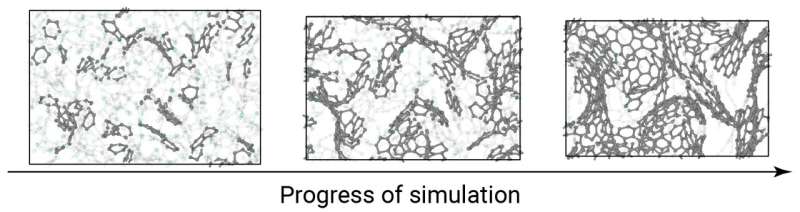
To study how this polymer breaks down when heated, the researchers used computer simulations based on machine learning. These simulations combined the accuracy of calculations based on quantum mechanics with the speed needed to study complex chemical structures. This let the team track individual atoms and see how chemical bonds broke and formed as the polymer heated up. The results gave them a detailed picture of how hard carbon develops at a very small scale.
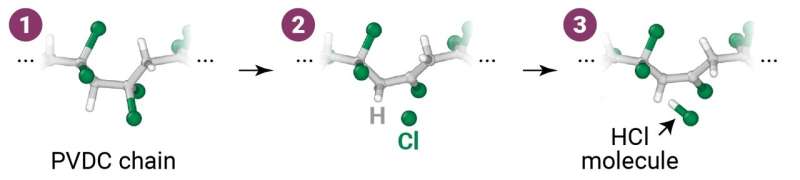
The simulations showed that hydrogen and chlorine atoms leave the starting PVDC material. This creates highly reactive places on the remaining carbon atoms, which then form new bonds with other carbon atoms. Over time, these bonds join the remains of the polymer chains into a large, connected network.
Importantly, this network contains carbon rings with five, six, and seven sides, rather than only the six-sided rings found in graphite. The five- and seven-sided rings make the structure bend. Think of a traditional soccer ball: its five-sided pieces help its surface curve into a sphere. In the same way, rings that do not have six sides bend and distort the carbon network. This stops it from forming the flat, orderly layers found in graphite.
The study was led by Litong Wu. It built on early studies by former students Zitong Wu and Zakariya El-Machachi, under the guidance of Professor Volker Deringer in Oxford's Department of Chemistry. The work shows that simulations using machine learning can reveal how complex materials form through chemical reactions. Studying these processes with traditional quantum-mechanical calculations would be too expensive in computing time and resources.
Lead author Litong Wu said, "Working on this project felt like opening a book that no one had ever read before. Out of the chaos of atoms moving at high temperatures, neat and easy-to-understand patterns start to appear. It was a real honor to revisit the work of Rosalind Franklin, someone I've long admired. I'm equally proud that our study shows what modern computer methods, combined with today's computing power, can make possible."
Deringer said, "I will just add to Litong's words how delighted I am to see multiple members of our group making this research possible: herself as a current DPhil student expertly leading the study; Zitong as a former MChem project student (whom I had first taught in her first year on the course); and Zak as a DPhil alum who helped build the foundations for this work."
Connecting starting materials to battery performance
As well as helping scientists understand how hard carbon forms, this research could support future work linking the chemistry of starting materials to the structure and electrical-chemical properties of battery anodes. This fits with the team's wider goal of finding ways to design materials with useful properties even when their atoms are arranged irregularly. The team hopes to do this with the help of machine-learning-based simulations that track atoms and their movements.
The authors have also made their research data freely available online so other researchers can use it in future studies.
Publication details
Litong Wu et al., Atomistic mechanisms of hard carbon formation from polyvinylidene chloride, Chemical Science (2026). DOI: 10.1039/d6sc05974k
Journal information: Chemical Science
Provided by University of Oxford