
Grand Jury Indicts Ex-OpenAI Engineer Over Bugged Exec Room
A federal grand jury indicted former OpenAI engineer Abdulrahman Alfozan on Tuesday, 27 October 2026. He faces a felony charge of intercepting spoken conversations, the San Francisco Chronicle reported, citing a court filing. Prosecutors say he placed an encrypted listening device in a conference room at OpenAI headquarters in San Francisco. Company executives used the room.
According to the Chronicle, the indictment says that from about 28 September to 5 October, Alfozan knowingly used electronic devices to “intercept one or more oral communications” about the business activities of OpenAI. He has not been convicted.
What the Indictment Says
The Chronicle reported that the grand jury charged the 35-year-old Saudi national with a felony for intercepting spoken conversations. Federal prosecutors say he installed the device in the conference room. According to the newspaper, the indictment was filed in the U.S. District Court for the Northern District of California.
The indictment also includes a claim that property should be taken away, the Chronicle reported. This means that if Alfozan is convicted, he would have to give up the recording devices and related equipment, according to court documents.
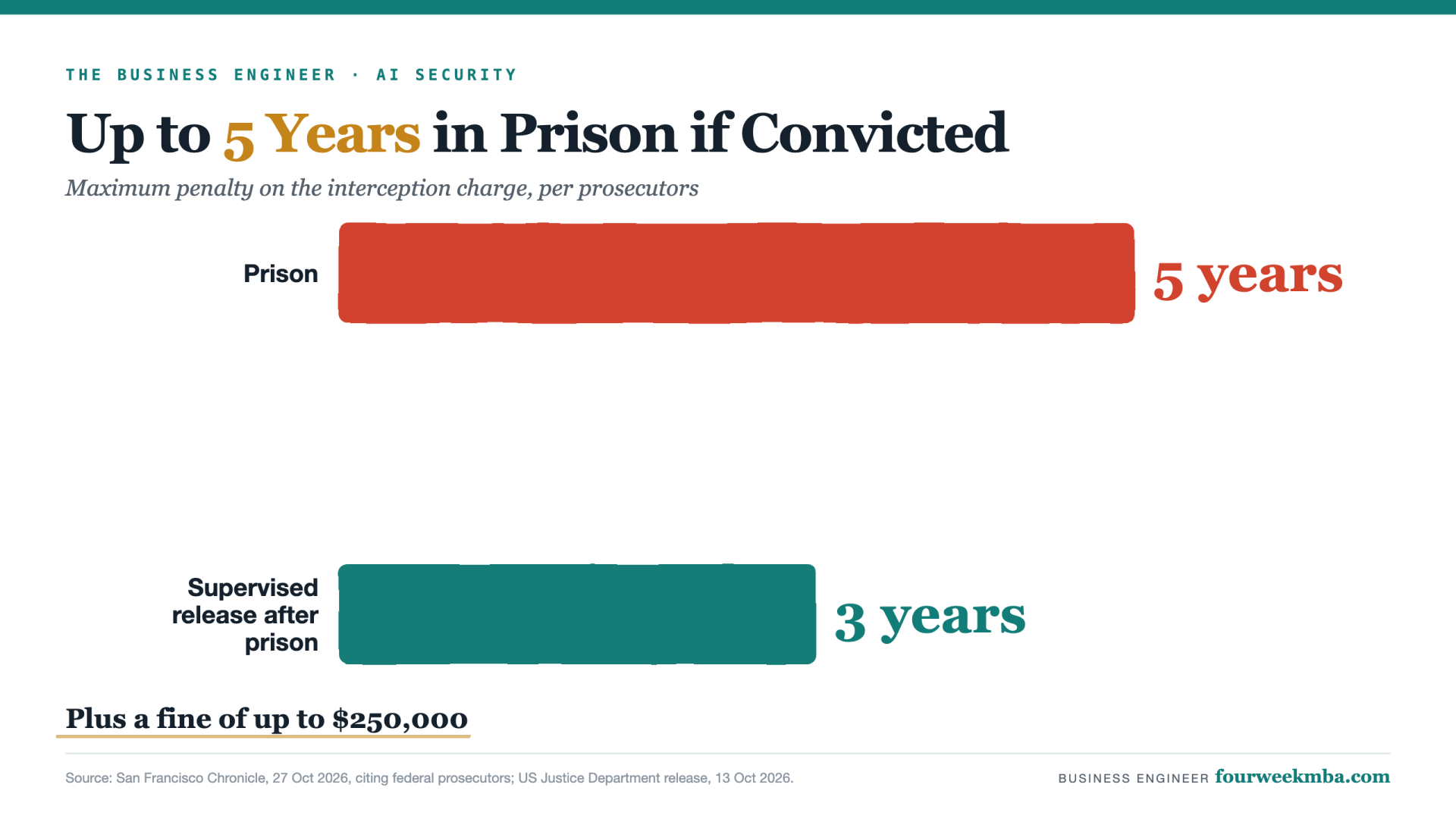
If convicted, Alfozan faces up to five years in prison, a $250,000 fine, and then three years of supervised release, according to federal prosecutors cited by the Chronicle. The newspaper reported that he remained in custody without bail on Tuesday.
Where the Case Stands
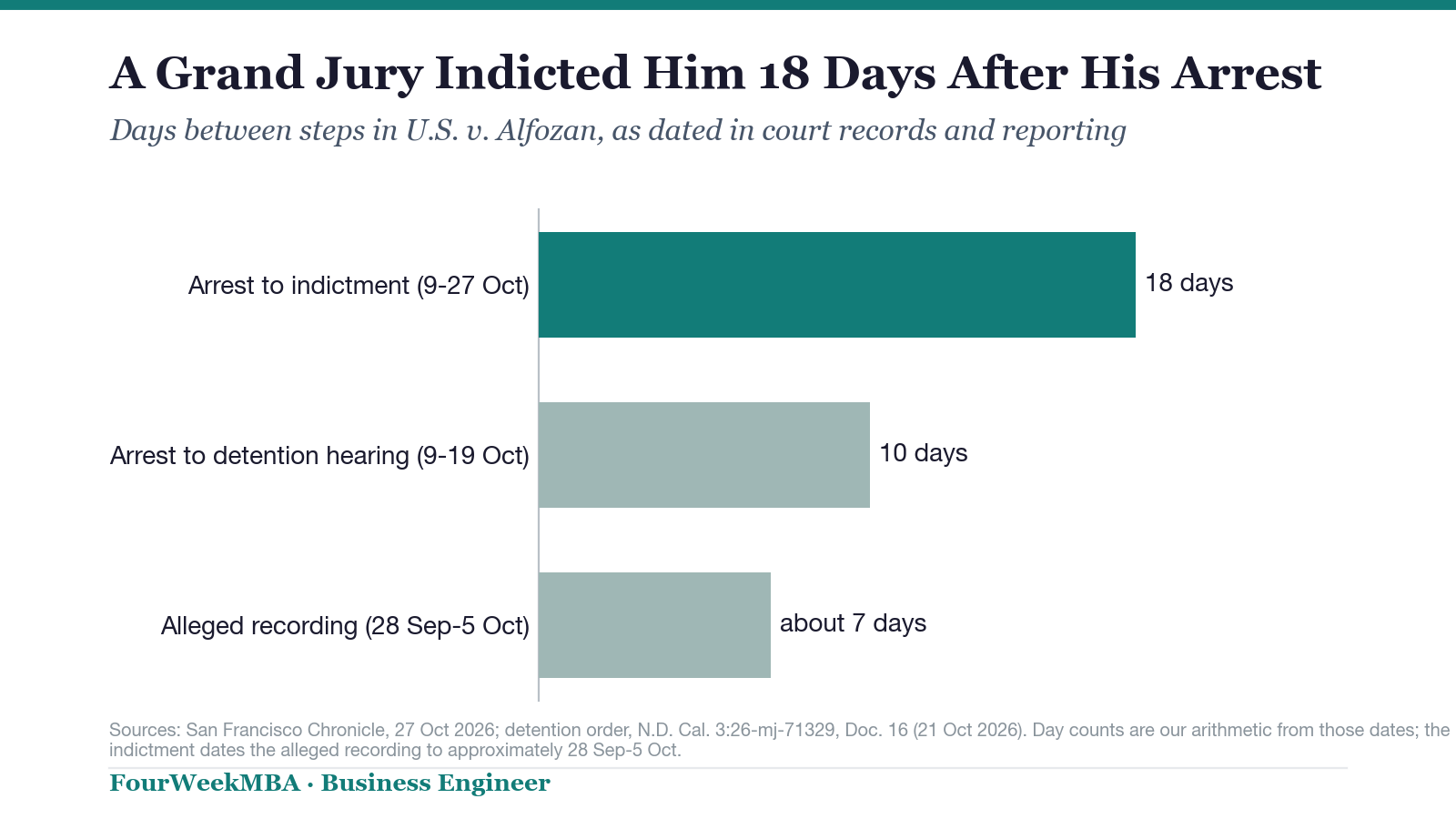
According to the court's detention order and the Chronicle, Alfozan was charged through a criminal complaint on 8 October 2026 and arrested by FBI agents in Millbrae on 9 October. The criminal complaint says the device was wrapped in toilet paper and hidden behind a television in a room often used to discuss confidential research, business plans, and government partnerships, the Chronicle reported.
After a hearing on 19 October, Magistrate Judge Alex G. Tse ordered that Alfozan remain in custody while awaiting trial. The written order, dated 21 October, says that the defendant “was fired after being arrested and no longer has a job in the United States.” On 13 October, OpenAI said on X that “The employee was terminated.”
By our calculation, the indictment came 18 days after his arrest. The Chronicle's report about the indictment does not mention an economic espionage charge. The Wall Street Journal reported on 24 October that the FBI was considering possibly adding such a charge.
Connecting the Coverage
This is our fourth article about the case. Our first article, OpenAI Engineer Charged Over Recorder in Exec Meeting Room, covered the announcement of the charge on 13 October, OpenAI's statement, and the FBI affidavit. Our second article, Judge Rejects Saudi-Backed $1M Bond for Ex-OpenAI Engineer, covered the 19 October detention hearing, using reporting from Fortune. It also noted that a preliminary hearing was scheduled for 6 November.
Our third article, FBI Weighs Espionage Charge Against Ex-OpenAI Engineer, reported The Wall Street Journal's account that the FBI was considering possibly adding an economic espionage charge. The new information in this article is the grand jury indictment itself, the dates of the alleged interception, the claim that recording equipment should be taken away if he is convicted, and the report that he was still being held without bail on the day of the indictment.
The Structural Read
In our view, the indictment moves the case from a criminal complaint signed under oath by an FBI agent to a formal charge brought by a grand jury. The detention order says Alfozan was charged through a criminal complaint on 8 October, while the Chronicle reports that a grand jury indicted him on Tuesday.
The Chronicle reported that the indictment includes a claim that Alfozan should give up certain property. If he is convicted, this would mean handing over the recording devices and related equipment.
In our view, the charge described in the Chronicle's report is still the charge of intercepting spoken conversations. The report does not mention the economic espionage charge that The Wall Street Journal said the FBI was considering.
Detention order, U.S. v. Alfozan, signed by Magistrate Judge Alex G. Tse, 21 October 2026
“The defendant was fired after being arrested and no longer has a job in the United States.”
Three Implications
FOR THE CASE The Chronicle reported that Alfozan remained in custody without bail on Tuesday. The detention order dated 21 October says he must remain in custody while awaiting trial.
FOR OPENAI On 13 October, OpenAI said it had no signs that this person had improperly accessed or taken away model weights, source code, or customer data. It also said the employee had been fired.
FOR AI LABS According to the Chronicle, the criminal complaint describes the room as a place often used for discussions about confidential research, business plans, and government partnerships.
The Business Engineer Lens
This story can be viewed through the Business Engineer framework Inside Anthropic's Permission Layer.
The framework explains the part of an AI system that sets rules for access. It describes this layer as the place where people decide who can use advanced AI, under what conditions, and for what reasons.
In our view, this case concerns access in a very physical setting: a room where, according to the criminal complaint as described by the Chronicle, people discussed confidential research and business plans. The framework was published in June 2026, is about Anthropic, and does not discuss this case.
What Is Not Established
We did not read the indictment itself. The details in this article come from the Chronicle's account of it. The Chronicle's report does not say how many charges the indictment contains, when Alfozan will appear in court to answer the charges, how he will plead, or whether the preliminary hearing scheduled for 6 November is still planned. We did not contact OpenAI, the Justice Department, or Alfozan's lawyer. An indictment is a formal accusation, not proof that someone is guilty.
The Bottom Line
A federal grand jury indicted former OpenAI engineer Abdulrahman Alfozan on 27 October 2026 on a felony charge of intercepting spoken conversations, the San Francisco Chronicle reported. The case concerns a listening device that prosecutors say he hid in a conference room at OpenAI used by company executives. If convicted, he faces up to five years in prison. He remains in custody.
A note on sources. The information about the indictment comes from the San Francisco Chronicle's report of 27 October 2026, which cites the indictment, court documents, and federal prosecutors. We did not read the indictment itself. Details about Alfozan's detention come from the court's detention order dated 21 October 2026 (U.S. v. Alfozan, N.D. Cal. 3:26-mj-71329, Document 16). OpenAI's statement comes from a post by its newsroom on X on 13 October 2026. Alfozan has not been convicted. Figures described as our calculations were calculated by us. Earlier articles linked above have their own sources.
Sources: San Francisco Chronicle, 27 October 2026 · Detention order, U.S. v. Alfozan, N.D. Cal. 3:26-mj-71329, Document 16 (21 October 2026) · OpenAI Newsroom on X, 13 October 2026