
OpenAI Opens an Election War Room a Week Before the Midterms
OpenAI is setting up an election “war room” ahead of the US midterm elections. The company told Politico’s Decoded newsletter about the plan, Politico reported on 28 October 2026. The team, called the Election Operations Center, will start work this week and continue until all votes have been counted. According to Politico, hundreds of employees will work together to respond to suspected attempts to misuse OpenAI tools during the elections.
In simple terms, OpenAI says people already use ChatGPT to find out how to register to vote and where to vote. Now, the company has created a special team to work during election week. Much of the team’s job will be to stop people from misusing OpenAI tools, including ChatGPT. Politico reported that the team will watch events as they happen and respond to reports of unexpected model behaviour or possible violations of the company’s rules. The midterm elections take place on 3 November.
The main point: OpenAI has already described its policies and published reports about threats from time to time. The new step is to bring together a dedicated team to watch how its tools are used during election week. According to Politico, the team will continue working until all the votes have been counted.
What the Election Operations Center Does
Politico’s report, based on information from OpenAI, explains what the new center will do.
- Timing. The center will begin work this week and continue until all votes have been counted.
- Purpose. It aims to find possible attempts to spread false information or interfere with the elections. Much of its work will focus on stopping people from misusing OpenAI tools.
- Method. The team will watch events as they happen and respond to reports that its models are behaving unexpectedly or that people may be breaking OpenAI’s platform rules.
- Staffing. Politico reported that hundreds of company employees will work on this effort.
- Leadership. Josh Lawson, OpenAI’s head of civic and strategic risk, will lead the center.
“We’ve put considerable effort [into] ensuring we help users get reliable voting information, combat misuse of our tools and support election defenders,” Lawson told Politico’s Decoded. “The Elections Operations Center builds on that yearslong work, bringing our teams together to respond quickly to emerging issues and enforce our policies as people head to the polls.”
What Was Posted on X
OpenAI launching election war room to track interference efforts https://politi.co/4iIc5Zc
— POLITICO (@politico) Oct 28 14:03
Politico posted a report saying that OpenAI was setting up an election war room to track attempts to interfere with the elections. The details about the center’s work, its staff and Josh Lawson’s comments in this article come from that report.
What OpenAI Says It Has Already Changed
On 20 October 2026, OpenAI updated its own webpage describing the steps it has taken to protect elections during the midterms.
- Voting information. OpenAI has added a Democracy Works service to ChatGPT in the US. It works in multiple languages and provides information about voter registration, deadlines, polling places and other voting requirements. It also links to official election sources.
- Results. A partnership with The Associated Press brings live vote counts into ChatGPT for elections in the US and Brazil after polling places close. OpenAI says election officials remain the trusted authority on voting rules and officially confirmed results.
- Images. When people request images showing election interference or that could discourage people from voting, the system now returns stylized or cartoon-like pictures instead of realistic-looking images.
- Election defenders. Through its Daybreak program, OpenAI says it has offered free access to its models for cyber defense to voting-system manufacturers registered with the US Election Assistance Commission and to state election authorities.
- Ads and campaigns. OpenAI says it still bans political ads on its platform and bans people from using its products to create or spread large-scale campaign messages for or against a candidate, political party or ballot measure.
The same webpage says that OpenAI has announced a partnership to add SynthID digital watermarks to images created with ChatGPT, Codex or its API. These watermarks are marks built into digital content that can help identify its origin. The company is also testing a public tool that people can use to check images. OpenAI says it supports two bills in the US Senate: the Protect Elections from Deceptive AI Act (S. 1213) and the Preparing Election Administrators for AI Act (S. 2346).
The Threat Record Behind It
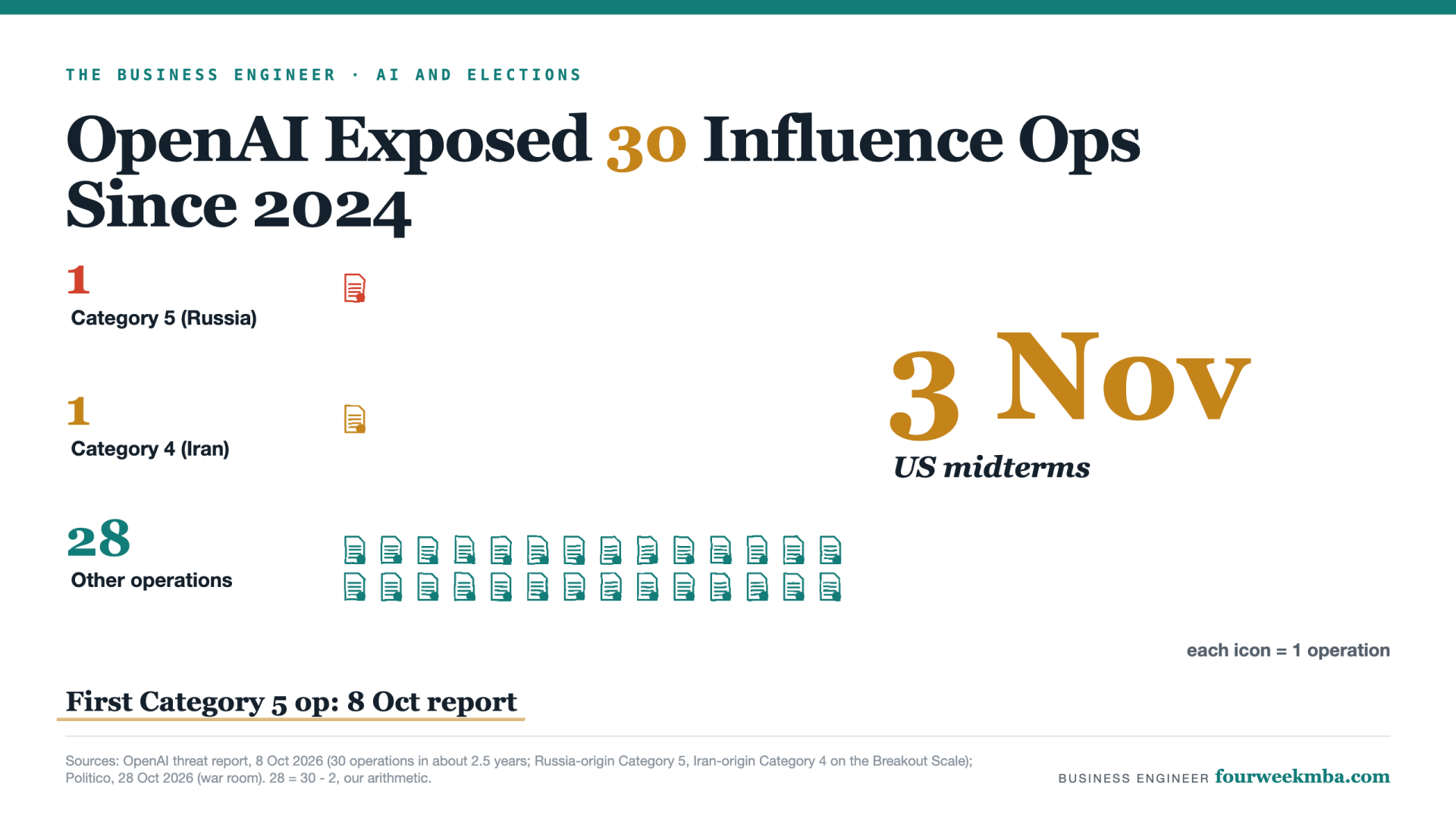
In its report published on 8 October 2026, OpenAI said it had uncovered 30 secret influence operations over the previous two and a half years. In that report, the company said it had banned two operations, one linked to Russia and one linked to Iran. Both used OpenAI models along with traditional methods to run fake organizations that appeared to be legitimate. The Iran-linked operation included seven fake people presented as journalists.
The Breakout Scale rates influence operations from 1 to 6. OpenAI rated the Russia-linked operation Category 5. The company says this was the first Category 5 operation it had taken action against since it began publishing these reports. It rated the Iran-linked operation Category 4.
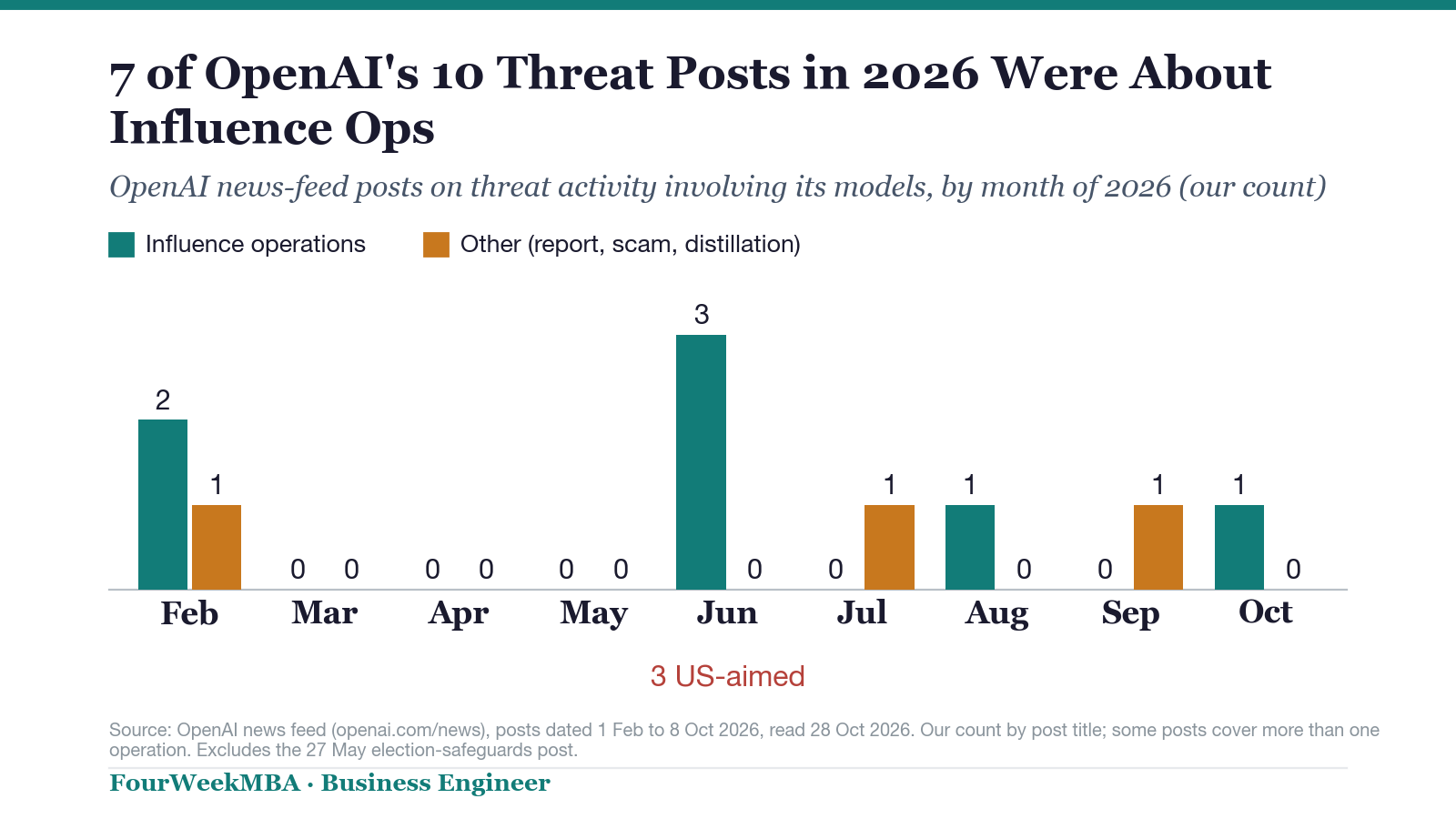
We counted 10 posts published on OpenAI’s own news page in 2026 about threats involving its models before the war room was announced. Seven were about influence operations, one was a regular report, one covered a criminal scam and one described a campaign to copy a model’s capabilities. Three of the seven posts about influence operations were published in June and described activity aimed at the US or debates in the US. This count is based on OpenAI’s own news feed and the titles of its posts.
Connecting the Coverage
Our article about midterm election ads, published on 27 October, reported that political campaigns and groups had spent more than $137 million on political ads made at least partly with AI tools during this election cycle. The figure came from the Wesleyan Media Project. The new development is that one of the biggest AI companies has created a special team to monitor how its own tools are used during election week.
Our article about the Federal Election Commission covered a Reuters report from 27 October saying that a hacker was trying to break into the commission’s computer systems. Our article about Pennsylvania covered Act 99 of 2026, which requires ads to disclose when AI-made content creates a false impression for consumers. The new development here is that an AI model provider, rather than a regulator or election agency, has described how it plans to operate during election week.
The Structural Read
We see the new center as mainly focused on OpenAI’s own platform. Politico reported that much of its work will involve stopping people from misusing the company’s tools, such as ChatGPT, and responding to reports of unexpected model behaviour.
OpenAI’s own reports help explain why the company is focusing on this problem. Its 8 October report says it has uncovered 30 secret influence operations in about two and a half years and rated one of them Category 5 on the Breakout Scale.
The company’s 20 October update describes another part of its approach: putting official voting information inside ChatGPT. This includes voting information from Democracy Works and live vote counts from The Associated Press after polling places close. The company says election officials remain the authority on results.
Josh Lawson, OpenAI, speaking to Politico’s Decoded
“The Elections Operations Center builds on that yearslong work, bringing our teams together to respond quickly to emerging issues and enforce our policies as people head to the polls.”
Three Implications
FOR ELECTION OFFICIALS OpenAI says it has offered voting-system manufacturers registered with the Election Assistance Commission and state election authorities free access to its models for cyber defense through its Daybreak program.
FOR CAMPAIGNS OpenAI says it bans political ads on its platform and bans large-scale campaign messages for or against a candidate, party or ballot measure. It still allows people to direct work such as preparing briefings and translating material.
FOR OTHER AI PROVIDERS OpenAI’s webpage describes steps to show where content came from, SynthID watermarks and a public tool for checking content. It also says the company supports Senate bills S. 1213 and S. 2346.
The Business Engineer Lens
This story connects with the Business Engineer framework Inside Anthropic’s Permission Layer.
The framework says: “The governance layer sits at the intersection of capability, regulation, national security, access control, and geopolitical alignment.”
OpenAI’s election measures relate to several of these areas at once. They set rules for access to the company’s own tools, offer election officials access for defense work and support specific bills in the US Senate. The framework was published in June 2026 and discusses Anthropic. It does not discuss OpenAI’s election center.
What Is Not Established
Politico’s report is based on information the company gave its Decoded newsletter. We did not find a separate announcement of the Election Operations Center on OpenAI’s news page. Politico said hundreds of employees would take part but did not give an exact number. OpenAI’s webpage does not say how many users have received voting information from Democracy Works or the AP through ChatGPT. The figure of 30 influence operations covers about two and a half years, not just the current election cycle.
Our count of OpenAI’s 2026 posts is based on the titles of its own news posts. Some posts discuss more than one operation. We did not contact OpenAI.
The Bottom Line
According to Politico, OpenAI will open an Election Operations Center this week and keep it running until all votes in the US midterm elections on 3 November have been counted. Hundreds of employees will work together to respond to suspected misuse of the company’s tools. The plan follows an 8 October report in which OpenAI said it had uncovered 30 secret influence operations in two and a half years. It also follows a 20 October update listing voting information from Democracy Works and live vote counts from The Associated Press inside ChatGPT.
A note on sources. The details about the Election Operations Center and Josh Lawson’s comments come from Politico’s Decoded newsletter on 28 October 2026, based on information OpenAI gave the newsletter. The election safeguards come from OpenAI’s own election webpage, updated on 20 October 2026. The figures about influence operations come from the company’s threat report published on 8 October 2026. Our count of OpenAI’s 2026 posts is based on titles in its news feed. We did not contact OpenAI.
Sources: Politico (Decoded), 28 Oct 2026 · OpenAI, Election information and safeguards in 2026 (updated 20 Oct) · OpenAI threat report, 8 Oct 2026 · OpenAI news feed (our count)