
Could next-gen artificial intelligence help map out future space outposts?
AI turns maps and other data about the moon into detailed information to help plan missions, research finds
 | Tatyana Woodall Ohio State News |
Planning a successful trip can be difficult, especially when the destination is in outer space.
Before a space mission can launch, scientists must do a huge amount of research and study large amounts of data. This preparation can take years. But space agencies are racing to build a permanent presence on the moon. Using artificial intelligence (AI) to bring all this information together in one system could make planning missions much faster and easier.
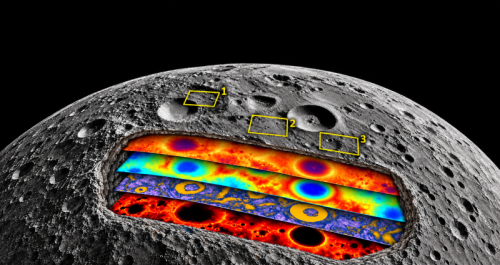
Gokce Inal, a PhD student studying civil, environmental and geodetic engineering at The Ohio State University, developed one such system. It uses AI to help scientists judge possible landing sites on the moon, find dangers that future crews might face, and search new areas for rock formations and other geological features that could be scientifically important.

Landing on the moon is more difficult today than it has ever been. But early results from Inal’s AI model, called “LUMINA,” show that it can study complex observations of the moon and produce useful scientific explanations about possible landing sites. These abilities could help mission planners find places with plenty of water ice and other useful resources.
The team had already developed a model called LLaVA-LE, which uses images and language to describe the moon's surface and answer scientific questions. LUMINA builds on that earlier work. It uses a system that can plan and carry out several steps of analysis, assess possible landing sites, and explain the evidence behind its suggestions, Inal said.
Inal created LUMINA to support the goals of moon missions. However, she sees it as a tool to help people make decisions, not as a machine that works mostly on its own. Mission planners would still make the final decisions. “Most AI tools are passive tools,” she said. “You ask a question and get an answer, but we’re moving toward an active scientific assistant that can work through a problem alongside the experts.”
Inal presented her findings this month at the 58th Annual Meeting of the Division for Planetary Sciences (DPS 58) of the American Astronomical Society.
One main goal of this research is to find ways for AI systems that can take steps toward completing tasks to support future space exploration. But LUMINA could do more than study data about the moon. It could also help scientists study and map the surfaces of other planets and space objects, including Earth, said Alper Yilmaz, a co-author of the research and a professor of civil, environmental and geodetic engineering at Ohio State.
“There aren’t many GPT-like map models being developed for space exploration, so our effort is aimed at making one that can also work on other surfaces, like Mars or some asteroids,” he said.
As datasets become more advanced, mission planners will need more efficient tools to search through them, Yilmaz said. Without such tools, finding the best places for future crews to land or explore would be like looking for a needle in a haystack.
“People are going to be landing in an extremely harsh environment, so it’s worth having another set of eyes that can verify and question things and help us communicate better,” he said.
As the system continues to improve, the team plans to test it using new, high-quality data about the moon. They will also study how well it helps people plan missions.
“NASA’s Artemis program creates important opportunities for our research,” she said. “As new lunar data becomes available, their results can improve systems like ours and better support future mission planning.”