
Generative AI shows promise for renewable energy, but Africa lacks field
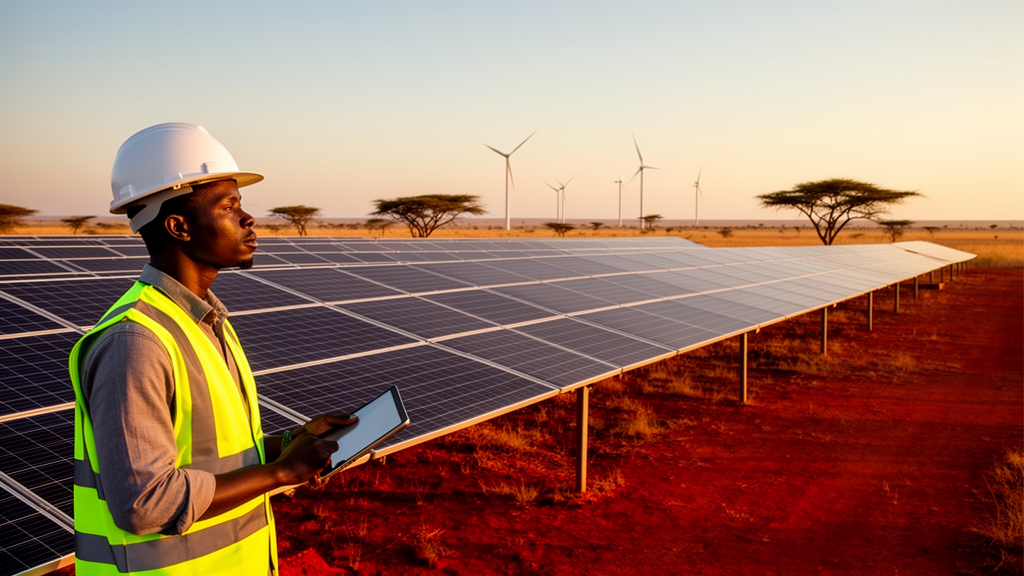
Scientists around the world are studying how generative artificial intelligence (AI) could help predict renewable energy production, manage electricity grids, predict equipment failures, create artificial data and plan energy infrastructure. However, a new systematic review has found that almost none of this research has been tested in real-world conditions in Africa. The review, published as an open-access article in Discover Energy on 12 October 2026, examined records in the OpenAlex database from 2020 to May 2026 and included 75 studies. Only five studies reported that at least one author was affiliated with an African institution. These institutions were in Morocco, Nigeria and South Africa, with additional affiliations in Tunisia and Gabon. None of the five studies reported testing its methods on a working renewable-energy system in Africa.
The review was carried out by F. H. Abanda, W. B. Nsanyuy, M. L. Katche and their colleagues. They reported their work using the PRISMA 2020 guidelines. The researchers also used an AI-supported process called PRALSMA. In this process, ChatGPT Project and Google NotebookLM helped compare documents, identify themes and track information back to its sources. However, the researchers remained responsible for deciding which studies qualified for inclusion and for making all final interpretations. The search found 157 records on 23 May 2026. After screening the records, obtaining the papers and checking their full texts, the team kept 75 studies. The authors explain that screening showed whether studies were relevant, not whether they were scientifically strong. They assessed research quality, how mature the evidence was and how well the findings might apply in Africa as separate questions.
To assess the strength of the evidence, the team used a five-part checklist adapted from the approach of the Mixed Methods Appraisal Tool. They scored how clearly each study stated its research question, explained where its data came from, chose suitable methods and comparisons, checked its results and reported uncertainty, and discussed its limitations. Each part received a score of 0, 1 or 2. The total scores were used to place studies into high-, moderate- or low-confidence groups. Of the 75 studies, 36, or 48 percent, provided high-confidence evidence. These were mainly studies based on real data, simulations or prototypes that compared their results with a reference point or starting result and discussed limitations. Another 35 studies, or 47 percent, provided moderate-confidence evidence. Most were review papers that brought together earlier research. Four studies, or 5 percent, provided low-confidence evidence. These were kept only to highlight possible directions for future research.
The team also classified studies by how far their evidence had progressed. E1 meant testing in real African energy systems or field conditions. E2 meant testing with real data outside Africa. E3 covered laboratory tests, computer simulations or prototypes. E4 covered ideas, reviews or proposed uses that had not yet been tested in practice. The researchers did not combine numerical results into one overall figure because the studies used very different outcomes, starting points, datasets and testing conditions. They also assessed how easily each application could be used in Africa by looking at four things: whether local energy resources and available data were similar; whether the electricity grid and system size were compatible; whether computing power, internet access, funding and skilled workers were available; and whether the approach fit local institutions, laws, languages and maintenance practices. The researchers did not assume that a numerical result would also apply in Africa unless the study had included testing in comparable African conditions.
The publication data show that this research field is still young and that most contributions come from a limited number of regions. Most of the studies included in the review were published between 2023 and 2025, with almost none published between 2020 and 2022. The authors link this pattern to the rapid spread of foundation models, which are AI systems trained on large amounts of data. Researchers from Western countries and several Asian economies account for much of the work. The studies included contributions from 19 Asian countries and 19 Western countries, as well as developing countries such as Bangladesh and Iraq. The authors point out that the five studies linked to African institutions add diversity to the list of contributing researchers, but they do not provide evidence from real-world African energy systems. The review treats these two measures separately.
Among the uses already tested or being developed, forecasting stands out. Several studies found that they could predict renewable-energy output more accurately using their own datasets and comparison methods. Some used established deep-learning models that do not generate new data, including hybrid CNN-LSTM and CNN-LSTM-Transformer models. A small group of studies in the review reported about 15 to 20 percent lower root-mean-square error for certain solar-irradiance prediction tasks, along with better simulations of how wind conditions change across locations and over time. However, the review treats these as results from specific studies, not as one combined finding. They do not prove that African energy systems would see the same improvements. In one computer-modelled case involving the use of solar photovoltaic power, researchers reported energy-cost reductions of up to 20 percent and carbon-emission reductions of 30 percent compared with that study's starting point. These results depend on the system's data, electricity prices, energy sources and optimisation assumptions. The review found no study that repeated these tests in Africa.
Creating artificial data is another area the authors see as especially relevant to African conditions. Energy planning often faces problems because datasets are incomplete, monitoring systems are weak and there is limited capacity to build and run models. Generative adversarial networks (GANs) and Wasserstein GANs can fill gaps in time-based data and help researchers develop models when sensors stop working. Some studies outside Africa reported errors that were more than 20 percent lower even when up to 40 percent of observations were missing. However, these results were measured using particular datasets and patterns of missing information. The review says that African pilot projects must check whether artificial data preserve local seasonal extremes and the way equipment behaves. Artificial data cannot replace the minimum amount of real-world monitoring needed to check results. One study linked to Durban University of Technology in South Africa used deep convolutional GANs to create artificial datasets for assessing defects in photovoltaic cells.
Other applications are at earlier stages of development. Diffusion models and score-based models can create a range of possible renewable-energy output scenarios, each with a probability, instead of giving only one forecast. But they need repeated calculations and large amounts of data. For now, they may be more practical in well-equipped control centres or research projects than in small electricity networks serving remote areas with few resources. AI agents that combine equipment measurements, images, weather information and maintenance records to identify signs of damage are also still being developed. The review found no field test in Africa supporting a claimed 60 percent reduction in maintenance costs. The authors recommend testing changes in costs and equipment downtime in controlled pilot projects and comparing them with current inspection methods. Generative adversarial imitation learning, which learns how to make decisions by copying examples of behaviour, is another possible way to manage electricity supply in microgrids. However, its benefits for cost and reliability have not been demonstrated in real-world African projects. Small language models can run on some devices near where data are collected and may provide access to equipment manuals without an internet connection. However, early tests for renewable-energy tasks found that the models performed below the required level and needed further adaptation to the field.
The review also considers the environmental costs of using AI. Large generative models can use large amounts of electricity, often from non-renewable sources, and water during both training and the generation of answers. These demands could reduce or even cancel out environmental gains from making energy systems more efficient. This is a rebound effect, which challenges the main ideas behind Green AI, an approach that aims to make AI more environmentally friendly. The authors say that assessments must cover the entire life of an AI system. This includes developing and training the model, running it repeatedly, transferring data, cooling data centres, using water, manufacturing processors and devices, and dealing with electronic waste. Savings during operation cannot automatically be assumed to outweigh these costs. A system should be called environmentally beneficial only when the energy use or emissions it prevents are greater than the impacts of training, running the model, communications, cooling and hardware, taking the local electricity mix into account and reporting uncertainty. The review found no evidence supporting a general claim that renewable-energy systems can achieve energy savings of 30 to 70 percent across different settings.
When considering which technologies are ready to use, the review finds that limited decision-support tools based on small language models, combined with information retrieval, and pilot projects using GANs or variational autoencoders (VAEs) to fill gaps in data are closer to practical use than resource-intensive diffusion models, complete digital twins, AI-agent maintenance systems or imitation-learning systems for controlling electricity supply. Even the more promising options need local testing, human supervision, ways to work offline and fail safely, cybersecurity protections, and a full assessment of costs. These costs include hardware, power-conditioning equipment, cooling, licences, maintenance and keeping trained staff. The authors recommend a step-by-step approval process. First, check data and sensor quality. Then verify internet access and reliable power, and form a team that includes experts in energy utilities, AI and cybersecurity. Test the system in shadow mode, where it makes predictions without controlling the real system. Compare its technical and financial results with existing methods, check local languages and extreme conditions, and set clear rules for escalation, human override and accountability. The system should be designed to work offline first and fail safely, with fixed safety limits, a manual backup and records that can be checked later.
At the policy level, the authors call for Green AI rules that encourage energy-efficient hardware and computing powered by renewable energy. They recommend explainable AI methods, such as Shapley Additive Explanations, to make it easier to understand and hold people accountable for model outputs. They also call for adding generative AI to renewable-energy education while protecting practical skills, and for sharing knowledge through partnerships that move beyond traditional relationships in which countries in the Global North lead and countries in the Global South mainly receive knowledge. Open-source platforms and tools such as Google Earth Engine could make these technologies easier for small businesses and local utilities to access. Transfer learning, which adapts models developed in places with abundant data, could also help make them useful in African settings while reducing the amount of local data needed. The review identifies six research priorities: small models that can work offline in areas without access to the main electricity grid; explainable decision-support tools designed together with operators and communities; federated learning that protects privacy; renewable-energy datasets designed for Africa; affordable digital twins for microgrids; and shared benchmarks for testing AI systems under resource-limited conditions. The review's main message is that generative AI should be treated as a group of possible tools, not as a solution that must be adopted. Real progress will depend on locally managed data, clear comparisons with existing methods, carefully staged pilot projects, full accounting of environmental impacts and independent testing in real African energy systems, rather than applying global claims to African energy policy without evidence.
Subject of Research: A systematic review of generative AI applications in renewable energy and how well they might support Africa's transition to sustainable energy.
Article Title: Global advances in Generative AI for renewable energy and implications for sustainable energy transitions in Africa
Article References: Abanda, F. H., Nsanyuy, W. B., Katche, M. L., Achiri, A. T., Sankey, E. M., Maluh, N. B., & Almukhtar, A. (2026). Global advances in Generative AI for renewable energy and implications for sustainable energy transitions in Africa. Discover Energy, 6(1), Article 82. https://doi.org/10.1007/s43937-026-00195-8
Image Credits: AI-generated.
DOI: 10.1007/s43937-026-00195-8
Keywords: generative AI, renewable energy, Africa, systematic review, energy transition, GANs, artificial data, predictive maintenance, Green AI, energy access, digital twins, small language models
News Source: Faith Mcneil. (October 28, 2026). Generative AI shows promise for renewable energy, but Africa lacks field evidence. Scienmag.