
Generative AI and 3D printing join forces to revive Lingnan stucco relief
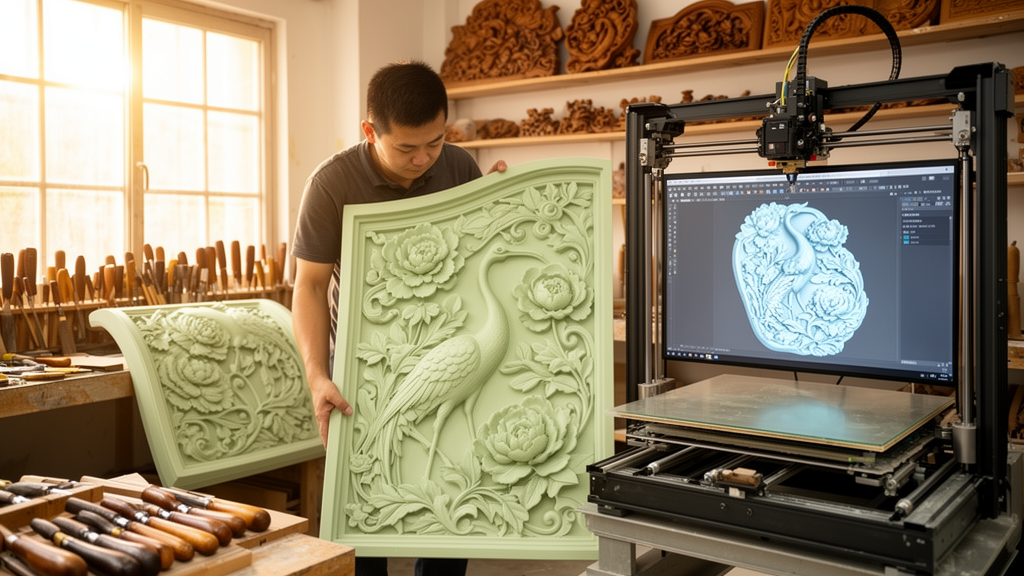
A team of researchers in China has developed a complete process that combines generative artificial intelligence (AI) with 3D printing to design, study, and make Lingnan stucco reliefs. These traditional decorations appear on historic buildings in Guangdong and Fujian. The craft is recognized as part of China's national intangible cultural heritage. It involves shaping lime-based mortar over an inner frame made of copper wire, iron nails, and bamboo nails. However, fewer people are learning the craft from older generations, and making these decorations requires a great deal of hard work. The study, published in AI in Civil Engineering, presents a digital method that can support skilled craftspeople rather than replace them. The aim is to reduce the pressure caused by long restoration projects and the growing shortage of skilled heritage conservators.
The process starts with design. The researchers adapted a Stable Diffusion v1.5 AI model, which creates images from text, to produce designs in the style of stucco reliefs. They used a method called Low-Rank Adaptation, or LoRA, which teaches an existing AI model a particular style by changing only a small number of its settings. Their training collection contained just 43 images of stucco reliefs gathered from the internet and photographs taken during fieldwork. They resized all images to 1,472 by 640 pixels to keep the wide, horizontal shape typical of this craft. The CLIP model automatically wrote captions for the images, which the researchers then corrected by hand. They also flipped the images horizontally to increase the amount of training data. Training took about 20 hours on a single RTX 3090 graphics card. The researchers saved model versions after 7,396, 14,972, and 22,188 training steps.
Choosing the right training stage was important. After 7,396 steps, the model could create stucco relief designs, but their colors and styles often differed greatly from real examples. After 14,972 steps, the generated images looked much more like real stucco relief artworks. However, after 22,188 steps, the quality became worse, with distorted shapes and disorganized designs. This appeared to be a case of overfitting, which happens when an AI model learns its training examples too closely and performs less well. The researchers therefore chose the model from the middle stage of training. They used Gram distance and LPIPS measurements to compare the images. The results showed relatively low similarity in how the images looked overall, but strong consistency in artistic style. This suggested that the AI could create new designs that shared a common style without simply copying the training images. The generated images also received a CLIPScore of 0.7997, compared with 0.7399 for the training images. This suggested that the generated images matched the specially prepared text prompts used during training more closely.
A flat, two-dimensional image cannot fully show the shape of a deeply raised relief or a sculpture that is rounded on all sides. To solve this problem, the team turned the generated images into 3D models. For shallow reliefs, they used grayscale maps as masks in Blender to control how much different parts of the surface were raised. For more complex shapes, they compared several tools that turn images into 3D models and chose InstantMesh. This tool uses a diffusion model to create images from several viewpoints, then uses a large 3D reconstruction model to build a 3D mesh. Each reconstruction took about 30 seconds on the RTX 3090 workstation. The result was a colored OBJ model that needed only a little extra work. This included stretching a bird-shaped design vertically because it had come out too flat, and transferring the colors stored on the model's points into texture maps. The researchers explain that this approach makes it possible to create digital models during the design stage, rather than waiting until after construction is complete.
To check whether the designs would be structurally safe, the team studied the properties of the materials. They used materials supplied by a craft practitioner in Guangzhou who has inherited the traditional skills. The researchers tested three kinds of lime mortar used in stucco reliefs: mortar mixed with straw for the base layer, mortar mixed with strips of paper for the surface layer, and a colored version containing pigments. They made cube-shaped and beam-shaped samples, allowed them to harden under natural conditions, and tested their resistance to compression and bending after 14, 28, and 90 days. The straw-mixed lime mortar, which carries most of the load, became mechanically stronger as it cured. After 14 days, it could continue carrying a load with little loss of strength even when cracks appeared. After 28 and 90 days, it broke in a more brittle way, with stress dropping quickly. It then showed a second stage of strengthening when the amount of compression became greater than 25 percent. Scanning electron microscope images showed shapeless calcium carbonate and crystalline calcite between the grains of material. The measured porosity, or the amount of empty space inside the material, was 34.5 percent.
Using the test results, the researchers built a finite element model, a computer method for predicting how a structure responds to forces. The model used a concrete damage plasticity law, which describes how materials can deform and become damaged, and its settings were adjusted to match the stress and strain measured in the experiments. The team then tested a representative bird-shaped relief design about 300 millimeters tall, created using their AI process. The computer simulation examined the effects of the sculpture's own weight and wind, with a 25-millimeter copper wire frame inside it. The results showed that most of the stress was compressive and that the internal frame carried much of the load. Some damage appeared at the corners, and parts of the mortar began to separate from the frame. However, the calculated stresses remained within the elastic range, meaning the model predicted that the material could return to its original shape when the load was removed. The researchers also studied a cantilever beam, which is fixed at one end and sticks out unsupported at the other, with a cross-section measuring 15 by 15 millimeters. With an internal frame and no tilt, it could extend 90 millimeters. At a tilt of 15 degrees, the maximum length fell to 60 millimeters. At 30 degrees, it failed when the length went beyond 45 millimeters. The authors emphasize that this computer model is still an early version and has not been checked against measurements taken at actual building sites. It also predicts compressive strength about 30 percent higher than the measured value.
The team also tested several ways to make the designs using 3D printing. A multi-nozzle material jetting printer produced small, full-color prototypes made from photopolymer, a material that hardens when exposed to light. These models were 20 centimeters in size and accurately reproduced the AI designs' colors and raised surface details. For molds and copies around a meter in size, the researchers used sand mold printing to quickly produce a full-size, 1:1 model. They suggest this method could be suitable for traditional decorations that do not serve an essential function, as well as decorative copies used in modern buildings. They also used low-cost fused deposition modeling, a type of 3D printing that builds objects by laying down material in layers, to make modular molds and support structures. These parts can be assembled at the building site and filled with stucco relief materials to form the decoration as a single piece. The molds can be made in a factory and then transported to the construction site.
Small-scale physical tests showed that the construction methods could work. The team printed shallow-relief molds using PLA and TPU95A plastics, filled them with lime mortar mixed with paper strips, vibrated the material, and removed the molds after three days. The finished pieces captured fine surface details that would be difficult to reproduce by hand. The researchers also made a freestanding bird-shaped sculpture using a printed PETG support built into its base and interlocking PLA molds. When they removed the molds after one month, the sculpture had taken shape. Its surface was rough, but the mortar had bonded well with the printed support. In another test, they made a flexible silicone mold from a printed copy. After 24 hours of curing, the resulting sculpture showed all the intended geometric details. The authors stress that these methods have only been tested on small objects so far. Skilled craftspeople must still finish the surfaces by hand.
Based on interviews with craftspeople, the team estimated that this process could cut the total time needed to make a medium-sized shallow relief by about 50 percent. This estimate does not include the time required to produce the molds and internal supports. The method could also allow several pre-printed molds to be installed at the same time. However, the researchers describe their approach as an extra engineering tool, not a replacement for traditional craftsmanship. An AI-generated relief does not have the same cultural value as a piece made by hand. The AI has not learned the subtle hand movements and step-by-step layering methods used by traditional craftspeople. Attempts to use ControlNet, an AI tool for guiding image generation, to restore images of damaged reliefs also produced limited results, especially for images that were not included in the training set. The authors say future work should use larger image collections, develop better ways to measure how training loss relates to image quality, improve the material models using more test samples, and systematically compare traditional craft objects with digitally made versions. These improvements will be important as the approach develops toward practical use in heritage conservation.
Subject of Research: An AI-based process for generating designs, analyzing structural safety, and using 3D printing to make Lingnan stucco reliefs for the renovation of historic buildings
Article Title: Combining generative AI with 3D printing for historic building renovation: a case study of Lingnan stucco relief
Article References: Yin, Y., Cheng, J., Zhou, J., Xiao, Z., Chen, W., Zheng, H., & Hu, N. (2026). Combining generative AI with 3D printing for historic building renovation: a case study of Lingnan stucco relief. AI in Civil Engineering, 5(1), Article 21. https://doi.org/10.1007/s43503-026-00106-9
Image Credits: AI-generated image
DOI: 10.1007/s43503-026-00106-9
Keywords: generative AI, Stable Diffusion, LoRA fine-tuning, 3D printing, Lingnan stucco relief, intangible cultural heritage, lime mortar, finite element analysis, additive manufacturing, historic building renovation, 3D reconstruction, Guangdong