How Artificial Intelligence Is Transforming Banking and Financial Services in India

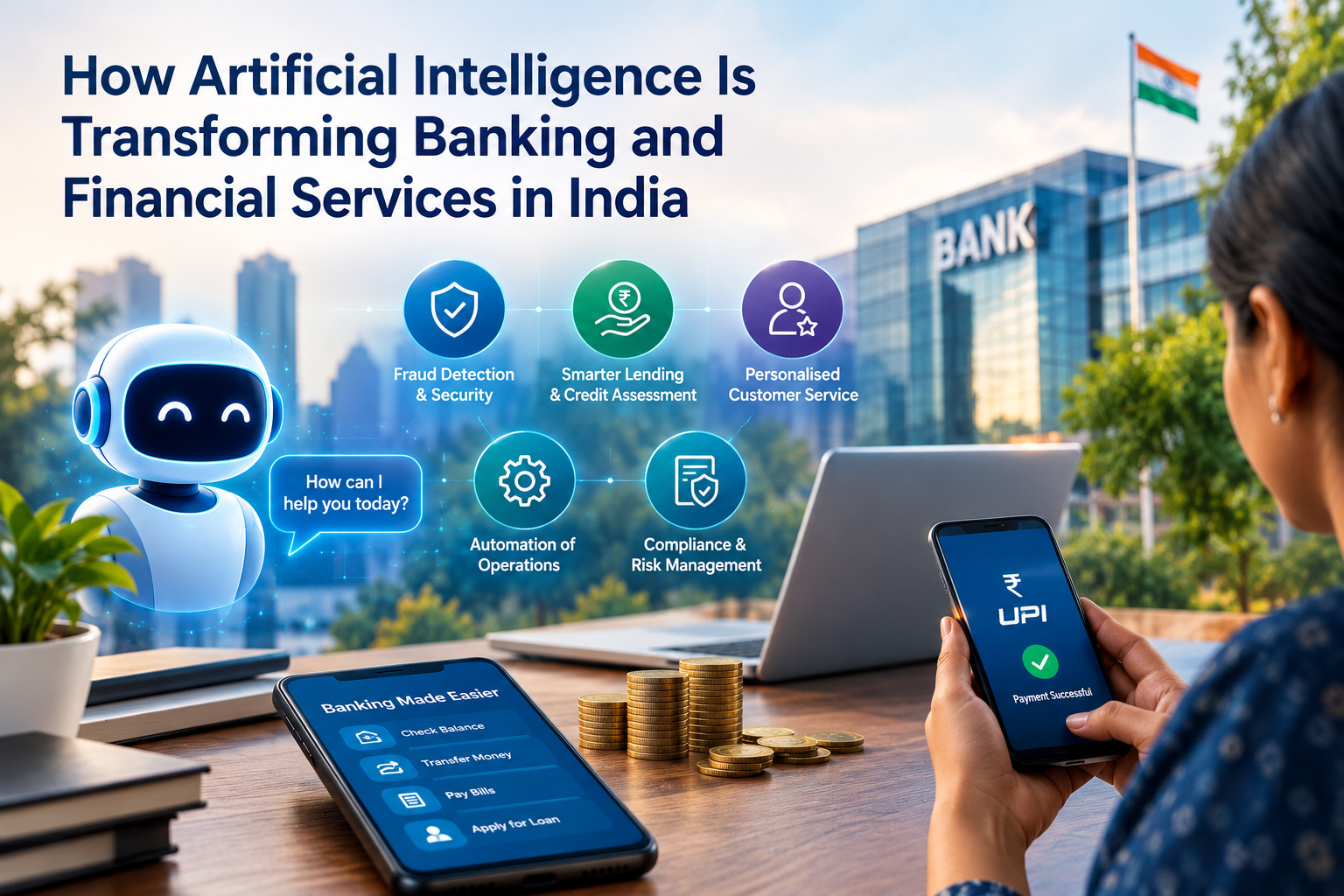
Artificial intelligence (AI) is changing how banks detect fraud, assess loan applications and serve customers. From answering routine banking queries to helping financial institutions identify suspicious transactions, AI is becoming an important part of modern financial services.
In India, the expansion of digital payments, mobile banking and fintech platforms has created new opportunities for AI-driven services. The technology could help banks operate more efficiently, reach underserved customers and make financial services more accessible. However, its success will depend on how effectively institutions address data privacy, cybersecurity, fairness and customer trust.
AI Is Making Banking More Convenient
Customers increasingly expect banking services to be available whenever they need them. AI-powered chatbots and virtual assistants help meet this demand by answering common questions, guiding users through banking processes and providing assistance outside regular branch hours.
These tools can handle routine enquiries about transactions, account services and payment procedures, allowing customer service teams to focus on more complicated issues.
AI can also help banks identify customer preferences and offer relevant financial information. For example, a banking application could analyse spending patterns to help a customer understand monthly expenses or plan savings. Such services must be based on appropriate consent and clear data-protection practices.
Smarter Fraud Detection and Cybersecurity
As more people use digital payments, financial institutions face growing pressure to identify suspicious activity quickly. Traditional security systems often rely on predefined rules, while AI can analyse larger volumes of transactions and identify patterns that may indicate unusual behaviour.
An AI-powered system might flag a sudden change in spending, repeated payment attempts or transactions that differ significantly from a customer’s usual activity. The bank can then request additional verification or investigate the alert.
AI is also being explored as a tool for identifying emerging cyber threats and helping security teams prioritise potential incidents. Nevertheless, it is not a complete solution. Fraudsters can change their methods, and automated systems may sometimes flag legitimate payments incorrectly. Strong authentication, regular system testing and human investigation remain essential.
AI Could Improve Access to Credit
Loan applications often require lenders to assess income, repayment capacity, existing liabilities and credit history. AI can help organise this information and support faster, more consistent credit assessments.
The potential benefits extend beyond established borrowers. Small businesses and individuals with limited conventional credit histories may have difficulty obtaining loans, even when they have the capacity to repay them. Where regulations permit, responsibly assessed alternative data may provide lenders with additional information to evaluate such applicants.
The Press Information Bureau’s May 2026 backgrounder, AI-Powered Financial Inclusion in India, highlights the potential of digital public infrastructure and AI to support more accessible financial services, including lending to micro, small and medium enterprises.
However, faster decisions are not necessarily fairer decisions. Models trained on biased or incomplete data can reproduce existing inequalities. Banks must test their systems for bias, explain important decisions in understandable language and provide appropriate channels for customers to challenge errors.
Automating Routine Banking Operations
A considerable amount of banking work involves processing forms, checking documents, reviewing records and responding to repetitive enquiries. AI can assist with these tasks, reducing manual effort and helping employees focus on work that requires judgement and experience.
For example, document-processing systems can extract information from loan applications, while AI-assisted tools can help compliance teams identify records that need further examination. Generative AI may also help employees summarise lengthy documents or retrieve information from internal knowledge systems.
For smaller banks and fintech companies, adopting AI does not necessarily mean building an expensive system from the ground up. They can evaluate established software platforms or specialised services, starting with a clearly defined business problem.
A sensible first step might be automating routine customer enquiries or improving document processing. Institutions can then measure whether the system saves time, reduces errors and improves customer satisfaction before expanding its use.
Strengthening Compliance and Risk Management
Banks must comply with regulatory requirements while managing credit, operational and cybersecurity risks. AI can help teams analyse large volumes of information, identify unusual patterns and prioritise cases that require closer attention.
The Reserve Bank of India’s August 2025 FREE-AI Committee Report, Framework for Responsible and Ethical Enablement of Artificial Intelligence in the Financial Sector, sets out seven foundational principles and 26 recommendations across six strategic pillars. Its central objective is to encourage innovation while addressing the risks associated with AI adoption.
The recommendations underline why financial institutions need more than technically capable systems. They also require clear accountability, appropriate oversight, risk management and safeguards throughout the AI lifecycle.
AI can support compliance professionals, but responsibility cannot simply be transferred to software. Banks must be able to understand how their systems are used, monitor their performance and intervene when results are unreliable.
India’s Digital Payments Ecosystem Creates Opportunities
India’s digital payments growth provides a significant foundation for further innovation in financial services. The Unified Payments Interface (UPI) has made it easier for individuals and businesses to transfer money, pay merchants and complete everyday transactions through digital channels.
According to data reported by Business Standard on September 1, 2026, UPI processed a record 24.51 billion transactions worth ₹29.82 trillion in August 2026. The scale of this activity illustrates the importance of reliable payment infrastructure and effective systems for managing financial risk.
AI could help banks and payment providers analyse transaction patterns, detect suspicious activity and improve customer support. It may also help financial institutions develop services suited to different customer needs, including those of small businesses and people in underserved areas.
However, digital payments and AI adoption are not the same thing. The growth of UPI demonstrates the scale of India’s digital financial ecosystem; it does not, by itself, measure how widely banks are deploying AI. The benefits of AI will depend on how effectively institutions apply it to specific challenges.
Will AI Replace Banking Employees?
Automation has raised understandable concerns about jobs in the banking sector. Some repetitive tasks may require less manual work as AI tools improve, but banking also depends on human judgement, communication and trust.
Employees are still needed to handle sensitive complaints, explain complex financial decisions, build customer relationships and investigate cases that automated systems cannot resolve confidently.
The nature of banking jobs may change as AI becomes more common. Skills in digital security, data interpretation, technology oversight and customer communication could become increasingly valuable. Banks that invest in staff training will be better positioned to combine automation with human expertise.
The goal should be to use AI where it adds value while ensuring that customers can still reach a qualified person when they need one.
The Risks Banks Cannot Ignore
AI offers considerable opportunities, but poor implementation can create new problems. Customer information may be exposed if systems are inadequately protected. Biased data can lead to unfair outcomes, while unreliable AI-generated answers can mislead customers.
Financial institutions may also become dependent on external technology providers. If a critical service fails or a vendor experiences a security incident, the effects could extend beyond a single application.
The Financial Stability Board’s June 2026 consultation report on responsible AI adoption in financial services highlights the importance of identifying and managing risks as these technologies evolve.
Banks should therefore assess AI systems before deployment, restrict access to sensitive information, test performance regularly and maintain clear procedures for dealing with errors or service disruptions. High-impact decisions should receive appropriate human oversight.
What the Future Holds for AI in Banking
AI is likely to play a growing role in fraud monitoring, customer support, credit assessment, compliance and financial planning. Generative AI may also help employees handle information more efficiently and support customers with more detailed questions.
The most successful applications will not necessarily be the most sophisticated. A simple system that reduces processing delays or helps customers resolve common problems reliably may deliver more value than an ambitious project without a clear purpose.
Banks and fintech companies should begin by identifying a genuine operational or customer-service challenge, selecting an appropriate tool and measuring its performance. They should also establish safeguards before expanding the system to more sensitive activities.
For customers, the benefits that matter most are straightforward: safer transactions, quicker assistance, fair access to credit and clear explanations when decisions affect their finances.
Building a Banking System That Customers Can Trust
Artificial intelligence is opening new possibilities for India’s banking and financial services industry. It can help institutions identify fraud, streamline operations, improve lending assessments and serve customers more efficiently.
But technology alone cannot guarantee better banking. Financial institutions must protect personal information, address unfair outcomes and ensure that automated decisions remain accountable.
The real opportunity lies in combining AI’s ability to process information at scale with human experience, responsible governance and a genuine understanding of customer needs. Banks that get this balance right can use AI not simply to reduce costs, but to build more accessible, resilient and trustworthy financial services.