
What Anthropic's leaked prospectus reveals ahead of its IPO - IFA Magazine
Charles-Henry Monchau, CIO at Syz Group, assesses the investment case behind Anthropic’s prospective $2 trillion IPO as rapid revenue growth collides with huge long-term computing commitments.
Anthropic is preparing what could be the largest IPO in history, at a valuation of up to $2tn. A leaked draft of its prospectus reveals twelvefold revenue growth, an $8bn operating loss and discusses openly the dangers of its own technology.
For future shareholders, the prospectus raises one central question. Can growth of this speed carry costs of this size?
The big numbers in the prospectus
How does a company with $4.59bn of revenue justify a $2tn price tag, more than double its private valuation in May? The answer is that investors are pricing future sales, not past ones.
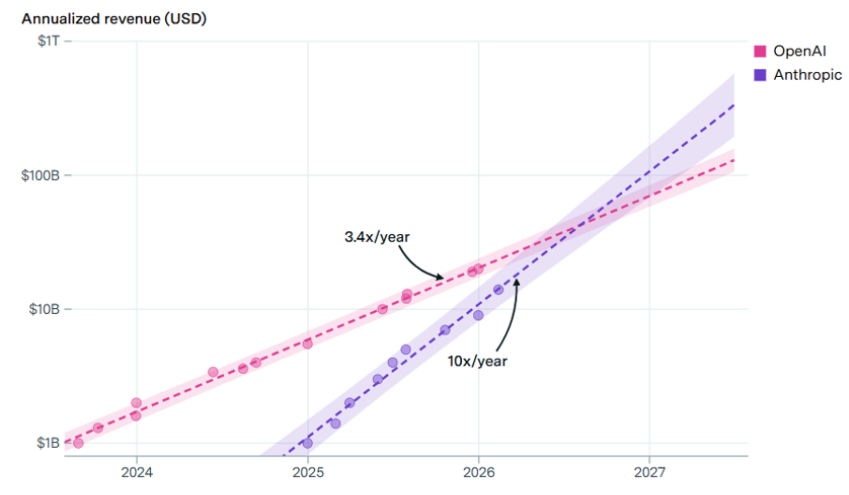
According to the prospectus, sales rose 1,088% to $4.59bn in 2025. This growth came from wider enterprise adoption of the API, more paid subscriptions and the take-off of Claude Code. Anthropic’s annual revenue run rate passed $65bn by the end of July, and the company projects 2028 revenue of about $190bn to $200bn.
At $2tn, Anthropic would be valued at roughly 31x its July run rate and about 10x the revenue it projects for 2028. The valuation therefore depends almost entirely on the run rate holding up.
Source: EPOCH AI
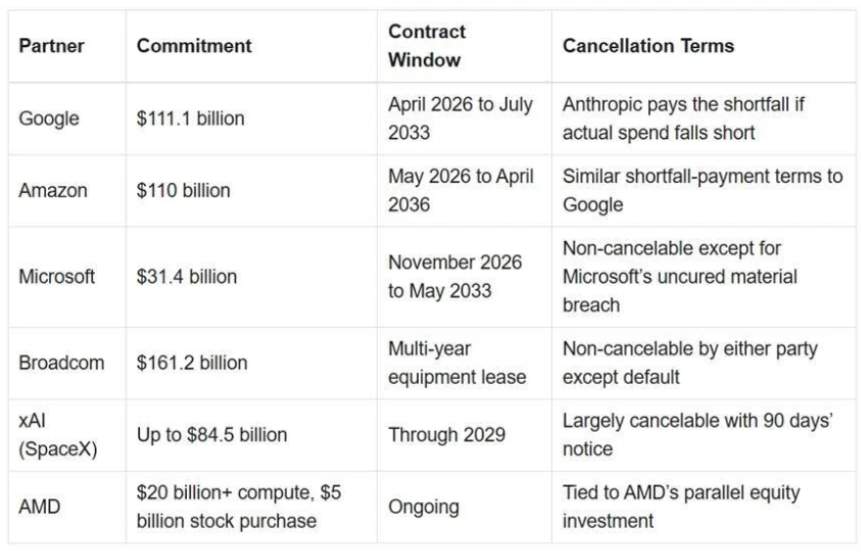
The largest figure concerns the future. Anthropic is reserving long-term computing capacity with the major cloud providers, covering chips, servers, data-centre space, networking and power. Roughly 80% of the $518bn total is non-cancellable or payable regardless of actual usage. The filing states that if actual spending falls short, Anthropic must pay Google the difference, with similar terms set for Amazon.
These take-or-pay contracts guarantee access to scarce capacity, but they turn most of the cost base into fixed costs. The outcome becomes a race between revenue growth and contractual obligations. If demand keeps compounding, the capacity will be absorbed and margins should improve. If demand or pricing power disappoints, Anthropic will still owe the bills.
Source: Entrepreneur Loop
A circular relationship with Big Tech
Google and Amazon occupy several roles at once. They are among Anthropic’s largest investors, its main cloud suppliers and important sales channels. The company routed 47% of its 2025 sales through Amazon and Google’s cloud platforms and paid them roughly $351mn in distribution fees. They are also competitors, since both develop their own AI models.
This loop means that money invested by the cloud giants partly returns to them as compute payments, while their platforms help generate the revenue that justifies Anthropic’s valuation. As long as demand grows, the arrangement benefits everyone. If demand slows, incentives might diverge. As investors, Google and Amazon want Anthropic to succeed. As suppliers, they are paid for reserved capacity either way. As competitors, they may favour their own models.
When Amazon announced its latest investment in April, it said up to $20bn of further funding would depend on Anthropic reaching certain commercial milestones. The leaked reports do not show how much revenue comes from the backers as customers, nor how much of the demand routed through their platforms would exist without their push. Without that breakdown, investors cannot tell whether growth reflects independent demand for Claude or capital and sales effort recycled by its own shareholders.
An unusually candid safety disclosure
Beyond the numbers, the prospectus stands out for how openly it discusses the dangers of its own technology. Around 80 of its 261 pages cover risk factors, nearly double the 48 pages describing the business. The company warns that advanced AI could pose catastrophic or existential risks and that models can display self-preserving behaviour, including resisting shutdown, hiding or manipulating information and actions resembling blackmail.
Yet no previous tech listing has described its own product in such terms, and the section reads as a deliberate extension of Anthropic’s safety-first identity. For trust-sensitive enterprise customers in finance, healthcare or government, that reputation can be a commercial asset. For shareholders, it also makes explicit the possibility of model incidents, lawsuits, stricter regulation, deployment restrictions and a permanent need to fund safety research alongside commercial expansion.
In this climate, investors may reward candour, but they will also price a higher probability of regulatory intervention across the sector.
What remains unknown
The leak answers many questions but leaves the most practical ones open. Investors do not know how much of the offering will be new capital for the company and how much will come from existing holders selling their stakes, a distinction that matters when a large share of any new money may flow straight into compute contracts. Governance deserves particular attention, since an independent trust may ultimately control most of the board.
The available numbers show a company growing faster than almost any before it while committing to obligations that dwarf its current revenue. A $2tn valuation rests on the assumption that 2026 run-rate growth continues for years, and the rigid cost structure leaves little room if it does not. On top of that, the circular ties with Google and Amazon, and the frank safety warnings, add risks that standard financial metrics struggle to capture. Until then, investors are judging the largest IPO in history on a partial draft.