
Anthropic in Talks for Massive 800 MW AI Data Centre Near Edmonton as Alberta Emerges as AI Data Centre Hub
The company that makes Claude may be coming to Sturgeon County.
Anthropic is in talks to lease a huge AI data centre campus about seven kilometres east of Gibbons, northeast of Edmonton. The Globe and Mail reported this on Friday, based on information from two sources who were not allowed to speak publicly. The San Francisco-based company is talking with Calgary-based developer Beacon Data Centers.
Neither company would comment. No lease agreement has been announced.
However, the project has already passed an important step. On October 23, the Alberta Utilities Commission (AUC) approved a 920-megawatt natural gas power plant, with certain conditions. The plant is designed to provide electricity to the campus.
If Anthropic signs the deal, it would be the second major global technology company to build a huge AI campus in Sturgeon County this year. Meta is the other company.
What's planned east of Gibbons
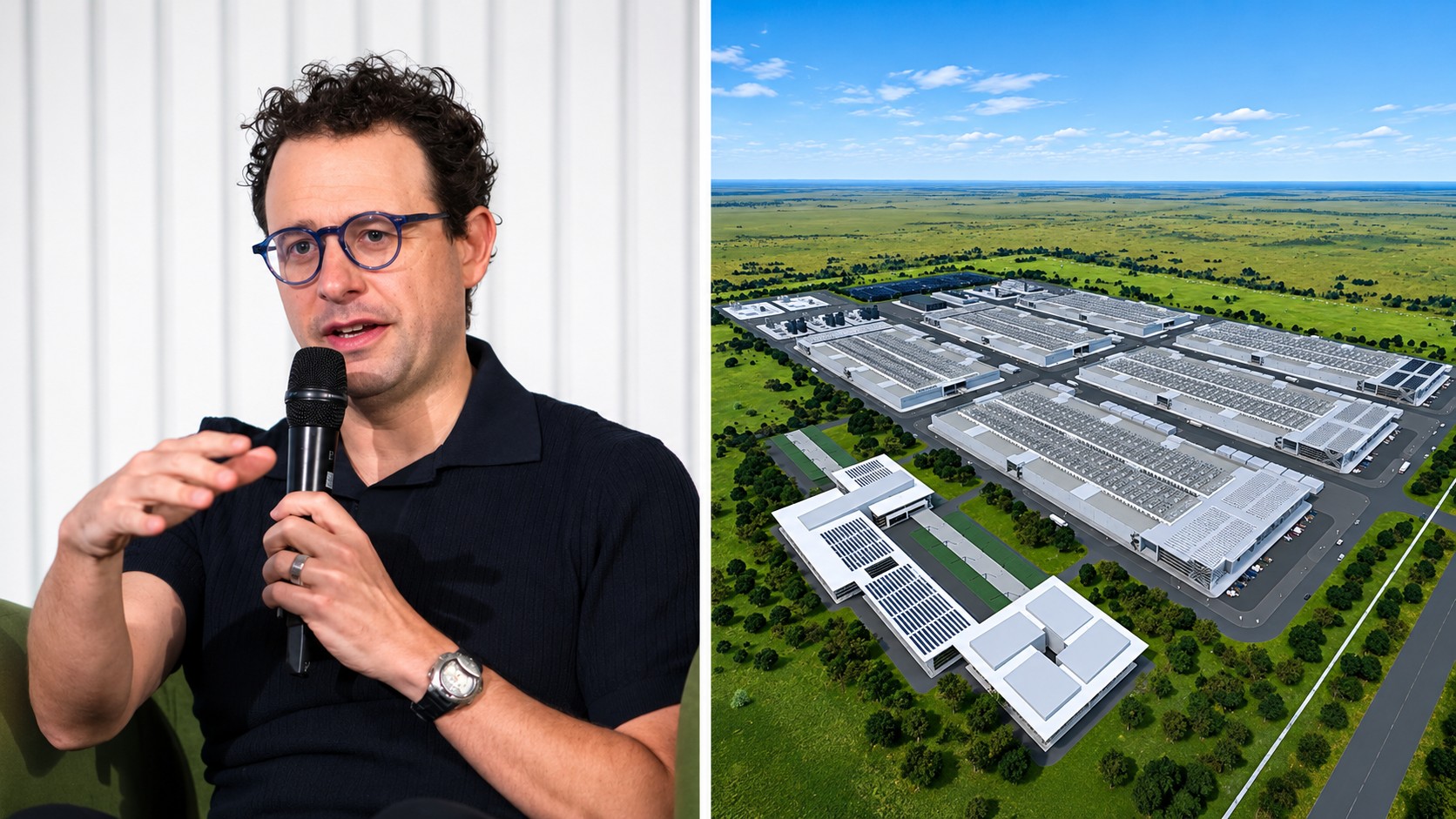
The project is called the Beacon Heartland campus. It would cover about 320 acres of heavy industrial land in Alberta's Industrial Heartland.
The campus would have four large buildings, called data halls. They would be designed for artificial intelligence and high-performance computing. Together, they would normally use about 800 megawatts of electricity. Beacon hopes to begin operating the first part of the campus in fall 2027.
That is a huge amount of electricity for one location. If the campus used all 800 megawatts every hour for an entire year, it would use about seven terawatt-hours of electricity. This is our own calculation based on the planned power use, not a prediction. The actual amount will depend on how much equipment is installed and how quickly the buildings fill up.
A power plant with 200 engines
The campus would produce its own electricity instead of depending mainly on Alberta's electricity grid.
Heartland Power Generation LP, the company behind the power plant, plans to install 200 natural gas engines. Each engine would produce about 4.6 megawatts. The engines would be arranged in 40 groups, with five engines in each group. Together, they would produce about 920 megawatts. That is roughly 120 megawatts more than the campus is expected to need during normal operation.
Construction is planned to begin in the fourth quarter of 2026. The power plant is expected to start operating by late 2027. These are plans, not guaranteed dates.
The AUC approval is only for the power plant. It does not mean Anthropic has signed a lease. Sturgeon County has separately given the campus a master development permit.
How many jobs it could create
Beacon says its Heartland project could create more than 1,500 construction jobs and up to 300 permanent operating jobs at its campuses. These numbers come from the company's project website.
These are the developer's estimates. They are not confirmed jobs, and they have not been independently checked.
Building the natural gas power plant and four data halls would create work for electricians, pipefitters, equipment operators, engineers and other skilled workers. Permanent workers would operate and maintain the data centre and power plant. Beacon also expects local suppliers, engineering companies and telecommunications businesses to benefit from the project.
Beacon has not announced how much the campus will cost to build.
How much water it would use
Beacon estimates that the campus and power plant together could use up to 1,500 cubic metres of water every day. That is about 1.5 million litres per day at the highest estimated level.
The company says it plans to use water from municipal and industrial supplies, not water set aside for farm irrigation. Its power plant design includes radiators that use air to remove heat. Beacon also says it is studying closed-loop cooling systems and ways to reuse treated wastewater. Both approaches could reduce water use.
Separately, Sturgeon County is planning to build an industrial water intake on the North Saskatchewan River. The project has a budget of about $16.6 million. It would allow industries to use untreated river water instead of treated drinking water. This is a regional project, not a water supply built specifically for Anthropic.
The actual amount of water the campus will use will not be known until it is operating.
Alberta's growing AI data centre hub
The Heartland campus is one of dozens of data centre projects that have been proposed, are being built or are already operating across Alberta. You can see these projects on our Alberta data centre tracker.
A nearby project provides a useful comparison. In July, Meta announced its $13-billion AI data centre in Sturgeon County. It is Meta's first data centre in Canada and is in the same industrial area as Beacon's proposed site.
These projects are getting bigger. A $20-billion AI data centre called Malachite One has been proposed near Edson. It would have its own natural gas power plant producing about one gigawatt of electricity.
Kevin O'Leary's Wonder Valley project near Grande Prairie has been promoted as a project worth up to $70 billion. It has also faced a legal challenge. In August, Sturgeon Lake Cree Nation won a court ruling that allows its challenge over a water licence to continue. The ruling did not decide who would win the dispute.
Another proposal suggests that northeast Edmonton could become one of North America's largest data centre areas.
All these projects are at different stages. The announced dollar amounts do not mean that the money has already been spent.
Why Sturgeon County keeps attracting these projects
The area has several things that large data centre projects need. It has large industrial properties, natural gas pipelines already in place and access to the Edmonton region's construction workers.
It is also inside Alberta's designated industrial area in the Heartland. This area was created to help organize infrastructure and make approval processes faster for large industrial projects.
The county has been clear about what it hopes to gain. Mark Morrissey, the county's director of economic growth and innovation, explained this last year: “The prize is the power plant itself.” He also said: “You can build large-scale (electricity) generation capacity in the designated industrial zone.”
There is also a problem with connecting to the electricity grid. Alberta's electricity system has received many requests from companies that want to connect large data centres. In 2025, the Alberta Electric System Operator limited the first round of large connections to 1,200 megawatts. This was only a limit for the first phase, not a permanent maximum. However, it showed how difficult it can be to get a large project connected to the grid quickly.
Building a private power plant allows a company to avoid waiting in the grid connection queue. But it does not solve questions about natural gas supplies, pollution or water use.
The federal government also wants these projects to happen. Ottawa is working to attract large AI data centres that are controlled and operated in Canada, often called sovereign AI data centres. Evan Solomon, Canada's federal minister of artificial intelligence, said: “Canada cannot compete in the AI economy without the infrastructure to back it up.”
Anthropic already has a deal in Canada
Anthropic announced its first confirmed Canadian data centre lease on October 16. The agreement is with EverWind Fuels in Point Tupper, Nova Scotia.
The first stage of that project is planned to provide 95 megawatts of power and begin operating in late 2027. A second stage, planned for 2028, would add 325 megawatts. Together, the two stages would provide 420 megawatts. EverWind has described more than $10 billion in related investment, including wind energy projects.
Beacon's planned Heartland campus, at 800 megawatts, would be almost twice as large as EverWind's planned campus.
However, there is an important difference. Anthropic's agreement in Nova Scotia is confirmed. Its talks with Beacon in Sturgeon County are not. No one has said how much of Beacon's planned capacity Anthropic would use, how long it might lease the space or how much it would pay.
Why Anthropic needs so much computing power
Every question people ask Claude is processed by special computer chips inside data centres. Training new AI models requires even more computing power. These chips need enormous amounts of electricity, cooling and network connections.
Anthropic spent about US$7.3 billion on computing and infrastructure last year. That was roughly three times as much as it spent in 2024. In a document filed with the U.S. Securities and Exchange Commission ahead of a planned stock market listing, the company says it has made commitments of between US$525 billion and US$567 billion for future computing needs.
This helps explain why developers are proposing data centre campuses that need hundreds of megawatts of electricity.
For Alberta, the bigger question is not whether companies want to build data centres in the province. It is how many projects will actually find tenants, secure financing, receive approvals and get the infrastructure they need to operate.
Environmental reviews and public concerns
The Heartland power plant has gone through both federal and provincial environmental reviews.
On March 10, the Impact Assessment Agency of Canada announced that the project did not need any further federal environmental impact assessment. The agency said its possible effects “would be limited or addressed through existing federal and provincial legislative and regulatory frameworks.” Its review looked at possible spills, waste management, Indigenous rights and traditional land use.
The AUC later approved the power plant, with conditions, on October 23.
Neither decision means the project will have no environmental impact. A natural gas power plant producing 920 megawatts will release greenhouse gases. Beacon says its design includes measures to control noise, manage water and keep buildings a safe distance from neighbours. However, it has not published an estimate of the plant's emissions.
Some people have directly objected to Beacon's project. Public comments sent to the federal agency about Heartland included submissions with titles such as “We do not want this” and “No Data Centres.”
The larger public protests in the area have focused on Meta's separate data centre project. In August, dozens of people gathered in Morinville to protest concerns about water, electricity and climate change. An analysis published this summer estimated that Meta's project could increase Alberta household electricity bills by $267 to $462 per year.
These concerns are about Meta's project. They are not findings about Beacon's project.
What happens next
The approval for the 920-megawatt power plant is confirmed. The planned 800-megawatt campus is documented. However, Anthropic's involvement is still based on reports of ongoing negotiations.
It is not known whether Anthropic will sign a lease, how much of the campus it might use, how much the agreement could be worth or how much the campus will cost to build. Beacon is aiming to begin operations in fall 2027.
If the deal goes ahead, Sturgeon County could become home to two of the world's largest technology companies within just a few kilometres of each other.
Sources
Alberta Utilities Commission: Beacon AI Centers Heartland Project, Proceeding 30518
Impact Assessment Agency of Canada: Beacon AI Centers Heartland Project
Sturgeon County: County Connections, Industrial Heartland Process Water Initiative
Government of Canada: Sovereign AI infrastructure announcement, May 11, 2026
Anthropic PBC: Form S-1, U.S. Securities and Exchange Commission