
OpenAI Debt Is A Junk —And Anthropic Barely Better—AI Bond Rating Startup Says
AI-Powered Bond Rating Startup Says Open AI Debt Is Junk, Anthropic Is Barely Investment Grade
Senior Writer.
While established bond rating firms like S&P and Moody’s are being lobbied by investment bankers to award AI giants investment grade status, a small AI-powered ratings firm has already passed judgment on the debt of OpenAI and Anthropic.
OpenAI debt is junk. Anthropic gets a “triple B” rating.
At least that’s the opinion of AIR Platforms, which on October 1 published an unsolicited credit report on the two companies. AIR is a 10-person, AI-powered New York City startup that has raised $6.1 million. Its cofounders include CEO Glenn Carvajal, who spent 12 years at Moody’s. AIR gives Anthropic a BBB and OpenAI a BB+, putting the two companies on opposite sides of the investment-grade divide (BBB- is the cutoff).
The AI buildout is expected to require trillions of dollars of spending over the next few years, much of it before the revenue arrives to justify it. Railroads laid track before the passengers came. Telecom companies buried fiber before the traffic showed up. AI companies are making a similar bet, and that makes the cost and availability of capital especially important. Ratings determine not only how much a borrower pays, but who can buy the bonds and notes being issued. Many bond funds and pensions are constrained by mandates that require them to keep most of their fixed income assets in investment-grade securities. These companies will need billions in financing to justify the massive spending already underway. If that financing gets too expensive, or dries up, they may never reach the scale needed to make today’s spending pay off. And with more of the economy riding on AI, they’re hardly the only ones with something at stake.
AIR hasn’t seen either company’s complete financial statements, so a heap of salt is required. AIR starts with what’s public, uses AI to estimate the missing pieces and then runs its best estimate of the companies’ financials through its credit model. One piece of that estimate, shared with Forbes, puts Anthropic’s EBITDA margin at 5.4% and OpenAI’s at negative 33.3%. The median for AIR’s seven-company technology benchmark, which includes giants Microsoft, Meta, Oracle, Palantir, Alphabet, Apple and Amazon, is 43.3%. All of these companies except Oracle get investment grade ratings according to AIR’s AI-enhanced analysis.
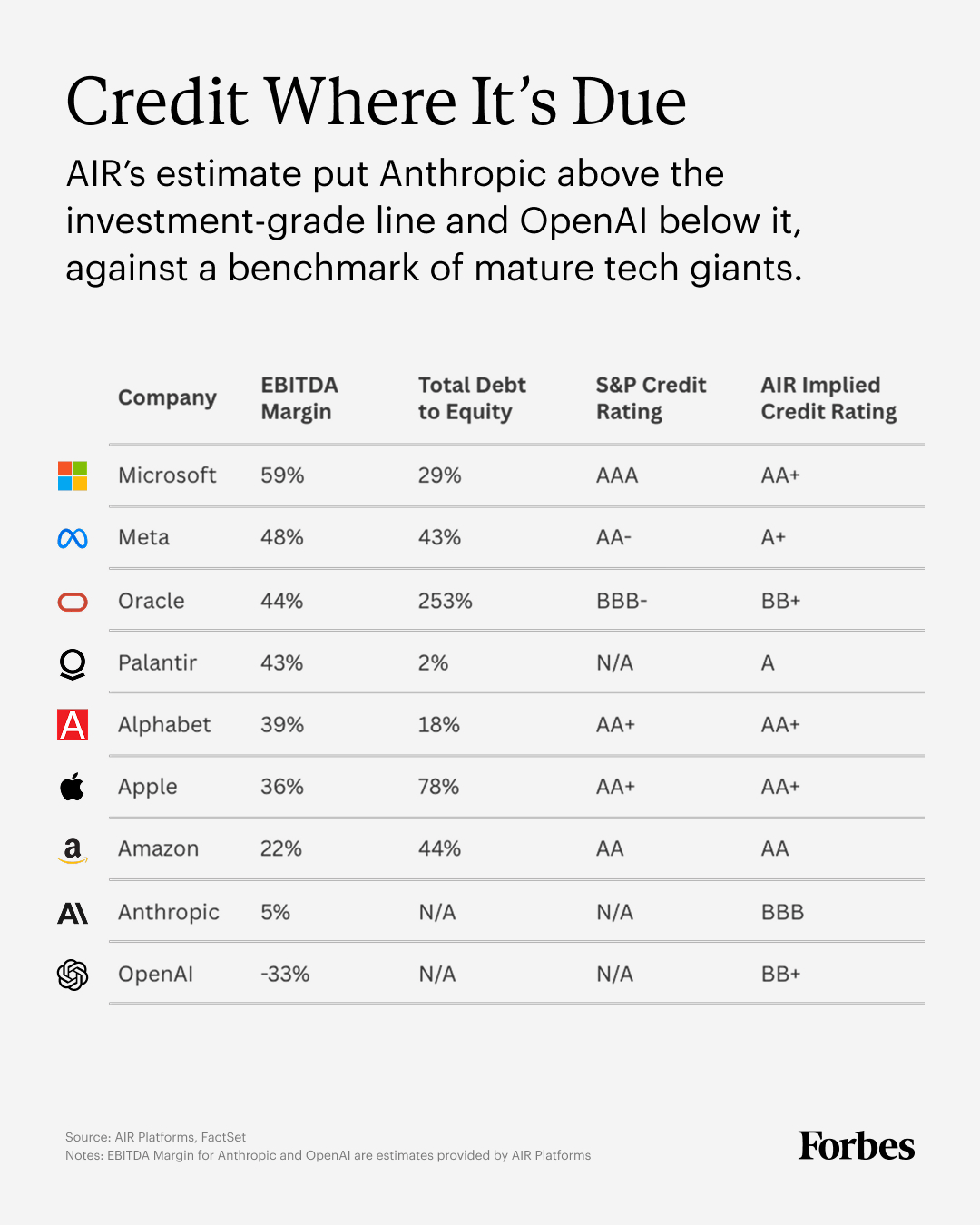
Among the companies with S&P ratings, all are investment grade. Microsoft carries the top AAA rating, followed by Alphabet and Apple at AA+. Oracle is the laggard with a BBB-, the lowest rung of investment grade. Palantir doesn’t have an S&P rating. Ratings make a difference: Apple’s 10 year unsecured notes are currently priced to yield 5.4% to maturity, compared to similar paper from Oracle, which yields 7.5%.
Joe Burdis, AIR’s co-founder and chief AI officer, says the biggest constraint is the incomplete public information available on the two companies. He says Anthropic’s positive adjusted operating result was the main reason it landed above OpenAI while noting that with companies growing this fast, relatively small changes in the underlying numbers can change the credit picture quickly.
Anthropic generated $4.6 billion of revenue in 2025 while losing more than $8 billion from operations, according to its IPO prospectus. AIR’s BBB relies on more recent results suggesting that the gap has narrowed. OpenAI and Anthropic didn’t respond to a request for comment.
If anything, AIR’s assessment may be generous. OpenAI reported no balance-sheet debt as of March 31, according to financial statements reviewed by The Information, though it does have more than $5 billion available in revolving lines of credit. Anthropic is harder to pin down, and there isn’t a clean public number for all of its conventional debt. What we do know is that Anthropic was finalizing a $15 billion revolver as of September. Broadcom has agreed to lend it as much as $42 billion through convertible debt to finance chip leases, while Amazon bought $8 billion in Anthropic convertible notes. Amazon’s filings suggest about $2 billion of that has already been converted into preferred shares with the remainder set to convert when Anthropic goes public. Convertible debt starts out as debt but can turn into stock, so credit analysts don’t treat it the same way they would a plain loan that has to be repaid in cash.
Almost all of the AI buildout is financed through leases, long-term computing contracts, guarantees and special-purpose vehicles rather than a company simply borrowing money and putting debt on its balance sheet. In other words, some of these obligations can behave a lot like debt without being recorded as such on the company’s balance sheet. With an SPV, the debt may technically belong to a separate entity created to finance a data center or other project. Whether OpenAI or Anthropic is ultimately on the hook depends on the contracts around it. They may have promised to lease the capacity, buy a minimum amount of computing power or support the financing in some other way. The accounting distinction is real, but a lender still wants to know how much cash the company has already committed and how hard it is to get out of those payments.
Capital-heavy industries have used leases, take-or-pay contracts and project financing for decades. What’s different here is the scale of the commitments being made by companies whose future cash flows are still largely hypothetical. Anthropic has at least $518 billion of future infrastructure commitments, including $161.2 billion of Broadcom-related equipment lease obligations, that are largely noncancelable. Meanwhile, OpenAI has forecasted that it will spend $856 billion on data centers and chips by the end of decade. A large part of that is committed to buying $100 billion of computing capacity from Amazon over eight years. Neither is a conventional corporate bond or loan, but both commit the companies to spending enormous sums years into the future.
AIR’s grades don’t directly include those obligations. It’s hard to see how adding hundreds of billions of dollars of fixed future payments would make either company look more creditworthy.
But how much weight to give those commitments is a judgment call. That partly explains why, as OpenAI and Anthropic prepare for IPOs, Morgan Stanley and Goldman Sachs have been talking with S&P, Moody’s and Fitch on their behalf about securing investment-grade ratings after they go public, the Financial Times reported in September.
Companies can give an agency nonpublic financials and get a private assessment before anyone sees a public grade. If they don’t like the answer, that assessment may never see the light of day. OpenAI and Anthropic didn’t hire AIR, didn’t give it access to its books and didn't get to decide whether AIR could publish their credit ratings.
It's fitting that just as OpenAI and Anthropic never asked permission to ingest the gobs of internet information it uses to create its products and near trillion dollar businesses, the 10-person startup behind AIR used that same technology to issue the relatively dismal ratings, whether OpenAI or Anthropic likes it or not.
More From Forbes
ForbesInside The Trillions Being Spent On The AI Data Center BuildoutBy Giacomo TogniniForbesMeet Joe Strada, Florida HVAC Mogul Set To Become The Richest Member Of CongressBy Brandon KochkodinForbesWhy The Economy Looks Great To Boomers, But Miserable To Gen ZBy Brandon KochkodinForbesThe Strange Way Data Centers Are Showing Up In The Muni Bond MarketBy Brandon KochkodinGathering Sources...