Google Just Put Claude Inside Gemini. The Company Picking Your AI Now Profits Either Way
TL;DR
- Google's new Gemini agent lets businesses choose Claude Opus 5 or Sonnet 5.5 next to Gemini models.
- It's the first time Claude appears inside Gemini itself, not just on Google's developer cloud.
- By default, an "Auto" mode picks the model for you, aiming for the best result at the lowest cost.
- It's business-first and still in early access; Google says consumers will get the agent later.
- Google earns either way: it's an Anthropic investor, and Claude runs on Google's cloud chips.
Google unveiled a new Gemini agent for work this week, and the most surprising part of the launch was a menu. Right under Google’s brand-new Gemini 4 Argon sit two models from Anthropic, one of Google’s biggest AI rivals. Here’s what changed, why Google would hand shelf space to a competitor, and the one question you should ask before trusting “Auto.”
What Actually Happened
At its Gemini at Work 2026 event, Google Cloud CEO Thomas Kurian introduced the Gemini agent, which Google calls “a single, universal agent for work.” An AI agent is an assistant that doesn’t just answer questions but completes tasks on its own: researching, writing documents, running code, and working across apps like Gmail, Slack, Salesforce, and Microsoft 365.
Today at Google Cloud’s Gemini at Work event, we announced Gemini, a new single universal agent for work that has all of your business context and can be used for everything from knowledge work to answering questions, and content creation to coding, all from a single prompt box.
It’s built around core architectural principles:
☑️ Unified Agent: Gemini can answer questions, do knowledge work and generate code from a single prompt box.
☑️Access: Gemini is web-based and can be accessed from any device and integrated into third-party applications. It can also operate without a dedicated user interface.
☑️Persistent Execution: It runs in the cloud, which means it maintains a single set of memories, context and one personalization graph no matter where you access it.
☑️Multi-Agent Orchestration: Gemini can create sub-agents to tackle multi-step tasks and can also act as a coworker agent with a defined role and its own dedicated identity
☑️Context: Gemini knows your tools, data, and work history and learns how you work the more you use it.
☑️Model Choice Flexibility: It orchestrates across multiple models to deliver optimal quality and lower your costs.— Thomas Kurian (@ThomasOrTK) October 8, 2026
The line that matters most for this story came from Kurian himself: “Gemini is the agent, and the model underneath it is a separate choice.”
A quick translation. The model is the AI “brain” that understands your request and writes the answer. The agent is everything wrapped around it: memory, tools, app connections, and permissions. Google is saying you can keep the Gemini agent and swap the brain.
In the model picker shown during the launch, the options look like this:
| Option | Made by | What it’s for |
| Auto (default) | Picks a model per task | |
| Gemini 4 Argon (new) | Google’s new top reasoning model | |
| Gemini 3.8 Flash | Fast, cheaper tasks | |
| Claude Opus 5 | Anthropic | Anthropic’s top model |
| Claude Sonnet 5.5 | Anthropic | Anthropic’s mid-tier workhorse |
Google says it orchestrates across “our Gemini family of models and Claude models from Anthropic today,” with other private and open-source models coming later. Orchestration here means the agent can send different parts of one big job to different models.
Why “First Time” Is a Big Deal
Claude has been available on Google’s cloud for a while, but only to developers building their own apps through Google’s AI platform. That’s like a grocery store’s warehouse stocking a rival brand. Shoppers never saw it.
This is different. Gemini is Google’s main AI product, the one with more than 1 billion monthly users, and until now it has only ever run Google’s own models. Seeing Claude sitting next to Google’s models inside Gemini is the store putting a competitor’s product on its front shelf, with its own logo on the bag.
Microsoft went down this road first. It added Anthropic’s models to Microsoft 365 Copilot in 2025. OpenAI hasn’t: ChatGPT still runs only OpenAI models. That leaves OpenAI as the one big player betting that its own model is all you’ll ever need.
Why Would Google Sell a Rival’s AI?
It looks odd at first. It makes sense once you follow the money.
- Google already owns a piece of Anthropic. In April, Google agreed to invest up to $40 billion in Anthropic: $10 billion in cash at a $350 billion valuation, plus $30 billion more tied to performance targets. When Claude wins, Google’s stake grows.
- Claude runs on Google’s chips. Anthropic is one of the biggest customers for Google’s TPUs (Tensor Processing Units, Google’s custom AI chips). The same April deal includes five gigawatts of next-generation TPU capacity starting in 2027. Every Claude answer served through Google’s cloud is cloud revenue for Google.
- Businesses already use Claude. Many companies lean on Claude for coding and long documents. If Gemini didn’t offer it, those teams would keep a second AI tool open in another tab, and Google would lose the thing it wants most.
That thing is the front door. Kurian put it plainly: “Work now starts in the prompt window.” Whoever owns that window owns the workflow, the data connections, and the subscription. Our read: Google has decided that owning the window is worth more than winning every model comparison.
The Real Question: Who Decides “Best”?
Here’s the part we’d keep an eye on. Auto is the default. Google says its routing tool sends each task to “the model that delivers maximum performance at the lowest possible cost.”
That sounds great, and partly it is. Simple questions don’t need the most expensive model. PayPal, one of Google’s early testers, routes 10 million requests a week across multiple models this way.
But look at the developer prices for the models in that menu:
| Model | Input price per 1M tokens | Output price per 1M tokens |
| Gemini 3.8 Flash | $0.75 (rises to $1.50 in 2027) | $3.75 (rises to $7.50) |
| Gemini 4 Argon | $2 introductory, then $4 | $10 introductory, then $20 |
| Claude Sonnet 5.5 | $2 | $10 |
| Claude Opus 5 | $5 | $25 |
A token is a chunk of text, roughly three-quarters of a word. “Input” is what you send; “output” is what the AI writes back. These are API prices for developers; Google hasn’t published per-seat pricing for the Gemini agent.
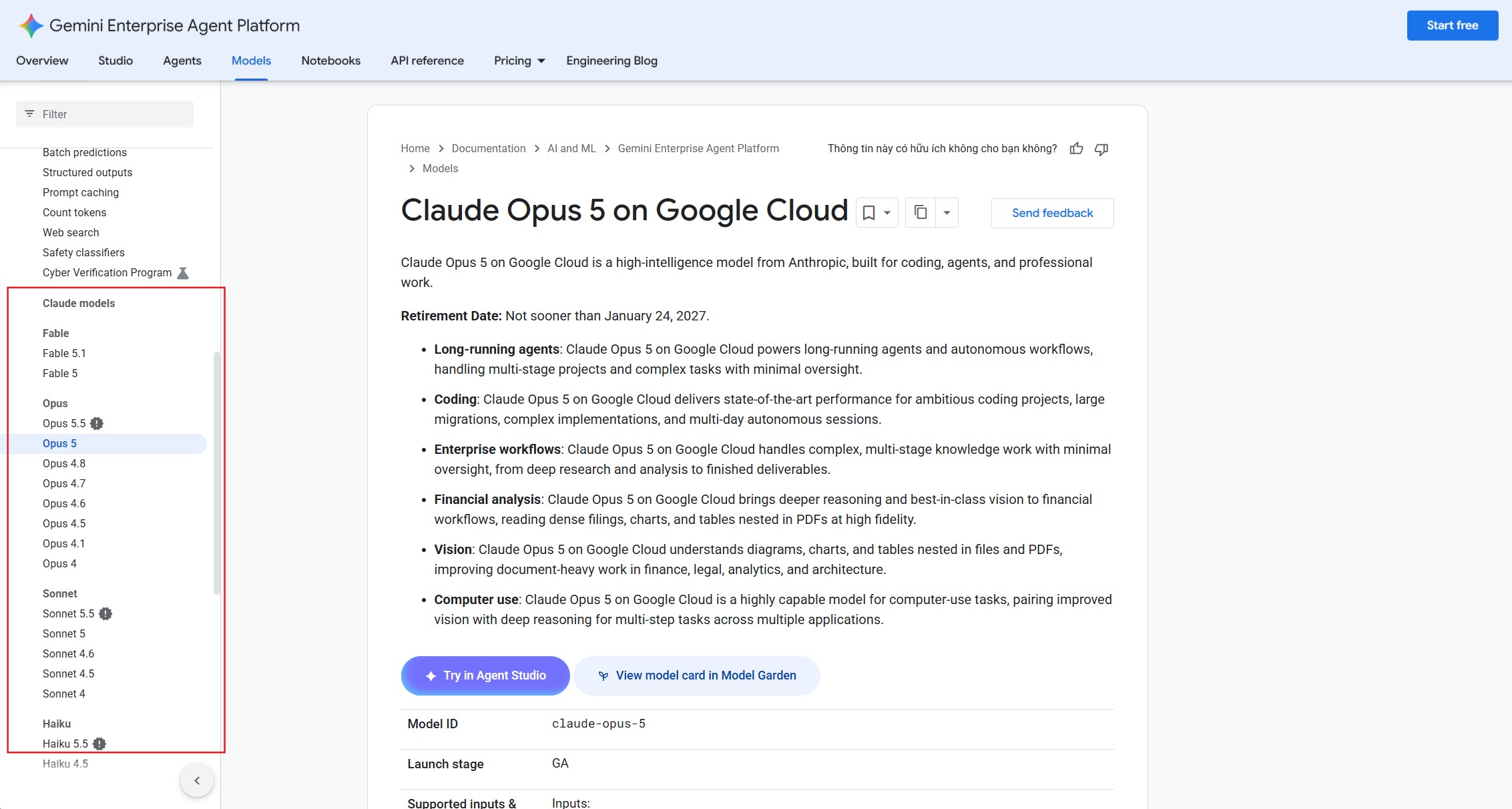
Claude Opus 5 is the most expensive option on the list. A router built to lower cost will naturally favor cheaper models, and Google makes most of them. Google also benchmarks its own models: by its numbers, Gemini 4 Argon leads in 13 of 19 tests, while Anthropic’s Claude Opus 5.5 still wins on Terminal-Bench 4.0, a test of real coding work in a command line, 66.4% to 57.4%.
We’re not saying Google will rig the router. We’re saying Google grades the test, sets the prices, and writes the router, and it hasn’t explained how Auto makes its choices. If you’re paying for this at work, ask your vendor whether you can see which model answered each request.
What’s Still Unclear
The launch left some gaps, and Google’s own pages don’t fully agree with each other:
- Availability. Google’s product page says third-party model choice is in early access and coming to all customers “soon.” Its FAQ lists only Gemini models today. No general release date is given.
- Which Claude. The launch video shows Claude Opus 5, not Anthropic’s newer Opus 5.5. The menu could change before wider release.
- Pricing. No per-seat or per-task prices yet. Google does offer real-time spend caps, which pause an agent when a project hits its budget.
- Your data. Google hasn’t detailed how prompts are handled when the agent routes work to Claude. If you work with sensitive information, that’s a question for your IT team before you switch.
When Can Regular Users Get Claude in Gemini?
Not yet. The Gemini agent launches for businesses first, and Sundar Pichai says Google is using that rollout to solve “harder problems around security, scale, and performance” before bringing it to consumers.
Will the free Gemini app ever list Claude? We doubt it. Claude Opus is expensive to run, and Google’s own models are cheaper to serve. We guess that if third-party models reach consumers at all, they’ll arrive in Google’s paid plans first. Treat that as our prediction, not a plan Google has announced.
For now, if you want Claude, you use Claude. If your company already pays for Gemini, the model menu may show up at work before it shows up on your phone.ac
FAQs
Is Gemini better than ChatGPT and Claude right now?
It depends on the task. Google’s own tests put Gemini 4 Argon ahead on most benchmarks, but independent results aren’t in yet. Earlier this year, Gemini 3.8 Live still felt like third place in everyday use.
What else is Anthropic building beyond chat?
Anthropic is pushing Claude into tasks with real stakes, like money. Leaked work on Claude handling personal finances shows how quickly AI agents are moving from writing emails to acting on your behalf.
Is Alphabet stock tied to Anthropic’s success?
Partly. Google’s investment and TPU deal tie the two together. Some analysts argue Alphabet is the cheapest Magnificent Seven stock with real AI upside. This isn’t financial advice; it’s context for how the deals connect.
Why do AI companies charge heavy users so much more?
A small group of users drives most AI costs. That’s why the top 1% of AI spenders outspend half of all paying users, and why premium plans keep climbing in price.
How do companies keep AI agents from going rogue?
They give each agent its own identity and limited permissions, like a new employee.
Vincee Cole
Vincee Cole is a technology journalist with four years of experience covering the full spectrum of modern tech — from consumer devices, artificial intelligence, to quantum computing, blockchain, and digital assets. His reporting cuts through complexity to deliver stories that are sharp, grounded, and relevant to both general readers and industry insiders. Previously, he worked with fintech research teams across Southeast Asia, analysing how emerging technologies are reshaping financial systems at scale.
Visit Profile