
IREN Rebounds on Reported Anthropic Deal as Microsoft Unveils Maia 300 AI Chip
IREN Limited (NASDAQ:IREN) shares jumped in premarket trading Monday after a report said Anthropic had signed a multiyear cloud-computing agreement with the data-center operator, giving investors a fresh reason to reconsider a stock that had posted three straight losing sessions. The rebound, however, faces a technical hurdle: shares must reclaim the $38-to-$40 zone where selling accelerated last week before a more durable recovery can take shape.
The Information reported that Anthropic, the AI startup behind the Claude chatbot, had reached a multiyear deal with IREN for AI cloud services. The report appears to identify the previously unnamed frontier AI lab that IREN co-CEO Daniel Roberts referenced during the company's August earnings call. IREN shares climbed roughly 5% in premarket action on Oct. 12.
The reported agreement strengthens IREN's push beyond Bitcoin mining and into AI infrastructure. The company already holds a $9.7 billion agreement with Microsoft Corp (NASDAQ:MSFT) for AI cloud capacity, giving it a second major customer relationship as it scales data-center operations. Anthropic currently relies on public cloud providers such as Amazon and Google, and adding IREN would let it lock in large GPU clusters with more flexibility and at lower cost, according to the report.
That flexibility matters for Anthropic as it approaches a planned initial public offering. Securing computing capacity from providers like IREN, which control their own power supply and data centers, helps the startup hold down research and operating costs. Cheaper computing could improve both Anthropic's losses and its gross margin, two metrics prospective shareholders are likely to scrutinize.
Yet the timing of Monday's catalyst is notable. IREN closed at $35.19 on Oct. 9, down 15.7% from its Oct. 2 close of $41.76. The stock fell in consecutive sessions on Oct. 7, Oct. 8 and Oct. 9, as investors reassessed execution risks and the cost of the company's AI transition.
The $40 level carries more weight than a round number. IREN closed at $40.48 on Oct. 5 and $41.28 on Oct. 6 before sliding to $38.69 on Oct. 7 and $35.71 on Oct. 8. That sequence places $40 near the point where the recent decline accelerated, making it a useful gauge of whether buyers are regaining control. A move toward $40 would mark a meaningful recovery from Friday's close, but reaching it would not automatically reverse the bearish technical picture. Investors would want to see the stock hold gains rather than spike briefly on the headline before sellers return.
The broader chart underscores the distance IREN must recover. Its 52-week range stands at $28.93 to $76.87, leaving shares well below their annual peak.
The immediate question is whether the Anthropic report can shift sentiment beyond a single session. A major customer relationship can strengthen the revenue outlook, but it does not eliminate the capital expenditure, infrastructure delivery and operational challenges involved in scaling AI computing capacity. Investors should watch whether IREN can reclaim $38 first and then approach $40 with sustained buying and strong trading volume. Failure to hold the rebound would leave Friday's $34.64 intraday low in focus.
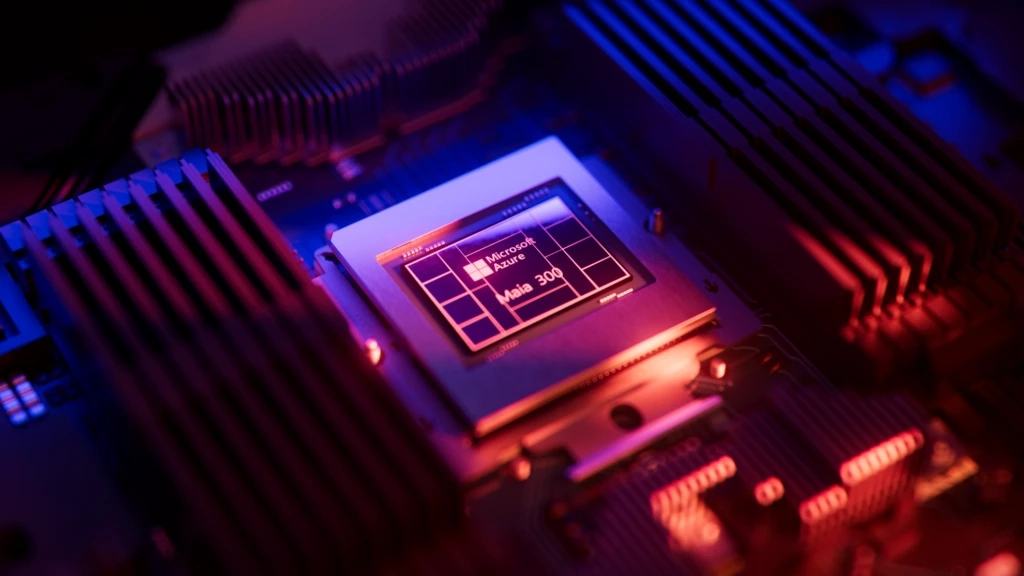
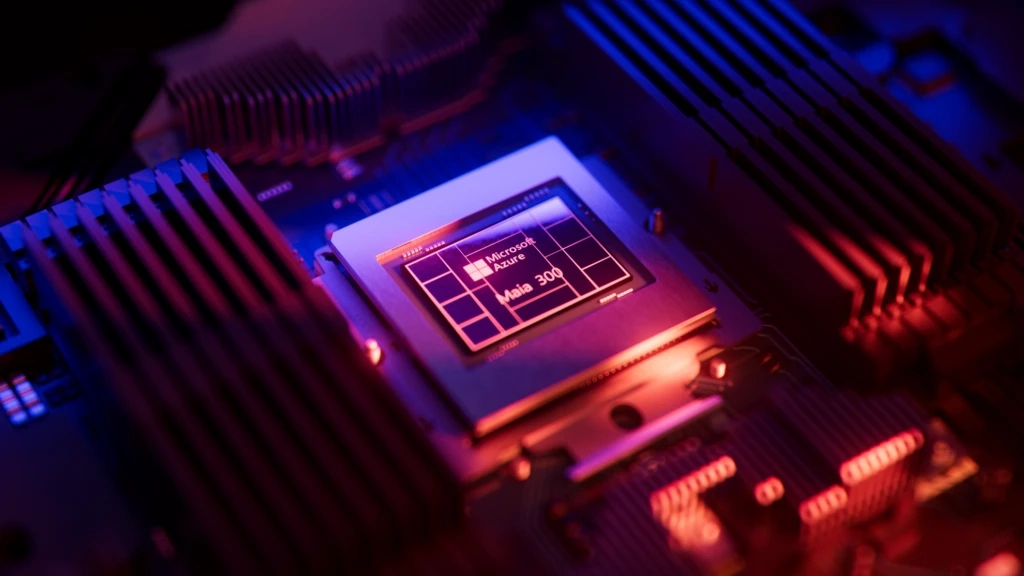
Separately, Microsoft shares climbed Monday after the company detailed its expanding in-house AI chip program, including plans to deploy the Maia 300 accelerator in production starting in 2027.
Microsoft said it intends to expand its Azure Maia systems to multi-gigawatt deployments beginning in 2027, positioning Maia as the primary engine for AI inference behind its products and services. The current-generation Maia 200 already powers live Copilot workloads and supports the MAI team's development of upcoming models. By the end of the year, GitHub Copilot and Microsoft Foundry are slated to run on it as well. The chip handles OpenAI's models, Microsoft's MAI models and major open-source families alike.
Installations of Maia 200 are underway in the United States, Europe and Australia. Microsoft claims up to 1.7 times better token output per watt than leading GPU infrastructure for the AI built into Teams, Copilot and Cowork.
Maia 300, the third chip in the lineup, is built for reasoning over long contexts, speedy chat responses and agent tasks that unfold over many steps. Against leading GPU-based systems, Microsoft expects 40% more tokens from each megawatt. A full 96-accelerator Maia 300 rack can deliver up to seven times the rack-scale token throughput of Maia 200.
| Specification | Maia 300 Detail |
|---|---|
| Memory | Eight HBM4 stacks, 18.0 TB/s peak bandwidth |
| Thermal budget | 950 watts |
| Precision support | Enhanced MXFP4 low-precision formats |
| Networking | Ethernet-based with custom AI transport |
| Process node | TSMC N2P |
| Production start | 2027 |
The chip's inference-first architecture balances compute, memory bandwidth, networking and power efficiency at cloud scale, Microsoft said in a statement. Support for low-precision formats such as enhanced MXFP4 lowers memory and bandwidth requirements, making room for larger context windows. Ethernet-based networking with a custom AI transport lets deployments stretch from a single rack to an entire data center.
Microsoft calls Maia a cornerstone of what it dubs Frontier Transformation, a strategy built on an open, multi-model platform spanning chips, systems and agents. More details on strategy, technology adoption trends and customer results will come at Microsoft Ignite 2026 next month in San Francisco.
The in-house chip effort reflects a broader industry shift. Microsoft is one of several companies developing proprietary AI processors alongside Alphabet (NASDAQ:GOOGL) and Meta Platforms (NASDAQ:META), as a global shortage of memory chips drives up costs. Microsoft's Maia chips are manufactured by Taiwan Semiconductor Manufacturing (NYSE:TSM), which produces roughly 75% of the world's chips.
Microsoft first introduced the Maia line in November 2023 as it works to reduce reliance on processors from Nvidia (NASDAQ:NVDA) and Advanced Micro Devices (NASDAQ:AMD). The Maia 200 chip, released in January of this year, is already running production workloads including the Copilot AI assistant.
Wall Street remains bullish on Microsoft. The stock carries a consensus Strong Buy rating among 37 analysts, based on 35 Buy, one Hold and one Sell recommendations issued in the last three months. The average price target of $558.86 implies roughly 40% upside from current levels.
For IREN, the Anthropic news gives bulls a catalyst. The stock's ability to recover lost ground will determine whether that catalyst becomes a more durable turnaround.