
Brockman: OpenAI’s Q3 Run Rate Rose 70%, Enterprise Doubled
OpenAI president Greg Brockman said at The Wall Street Journal’s WSJ Tech conference on 4 November that OpenAI’s annualized revenue grew 70% in the third quarter. He also said that revenue from business customers was doubling. These words come from The Wall Street Journal’s own captions for a 71-second video of the session, published at 02:04 UTC on 5 November.
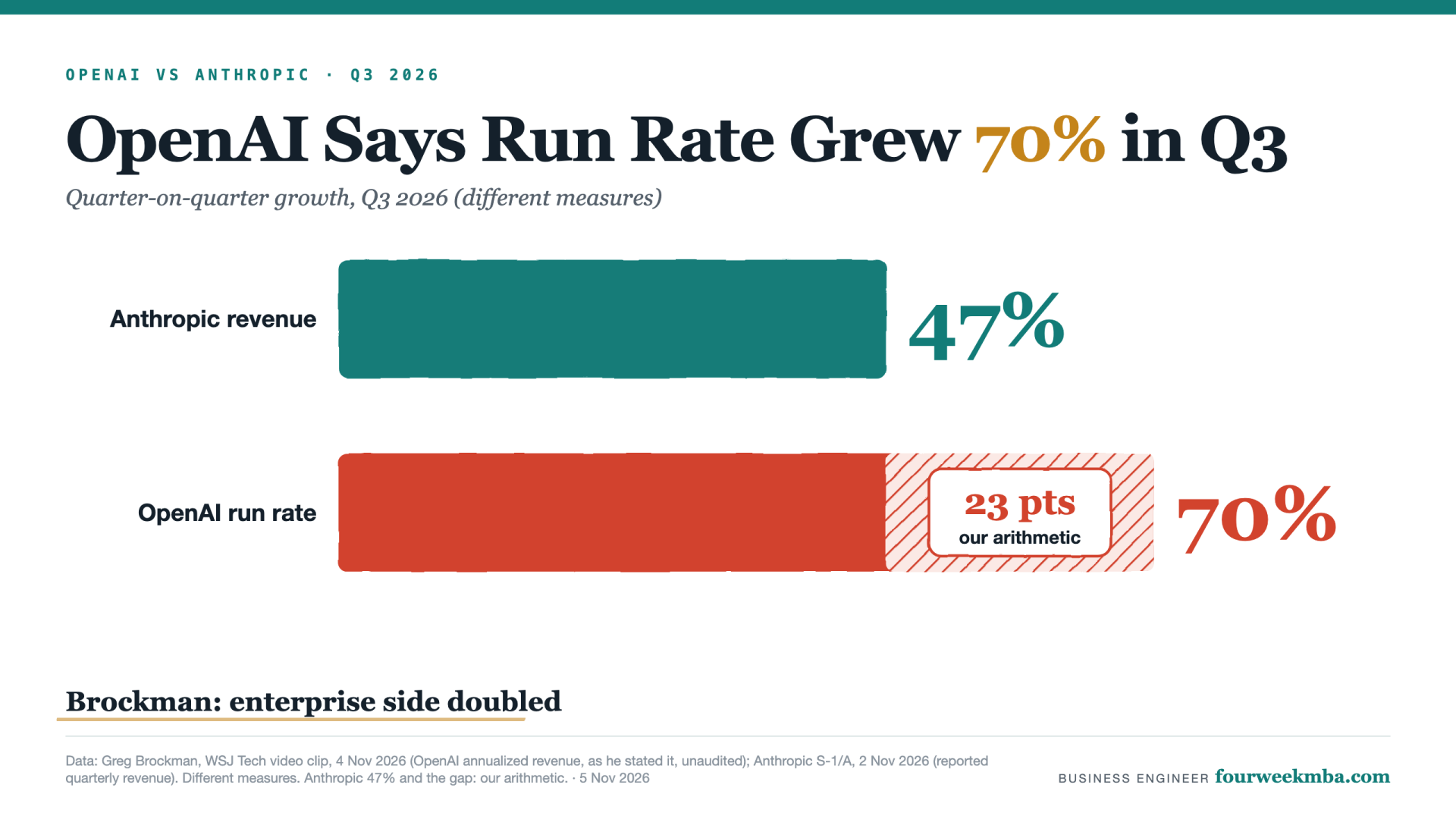
Using figures from Anthropic’s updated Form S-1 filing, we calculated that Anthropic’s reported revenue grew by about 47% in the same quarter. It increased from $11,555 million to $16,956 million. This is 23 percentage points less than Brockman’s 70%. However, these numbers measure different things. Brockman was talking about growth in annualized revenue and did not give a dollar amount. Anthropic’s figure is the actual revenue it reported for the quarter in its filing.
This one-minute explanation from Business Engineer describes what annualized revenue means. It does not discuss OpenAI, Anthropic or the numbers in this article.
What Brockman Said in the Video
The Wall Street Journal titled the video “Greg Brockman on the Rise of Anthropic”. The interviewer asked: “So when did you personally realize that Anthropic was going to overtake you guys in revenue?” The Journal’s description says Brockman discusses when he realized Anthropic would pass OpenAI in revenue that year and how OpenAI was recovering.
Brockman answered: “So I think to me, this became fairly clear, honestly, even at the very beginning of the year.” He described the first half of the year this way: “Q1 was pretty rough. Q2 was pretty rough. It really looked in many ways like coding, we weren’t even in the conversation. We had Codex, but no one was talking about it.”
He described the third quarter as very different: “And Q3, entirely different. We had 70% quarterly growth in our annualized revenue. And if you just break it down by the enterprise side, doubling, right? That’s like crazy growth for a single quarter.”
He said the improvement came from work OpenAI had done earlier, not just from things launched in the third quarter: “It wasn’t something we did in that quarter. It was all the investments that we’d been making up to that date.” He mentioned two product launches: “we got a Frontier model out in the form of GPT-5.6 Sol. We got ChatGPT work released as well.”
The IPO and OpenAI’s Business Customers
Reuters reported, in a story published at 02:07 UTC and carried by CNA, that Brockman said OpenAI now gets most of its revenue from sales to businesses. Reuters did not give a percentage. When someone asked whether OpenAI would be ready for an IPO next year, Brockman answered, “I think so,” according to Reuters.
Reuters also reported that Brockman said OpenAI was increasing its sales efforts to businesses to compete with Anthropic. These efforts included promoting its Codex agent. In our article on 15 August, we reported CNBC’s account of what OpenAI chief financial officer Sarah Friar told investors. She said business revenue had become larger than consumer revenue: “We entered the year at 60-40, but enterprise has accelerated much faster than expected and those lines have now crossed.”
Comparing the Numbers With Anthropic’s Filing
Anthropic filed its S-1/A on 2 November. It reported quarterly revenue of $4,731 million for the three months ending 31 March 2026, $11,555 million for the three months ending 30 June, and $16,956 million for the three months ending 30 September. Our calculations show that revenue grew by about 144% in the second quarter and about 47% in the third quarter.
Based on these figures, OpenAI’s 70% growth figure for the third quarter is about 1.5 times Anthropic’s 47%, according to our calculations. But the figures are not directly comparable. Brockman gave an unaudited growth figure for annualized revenue during a public event. Anthropic reported its quarterly revenue in an official registration filing. These numbers show growth rates only. Neither source we reviewed gives OpenAI’s revenue in dollars.
We can also look at Brockman’s two figures together. He said total annualized revenue grew 70% and business revenue doubled. Based on our calculations, this means the rest of OpenAI’s annualized revenue grew by less than 70% during the quarter.
What Helped OpenAI Grow
The main business factor in this story is sales to companies. Brockman pointed to two products behind the third quarter’s results: the GPT-5.6 Sol model and the ChatGPT work product. He also explained that coding had been an area where OpenAI struggled earlier in the year. He said the company had not even been part of the conversation, despite already having Codex.
Our reading of the video is that Brockman connects OpenAI’s recovery to its business customers. Anthropic’s filing does not separate revenue from business customers and consumers. However, our calculations show that its total quarterly revenue grew about 3.6 times between the first and third quarters of 2026.
How the Two Companies Fit Into the Wider Story
Our reading of the video is that Brockman describes OpenAI’s problems in the first half of the year as being especially serious in coding. He said the company “weren’t even in the conversation” and that it had Codex but “no one was talking about it.”
The two companies’ figures also measure different things. One is the growth rate Brockman gave for annualized revenue. The other is Anthropic’s reported revenue for a full quarter. Since OpenAI’s dollar revenue was not provided, the 70% figure cannot tell us the dollar difference between the companies.
When we compare Reuters’ report with our August article, the statement that most OpenAI revenue comes from business customers matches the change Sarah Friar described to investors in August. Reuters also reported that Brockman said “I think so” when asked whether OpenAI would be ready for an IPO next year.
Greg Brockman, OpenAI president, at WSJ Tech, 4 November 2026 (The Wall Street Journal caption file)
“And Q3, entirely different. We had 70% quarterly growth in our annualized revenue.”
Three Things This Could Mean
FOR OPENAI Reuters reported that Brockman believes OpenAI will be ready for an IPO next year. He answered, “I think so.” Anthropic’s filing gives revenue amounts in dollars for each quarter, while the video gives only OpenAI’s growth rate.
FOR ANTHROPIC Its filing shows that quarterly revenue grew by about 144% in the second quarter and about 47% in the third quarter, based on our calculations. Traders also gave a 55% chance that Anthropic shares would begin trading during the week of 16 November.
FOR PEOPLE BUYING CODING AGENTS During the same week, OpenAI said it would buy Pierre, a company whose libraries are used in the Codex app. Cat Wu, whom Business Insider described as the head of product at Claude Code, also said Wu was joining OpenAI.
The Business Engineer View
This story connects to the Business Engineer framework called The Agentic Harness War.
The framework’s main idea is: “The surface, not the model, governs autonomy.”
Our reading is that Brockman credited OpenAI’s third-quarter improvement to both its model, GPT-5.6 Sol, and its work product, ChatGPT work. This followed a first half when Codex existed but “no one was talking about it.” The framework’s analysis compares OpenAI’s Codex data with Anthropic’s usage data. It does not discuss the revenue figures in this article.
What We Still Do Not Know
The video we reviewed does not give OpenAI’s annualized revenue in dollars, the amount used as the starting point for the 70% growth figure, or the exact share of revenue coming from business customers. The statement that most revenue comes from business customers, and the answer about an IPO, come from Reuters’ report. We tried to access the full 1,772-second session through The Wall Street Journal’s caption file, but access was denied. Therefore, we have not reviewed the rest of the session. The short video also says nothing about computing resources.
The figures of 47%, 144%, 3.6 times, 1.5 times and 23 percentage points are our own calculations. The sources we reviewed do not give an IPO date or IPO terms for OpenAI.
The Main Point
Greg Brockman said at WSJ Tech that OpenAI’s annualized revenue grew by 70% in the third quarter of 2026 and that revenue from business customers doubled. This came after two quarters that he described as “pretty rough”. Our calculations from Anthropic’s filing show that its quarterly revenue grew by about 47% in the same quarter, although this is a different measurement. Reuters reported that Brockman said most of OpenAI’s revenue now comes from business sales. Reuters also reported that he answered “I think so” when asked whether OpenAI would be ready for an IPO next year.
A note about our sources. Brockman’s words come from The Wall Street Journal’s own English caption file for its 71-second video of his WSJ Tech session on 4 November 2026. We could not access the caption file for the full session, so we did not review the entire event. The statement about most revenue coming from business customers and the answer about an IPO come from Reuters’ report, as published by CNA. Anthropic’s quarterly revenue figures come from its S-1/A filing dated 2 November 2026. These quarterly figures are unaudited.
OpenAI’s growth figure is the unaudited number Brockman stated. The figures of 47%, 144%, 3.6 times, 1.5 times and 23 percentage points are our calculations. They compare different types of measurements.
Sources: WSJ video, Greg Brockman on the Rise of Anthropic (caption file), 4 Nov 2026 · WSJ video, OpenAI Co-Founder Greg Brockman at WSJ Tech, 4 Nov 2026 · Reuters via CNA, 5 Nov 2026 · Anthropic S-1/A, SEC, 2 Nov 2026