
Witten’s Physics Paper Credits Claude Opus 5.5 in 3 Places
Physicist Edward Witten of the Institute for Advanced Study mentions Anthropic's Claude Opus 5.5 three times in a new paper about lattice gauge theory. The paper was posted on arXiv on 3 November. In Section 3, Witten writes that “Anthropic’s Claude Opus 5.5 suggested a likely variant” of a mathematical construction. In the acknowledgements, he writes: “Assistance on many details was provided by Claude Opus 5.5.”
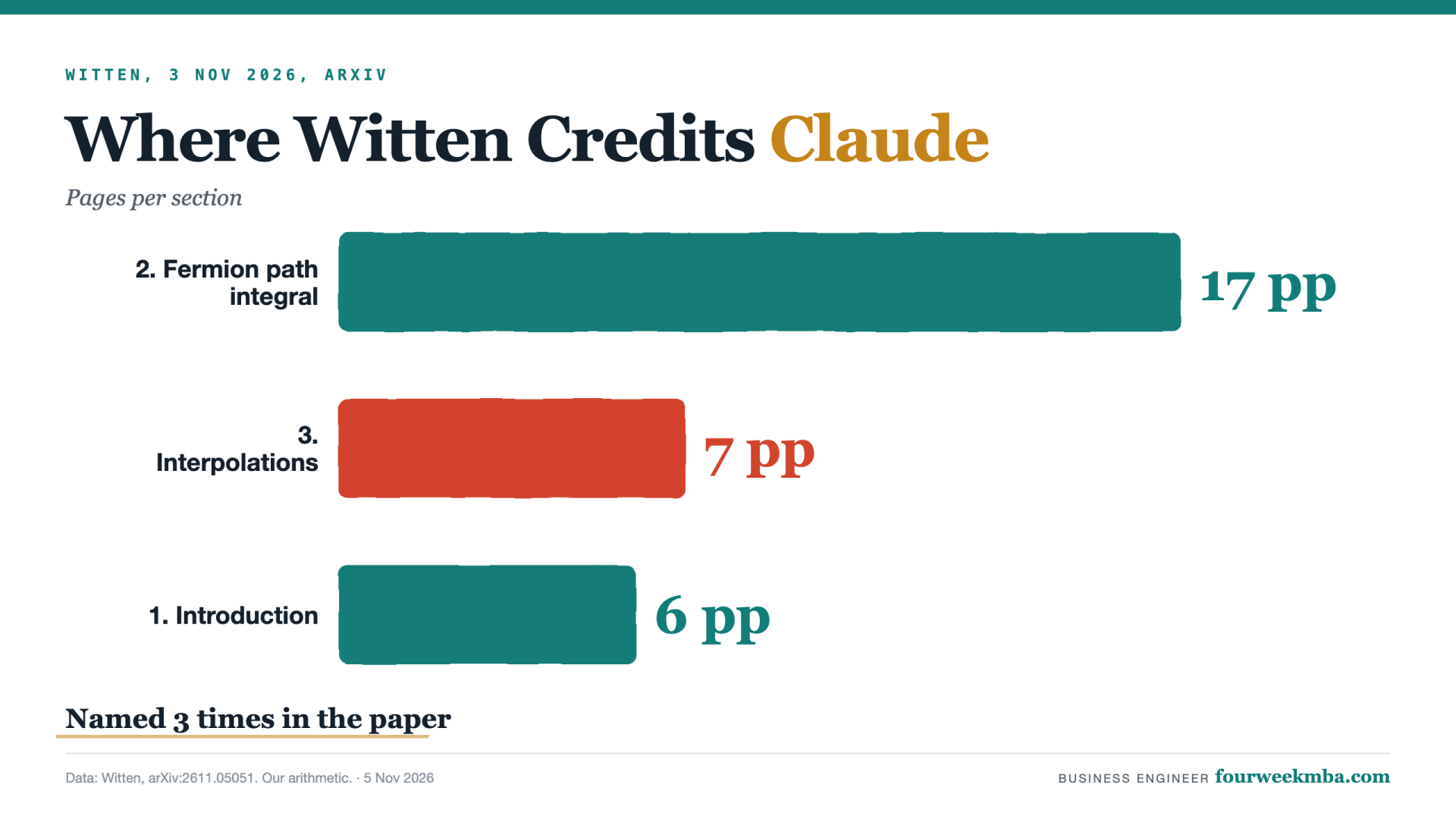
The paper is called “A Note On Lattice Definition of Gauge Theories With Chiral Fermions” (arXiv:2611.05051). Witten is its only author, and it is 36 pages long. By our count, Claude Opus 5.5 is mentioned twice in Section 3 and once in the acknowledgements.
The key point: In a paper posted on 3 November, Edward Witten mentions Claude Opus 5.5 three times. Twice in Section 3, he says the model suggested and described different ways to create a smooth connection between a lattice and a continuous space. The third mention is in the acknowledgements, where Witten says it helped with many details.
What the Paper Says Claude Did
Section 3 is called “Continuum Interpolations of Admissible Lattice Gauge Fields”. It explains how to turn a lattice gauge field into a smooth field that exists across continuous space. After describing one method, Witten writes that “Anthropic’s Claude Opus 5.5 suggested a likely variant that gives a smooth interpolation with link holonomies that equal precisely the corresponding lattice link variables”.
The paper then explains this method step by step. A few paragraphs later, Witten adds that “Opus 5.5 also described a variant in which the inductive step is made by a sort of linear interpolation rather than by solving a Dirichlet problem.”
The third mention appears in the acknowledgements. Witten also thanks two physicists: “I thank T. Hartman for pointing out Craig’s paper, and K. Yonekura for helpful comments on the manuscript. Assistance on many details was provided by Claude Opus 5.5.”
What Was Posted on X
Ed Witten published this paper yesterday
— Dave (@dmvaldman) Nov 04 20:43
On 4 November, the X account @dmvaldman shared a post saying “Ed Witten published this paper yesterday”. The post included a screenshot of the passage in Section 3 where Witten says Anthropic's Claude Opus 5.5 suggested a possible version of a mathematical construction.
smartest mfer on the planet who revolutionized modern string theory is using Opus 5.5
— Lisan al Gaib (@scaling01) Nov 05 12:26
it’s over for OpenAI
(they will offer him access to internal GPT models before I finish typing this)
The account @scaling01 quoted the earlier post. It said Witten was “using Opus 5.5” and added “it’s over for OpenAI”. This last statement is the poster's opinion, not a conclusion from Witten's paper.
What the Paper Is About
The paper's abstract says that researchers have faced a long-standing challenge: finding a way to study four-dimensional gauge theories that include chiral fermions using a lattice-based computer method. One reason this is difficult is a problem called fermion doubling.
The abstract says Craig recently described an algorithm that addresses this challenge. Witten's paper describes a different version of the approach. It works by smoothly connecting a lattice gauge field across continuous space.
The abstract also says that Hsu recently proposed the same version. It explains that the method could, in principle, be run on a computer. However, it cannot be used in practice with Monte Carlo methods because the path integral for chiral fermions is not positive.
How It Spread on X
On 4 November, the X account @dmvaldman shared a screenshot of the passage in Section 3, with the words “Ed Witten published this paper yesterday”. The post had about 97,000 views when we checked on 5 November. On 5 November, @scaling01 quoted the post and wrote that Witten “is using Opus 5.5”. The account also added “it’s over for OpenAI”. That final statement is the poster's opinion.
The Structural Read
Our reading of Section 3 is that the paper credits the model with suggesting a specific idea: a “likely variant” of a method for smoothly connecting a lattice to continuous space. Witten then explains that construction in the paper himself.
In the acknowledgements, Claude Opus 5.5 is mentioned alongside two physicists. Witten thanks those physicists for pointing out a paper and giving comments on his manuscript.
The paper does not explain exactly how the model was used. Therefore, it does not tell us how much it contributed beyond the specific passages that mention it.
Edward Witten, arXiv:2611.05051, 3 November 2026
“Assistance on many details was provided by Claude Opus 5.5.”
Three Implications
FOR AI LABS The paper has one human author. In its acknowledgements, it credits a named model alongside human colleagues.
FOR RESEARCHERS In Section 3, Witten credits the model with two versions of a mathematical construction. He describes one of them as a “likely variant”.
FOR READERS The paper is a preprint published on arXiv. We have not seen a version that has been reviewed by other experts.
The Business Engineer Lens
This story fits the ideas in the Business Engineer framework The Agentic Harness War.
The framework says: “As execution delegates, human effort moves to delegation, supervision, review, and integration, and the returns to domain expertise rise.”
In our reading, Witten's paper shows this division of work. The model suggested a version of the method and helped with details. Witten, the human author, explained the construction and presented it in the paper. The framework itself does not discuss Witten or physics.
What Is Not Established
The paper does not explain how Witten used Claude beyond the three passages that mention it. It does not say how many prompts or sessions he used, or which details were covered by the acknowledgement. The paper is an arXiv preprint, and we have not seen a version reviewed by other experts. We have not independently checked the suggested construction. Witten describes it as a “likely variant”. The count of three mentions comes from our own reading.
The Bottom Line
Edward Witten's paper, posted on arXiv on 3 November, is about lattice gauge theories with chiral fermions. It mentions Claude Opus 5.5 three times. Twice in Section 3, Witten says the model suggested and described different ways to connect a lattice gauge field smoothly across continuous space. The third mention is in the acknowledgements, where Witten says Claude Opus 5.5 provided “assistance on many details”.
A note on sources. All quotations come from Edward Witten's paper as it appeared on arXiv on 3 November 2026 (arXiv:2611.05051v1). Our count of three mentions and the page numbers in the chart are our own calculations. The posts from X are quoted as they were published.
Sources: Edward Witten, A Note On Lattice Definition of Gauge Theories With Chiral Fermions, arXiv:2611.05051, 3 November 2026 · arXiv:2611.05051v1 (PDF) · @dmvaldman, post on X, 4 November 2026 · @scaling01, post on X, 5 November 2026