
FPT proposes AI solutions to support management, operations, and public service.
FPT has introduced AI solutions for application in the public sector, contributing to bringing technology into solving specific problems in government operations and providing public services.
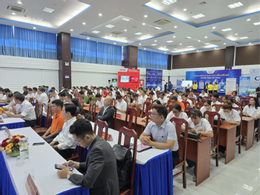
On October 8-9, 2026, in Ca Mau and Dong Thap provinces, the Department of Digital Technology and Artificial Intelligence (Ministry of Science and Technology) organized the workshop "Promoting the Development of the Digital Technology Industry with the theme: Mechanisms, preferential policies and investment opportunities in the digital technology industry - Driving force for digital transformation and new growth for Ca Mau" and "Artificial intelligence and concentrated digital technology zones - A breakthrough driving force for digital transformation in Dong Thap province".
The workshop introduced the mechanisms and preferential policies under the Law on Digital Technology Industry, the legal framework on artificial intelligence (AI), and also created a forum for businesses to introduce technological solutions serving management, administration, and the public. At the event,FPT introduced AI solutions applied in the public sector, contributing to bringing technology into solving specific problems in government operations and providing public services.

The urgent need for technology in streamlining organizational structures.
The restructuring of the government model creates new demands on administrative capacity. As the scale of management and workload increase, citizens and businesses expect more from public services. These are the tasks that AI can support, from handling internal work to improving the quality of public services.
If digital transformation creates the foundation and data for agencies to operate in a digital environment, AI can further leverage that data to support information processing, task execution, and interaction with citizens.
This orientation aligns with the National Strategy on Artificial Intelligence to 2030, with a vision to 2045, approved by Decision No. 1671/QD-TTg dated August 28, 2026, of the Prime Minister . The strategy identifies AI as a crucial driving force for redesigning governance methods and service delivery, enhancing national governance efficiency. Specifically, the goals for 2030 include 100% of online public services being supported by AI, 100% of officials and civil servants using AI-powered public service platforms weekly, and 60% of operational decisions being supported by data and AI.
From assistants serving citizens to "AI personnel" supporting the entire public service system.
In Ca Mau, FPT.AI and the organization's leadership have launched a 24/7 AI hotline to directly serve people at the Employment Service Center, receiving thousands of calls daily, providing advice on unemployment insurance, employment, and vocational training, serving more than 10,000 workers. AI has thus become a channel for providing public services, rather than just an experimental tool.
Beyond directly serving the people, AI in Ca Mau has also been expanded to internal government operations. In Thoi Binh commune, Ca Mau, AI is being tested to assist officials in routine tasks such as searching for legal documents, finding operational guidance, compiling information, and preparing reports.
From initial local applications, the AI roadmap in the public sector is expanding from serving citizens and supporting officials to professional specialization and the formation of a shared platform. Unlike AI that only answers questions, AI Agents are designed with specific roles, capable of understanding requests, retrieving authorized data, and performing tasks such as aggregation, analysis, drafting, and guidance within their scope of control.
Building a sustainable AI operational platform for the public sector.
For the public sector, implementing AI is not simply a matter of choosing a major programming language. The value of the system depends on its ability to connect data, understand business processes, control access, and ensure verifiable results.
For AI to create real value in the public sector, a suitable technological platform, a team of professionals proficient in the technology, and clear performance metrics are needed. Based on this, FPT.AI develops a solution ecosystem including a virtual assistant for public services, an e-portal, legal Q&A, report aggregation, a 24/7 AI call center, and a shared AI platform.
Through this event, FPT commits to continuing its partnership with the Department of Digital Technology and Artificial Intelligence in bringing AI solutions to localities, contributing to promoting the application of technology in management, administration, and serving the people.
Collaboration between government agencies and technology companies facilitates the development of AI solutions that meet real-world needs, gradually expanding their scope of application and improving the efficiency of government operations.
With 13 years of AI research and development and a team of experienced AI experts, FPT.AI currently provides solutions serving over 200 organizations and 20 million end users. Based on its technological capabilities and implementation experience, FPT aims to continue collaborating with ministries, sectors, and localities, including the Ministry of Science and Technology, the Ministry of Finance, and the Ministry of Justice, to promote the application of AI to practical problems, contributing to improving the quality of governance and public services.
Bich Dao