
The biggest obstacle to AI transformation is leadership...Don't throw it. Hit it yourself. [Kim Insoo's column]
Productivity disconnection is secretly used when a leader is given only an AI tool
CEO catches a mouse
The reality is that artificial intelligence (AI) is everywhere, but it is not visible in productivity statistics. This is an application of the "Solo Paradox" to AI, which economist Robert Solo said in 1987 that "computers are visible everywhere except for productivity statistics."
The Bank of Korea's "BOK Issue Note" in June is evidence of this. The average work hours of workers using AI decreased by 3.8%, but it did not lead to an increase in the productivity of the organization. The contents of the MIT NANDA report for 2025 are similar. 95% of corporate AI projects did not produce significant results. The number of employees using AI is soaring, but corporate productivity remains the same.
What is the reason. The Bank of Korea interprets it this way. "There is a 'productivity disconnect' as AI has increased the efficiency of individual work levels but has not expanded to improve workflow, change in organizational structure, and repositioning personnel."
But whose job is that in the organization. It's the leader's job. Then, isn't the productivity disconnection because the leader can't do his or her job. Professor Ryu Geun-kwan, who leads the big data AI CEO course at Seoul National University, also said, "The biggest bottleneck of AI transformation is leadership, not technology."
Why can't a leader do the job properly. The clues could be found in the book "How Do Leaders Become AX Designers?" in which 19 leaders who have gone through the AI CEO process compiled their own "AI Struggle?" Lee Sang-gu, CEO of Intermajor, said, "If you throw tools and don't see the minds of employees, the change will fizzle out."
In fact, many companies 'instruct' employees to increase productivity after holding AI in their hands. However, for a designer who has lived in Photoshop for 15 years, "Try using Figma AI" may sound like a ruling that "your 15 years don't matter anymore." Eventually he resists change. Even if you use AI, you use it without the company's knowledge.
Leaders are no exception to that fear. Jeong Jae-wook, MD, who has been directing home shopping live broadcasts for 25 years, said he felt despondent that his 25 years of experience was useless in the AI classroom. Moreover, a leader is a person who has risen to a high position in recognition of his past achievements. The existing success equation is embodied. But in the age of AI, it's useless. Rather, it gets in the way.
Many leaders who feel scared and frustrated call out IT experts first. Leave the job to him. However, the authors say not to do that, but to face it directly. Jeong Yeon-kyu, the CEO of Bonn, is impressive. When the CEO, who is a non-major at the "Moonsong" level, holds the AI tool in his hand and makes and shows the results, the team's uncertainty finally turns into confidence.
This is what 19 authors consistently emphasize. They said that the miraculous achievements they experienced were not made through the introduction of billions of won solutions or expensive consulting. "The strange and shocking scene that the CEO created himself becomes a catalyst for changing the organizational culture much more strongly than hundreds of top-down instructions," he said.
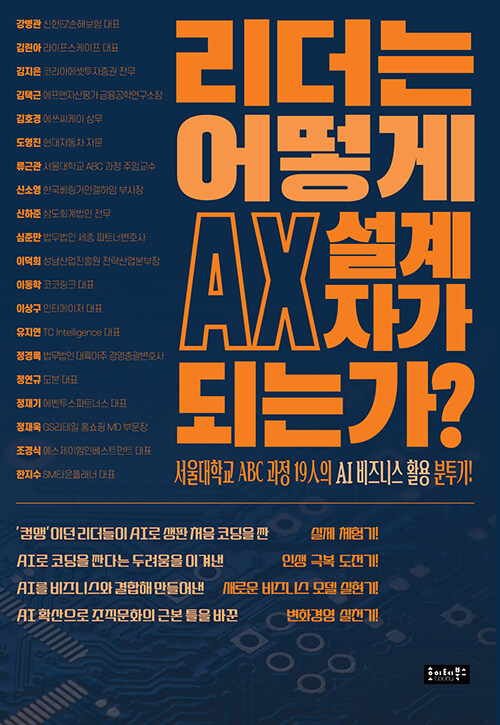 사진 확대
To do so, I have to admit that I don't know in front of AI. Han Ji-soo, CEO of SM Town Planner, said "Unlearning" is necessary. It is to deliberately discard existing knowledge and success equations. He also put down stereotypes such as "ideas are executed after sufficient review," so he was able to continue the project despite "the fact that I don't know coding" and "the fact that the company doesn't have a developer."
Solo's paradox was not a better computer. They were managers who changed the way they worked. The key to solving the AI paradox is also not in the state-of-the-art server room. The leader must grab the mouse and jump into AI with his whole body to find the key.
[Kim Insoo Editorial Writer]