
"I introduced AI, but why didn't it come true?"Kolon Benite Suggests 6-Step AX Solution
About 500 customers and partners
Representative Kang Yi-gu "Re-engineering work under the premise of AI"
A six-step methodology from project selection to operation
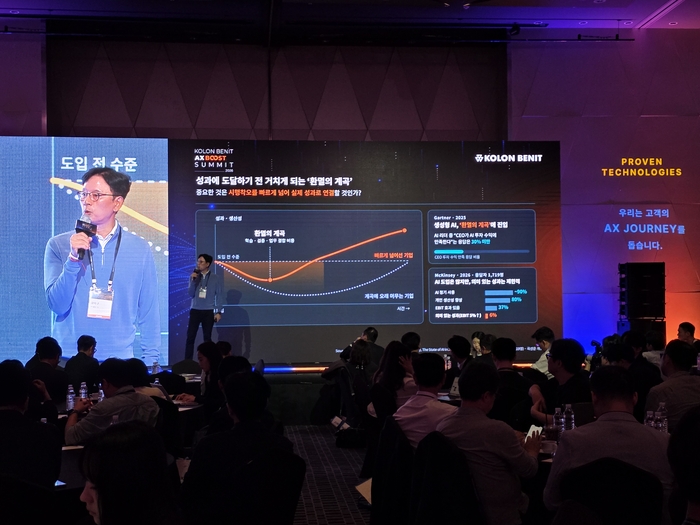 사진 확대
While companies are scrambling to introduce artificial intelligence (AI), Kolon Benet has launched a strategy to focus on AI transformation (AX) that changes actual work and financial performance, away from introducing technology. The plan is to connect companies' AI investment to actual performance through a six-step methodology that extends from the stage of selecting AI application tasks to redesigning tasks, measuring performance, and operating them.
On the 13th, Kolon Benite held the "AX BOOST SUMMIT 2026" at Seoul Dragon City in Yongsan-gu, Seoul, attended by more than 500 customers and partners. The event, which marks its second anniversary this year, shared strategies and industry-specific examples to link companies' AI introduction to actual business performance under the theme of "Customer's AX Journey."
Kang I-gu, CEO of Kolon Benite, stressed that the introduction of AI itself does not guarantee productivity improvement. This is because there may be less productive sections in the process of learning new technologies, verifying results and applying them to existing tasks.
CEO Kang said, "There is a limit to adding AI to the existing work method," adding, "Practical results can be achieved only when process re-engineering and organizational changes are accompanied by AI."
He also emphasized the need to re-establish the boundaries between AI and the tasks that people will be in charge of. While there are areas where AI can greatly increase efficiency, such as data analysis or report writing, it is explained that human roles are still needed in the process of grasping the work context and making final decisions.
 사진 확대
CEO Kang said, "The most important thing in the AI era is the knowledge of the business domain of companies and the know-how to discover and apply the most suitable technologies for our industry among the numerous technologies scattered." "It is our task now to make AI introduction lead to practical financial performance such as sales and profits of companies beyond simply increasing the work efficiency of support organizations," he stressed.
To this end, Kolon Benite plans to combine solutions from global IT companies and technologies from more than 100 AI alliance participants with industry-specific business experiences. If AX enabler (Enabler) who supports AX of customer companies was put forward last year, it will expand its business scope by supporting the entire process from finding AI tasks to generating results.
Jang Jae-yong, head of Kolon Benite's DX division, pointed out the problem that AI demonstration projects cannot lead to actual work in companies. According to the results of the survey introduced by Jang on the same day, the AI utilization rate of Korean companies is 58%, but only 27% of companies have official AI strategies. It was found that 47% had no way to measure the effectiveness of AI investment.
Director Jang compared the situation where only technology verification (PoC) projects that are not connected to actual tasks continue to increase to AI museums. "If there are too many PoCs, the company becomes an AI museum," he said. "The actual AX is to connect system authority, reflect work regulations, and determine operating costs and organizations in charge from after PoC."
As a solution, we selected three to five AI tasks to be applied first, and then presented a six-stage AX methodology that leads to infrastructure configuration, work redesign, organizational change, performance measurement, and operation. Depending on the size of the company, the investment starts small, but the entire structure is designed to be expanded in the future.
Kolon Group's AX is also in progress. CEO Kang said, "Kolon Group has formed an AX TF within the holding company to focus on quickly introducing AI by all affiliates and creating practical management results such as productivity improvement and cost reduction."
At the event, 17 sessions were also held on how to apply AI to corporate tasks such as data analysis and manufacturing and enterprise resource management (ERP). Kolon Benite also introduced AI diagnosis, "AXeed" that supports the connection of specialized companies and review of government support projects, and autonomous manufacturing solutions.
Kim Dae-sik, a professor at the Korea Advanced Institute of Science and Technology (KAIST), who gave a special lecture, predicted that even if AI spreads, it will not completely replace software as a service (SaaS). This is because the trust accumulated by existing SaaS companies, work understanding, and relationship with companies are related. However, he stressed that in order to survive in the AI era, it is necessary to have differentiated solutions and competitiveness.
It also stressed that companies should pay attention to "business-AI agent-to-business (B2A) transactions" beyond corporate-to-consumer transactions (B2C) and corporate-to-business transactions (B2B) dealing with consumers or other companies. B2A refers to a market where AI agents search and select information on behalf of individuals instead of searching and comparing goods and services directly.
Professor Kim predicted that if AI agents become the first contact point for consumers, companies' product development and marketing methods could also change. It is explained that it can be important not only to inform and select products to people, but also to make AI able to accurately grasp information about companies and products.