AI Agents Excel in Shopping, Struggle With Reservations

“Find a restaurant within a 10-minute walk from Jeongja Station at 7 p.m. on October 17. For 2 people, under 30,000 Korean won per person.”
When asked to find a restaurant, Meta’s personal AI agent ‘Muse’ first notified that the request overlapped with existing schedules, checking the connected calendar. In response to the same query, Naver recommended two restaurants and linked to a reservation screen. Kakao’s ‘Kanana in KakaoTalk’ recommended a restaurant 17 minutes away on foot.
The competition among AI agents that go beyond answering questions to handle searches, reservations, and purchases is intensifying. Following OpenAI’s ‘Dot,’ Google also unveiled its enterprise-focused ‘Gemini Agent’ on the 8th. Domestically, Naver has successively launched AI agent services specialized in shopping, search, and location recommendations this year, while Kakao operates ‘ChatGPT for Kakao’ and ‘Kanana in KakaoTalk,’ which suggests necessary information based on conversations. To assess how well these agents perform tasks, Muse, Naver, and Kakao were tasked with three challenges: restaurant reservations, gift purchases, and planning outings.
◇Checked schedule but recommended a closed restaurant
In restaurant reservations, differences emerged between meeting search conditions and completing actual bookings. After alerting about schedule overlaps, Muse suggested four restaurants. However, one of the options was a closed business, as it relied solely on visit reviews without franchise data. It also guided users to provide CatchTable account information for reservations but later reported an error halting the process.
Naver Place Agent recommended a Korean restaurant and a meat-focused eatery. However, it did not explain the reasoning behind the recommendations, making it difficult to decide based solely on the two options. Separately, ‘ChatGPT for Kakao’ was also queried. While it linked to a reservation screen, it noted that it could not confirm distance, budget, or reservation availability.
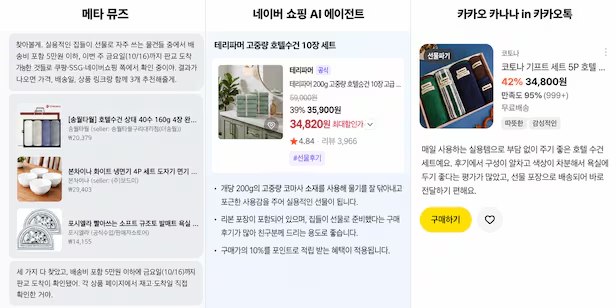
In gift purchases, the strengths of domestic platforms’ accumulated product and delivery information became apparent. When asked for a practical housewarming gift under 50,000 Korean won including shipping, deliverable to Pangyo by Friday, Naver Shopping AI Agent displayed estimated arrival dates based on registered addresses and summarized purchase reviews for each product. Kanana also presented Kakao Gift recommendations, reasons, and reviews, simplifying the selection process. It even allowed users to proceed to the gift-giving step, where they could choose the recipient and payment method.
Muse selected products from SSG.com, suggesting towel sets, tableware, and placemats. While it logically explained reasons like “a staple housewarming gift,” it was less detailed in reviews compared to Naver and Kakao. It calculated total costs including shipping and coupon conditions but stalled three times during the order entry phase, failing to proceed to payment.
◇Asked for a Seoul date course but connected to a Bundang restaurant
Differences were stark in planning itineraries requiring multiple conditions. The task was to create a course in Seoul for two people to view an exhibition and have dinner, totaling under 100,000 Korean won and finishing by 6 p.m. This required balancing venue fees, meal costs, travel time, and operating hours.
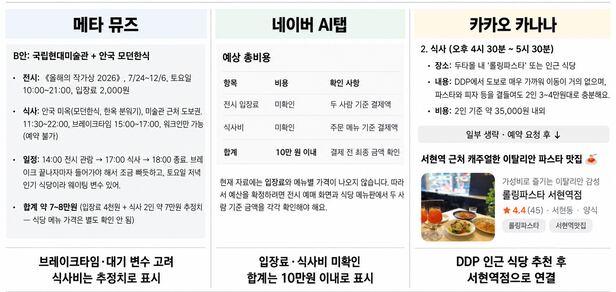
Muse calculated exhibition and meal costs, distinguishing between discounted and regular prices. For alternative courses, it noted that a restaurant’s break time ended at 5 p.m., making it tight to finish by 6 p.m., and highlighted potential wait times as a variable. It did not merely list recommendations but evaluated whether the course was realistically feasible within the timeframe.
Naver AI Tab marked entrance and meal fees as “unconfirmed” in follow-up questions but stated the total was “under 100,000 Korean won.” It scheduled the exhibition to end at 5 p.m. and dinner to start at the same time, omitting travel time. Kanana recommended an exhibition at Seoul’s Dongdaemun Design Plaza (DDP) and a nearby restaurant but, when asked to reserve, linked to a branch in Seohyeon Station, Bundang.
Ultimately, the competition will hinge on whether consumers prefer services emphasizing AI’s task-processing capabilities or platforms with product and reservation data. Muse proactively managed the reporter’s event notifications and related coverage without specific instructions but failed to complete domestic product orders and restaurant reservations, functioning as a “halfway” assistant. This underscores the importance of integrating AI capabilities with existing platforms. As one industry insider explained, “Domestic companies must strategize fiercely on whether to collaborate with or block existing agents.”