
Anthropic’s Run-Rate Hit $81B; October Added 2.2x 2025 Sales
Anthropic reported that its annualized revenue run rate was about $81 billion on 31 October 2026. This was $10 billion more than on 30 September, according to the second amendment to its IPO prospectus, filed with the SEC on 10 November. The first amendment, filed on 2 November, did not include this number.
Based on our calculations, the $10 billion increase in October alone was about 2.2 times Anthropic's total revenue for all of 2025, which was $4,585 million. These numbers measure different things. Run-rate is a yearly estimate based on a recent period, while the 2025 figure is the revenue Anthropic actually recorded during that year.
Business Pill · Run-Rate Revenue
A one-minute video explaining run-rate revenue, the measure used in this report. It explains the general idea and does not discuss Anthropic.
The main point: Anthropic's run-rate revenue was about $81 billion on 31 October, $10 billion higher than on 30 September, according to its updated prospectus. Based on our calculations, the increase in October alone was about 2.2 times the company's total revenue of $4,585 million in 2025.
What the Filing Says
The filing states: “our Run-Rate Revenue was approximately $81 billion as of October 31, 2026, up $10 billion from September 30, 2026”. It does not directly state the figure for 30 September. Based on our subtraction, that figure was about $71 billion. This means the run-rate increased by about 14% in October.
Anthropic calculates run-rate in two parts. First, it takes the fees customers paid based on how much they used its services during the previous 28 days and multiplies that amount by 13. Second, it takes its total monthly subscription fees and multiplies them by 12. The filing does not say how much of the $81 billion comes from each part.
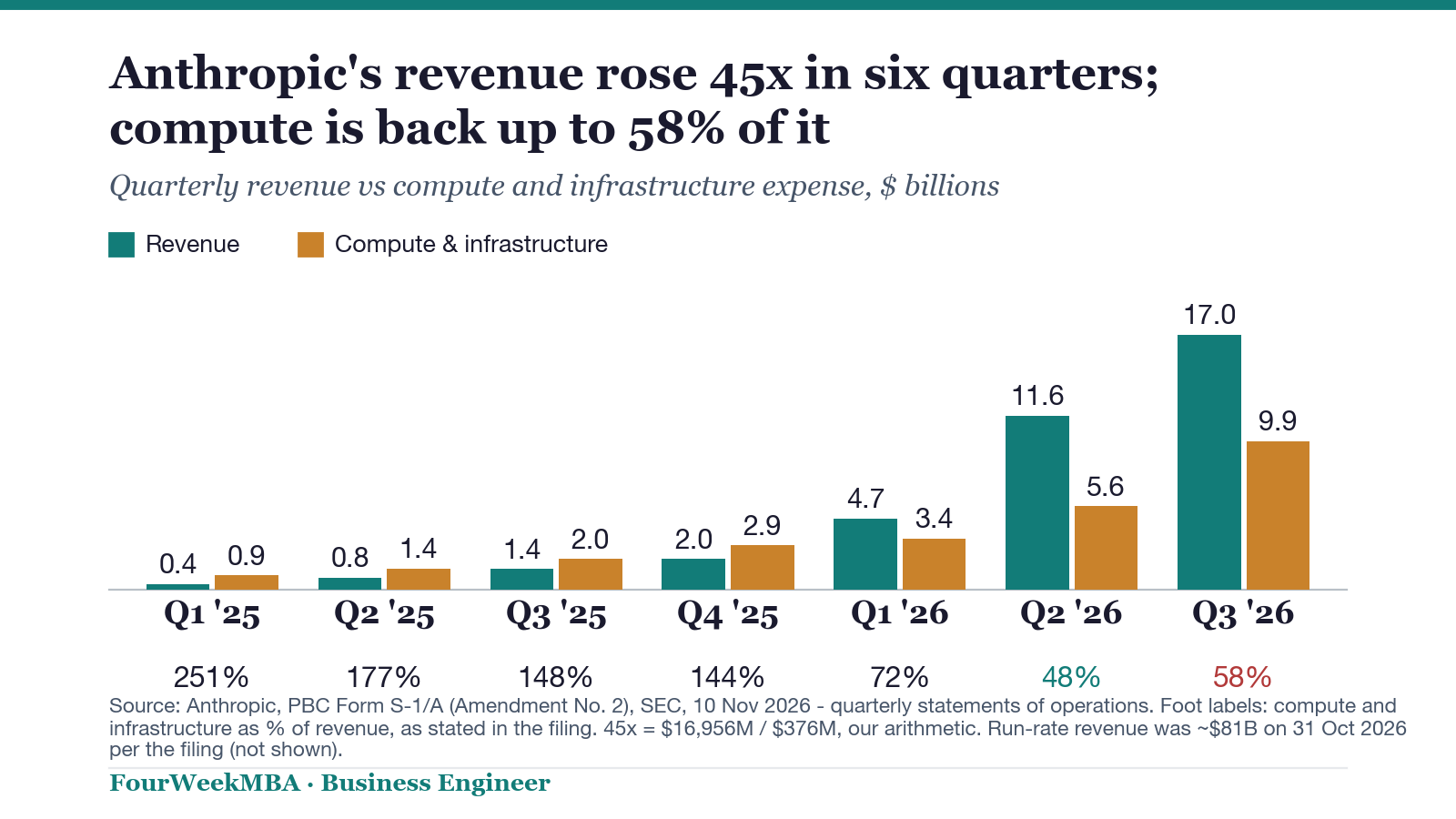
The same filing reports that third-quarter revenue was $16,956 million, an increase of 1,127% compared with the same quarter a year earlier. This was 47% higher than the second quarter's $11,555 million. Based on our calculations, it was also about 45 times the $376 million recorded in the first quarter of 2025.
What $81 Billion Means Per Day
Anthropic earned about $184 million per day in the third quarter, based on its $16,956 million in revenue over 92 days. This is our calculation. If the $81 billion run-rate is spread across 365 days, it equals about $222 million per day, which is roughly 20% higher. Another way to look at it is that the $81 billion run-rate is about 19% higher than four times the third-quarter revenue, which would be $67.8 billion.
The October increase was also close to the growth rate seen during the third quarter. Revenue growth of 47% over three months works out to about 13.7% per month when compounded, based on our calculations. This is close to the roughly 14% increase in run-rate during October. However, these are different measures, so the comparison is only a general guide.
On 6 November, The Wall Street Journal reported, citing a person familiar with the matter, that Anthropic's run rate had passed $80 billion by the end of October. The new filing now gives the figure as approximately $81 billion.
The Warnings in Anthropic's Own Words
The prospectus says that run-rate “is not a substitute for revenue prepared in accordance with GAAP or a forecast of revenue”. In other words, it is not the same as officially reported revenue and should not be treated as a prediction of future revenue. The company also warns that figures measured during holiday periods may change. It says that “we expect our Run-Rate Revenue growth rate to decline over time”.
Anthropic also says that its run-rate “has included, and we expect will continue to include, amounts from customers that we subsequently determine are using our models, platform, and applications in violation of our usage policy or commercial terms”. This means the figure includes some money from customers that the company later discovers have broken its rules or business agreements. The filing does not say how much money this represents.
The Costs in the Same Quarter
Anthropic spent $9,863 million on computing and infrastructure in the third quarter. This was 58% of its revenue, up from 48% in the second quarter, according to the filing. However, this share was still much lower than the 148% recorded a year earlier. The filing says the increase happened because Anthropic added more computing capacity. This included $5.0 billion in computing capacity under short-term agreements, which “currently costs significantly more” than capacity purchased through agreements lasting several years.
Between the second and third quarters, revenue increased by $5,401 million, while computing costs increased by $4,305 million. Based on our calculations, Anthropic spent about 80 cents more on computing for every additional dollar of revenue. One quarter earlier, the figure was about 32 cents. Anthropic also went from operating income of $974 million in the second quarter to an operating loss of $567 million in the third quarter. Our earlier report examined how research and development spending compares with the cost of running Claude.
Anthropic says it has purchase agreements and leases with total spending commitments of about $900.9 billion. Of this amount, about $70.7 billion must be paid during the 12 months after 30 September. Based on our calculations, that is about 87% of the $81 billion run-rate.
The Customers Behind the Number
The filing says Anthropic had more than 11,900 customers who each generated at least $100,000 in revenue during the previous 12 months. One year earlier, there were more than 950 such customers. The filing also reports a Net Revenue Retention rate of approximately 900%. These larger customers generated 74% of Anthropic's revenue during the 12 months ending on 30 September. The remaining 26% came from about 40 million smaller customers.
Where It Fits Into the IPO
The same prospectus amendment estimates an IPO price of between $70 and $78 per share, for an offering of 825 million shares. Our other IPO reports also examine the number of shares, Anthropic's own calculations of its stock option values, the $26 billion share placement for suppliers, the registered amount, the withdrawn IPO minimum price and the withdrawn price range. A broader view is available in our IPO overview and our Anthropic revenue data page.
The Bigger Picture
Our reading of the filing points to two things happening at the same time. Revenue continued to grow in October at roughly the same monthly rate as in the third quarter, based on our calculations. But during the third quarter, computing costs took up a larger share of each additional dollar of revenue.
The warnings in Anthropic's filing also point to two limits of the $81 billion figure. It is a yearly estimate based on a recent 28-day period, and it includes some revenue from customers later found to have broken the company's usage rules. The filing does not say how much of the total came from these customers.
Anthropic, Form S-1/A, 10 November 2026
“we expect our Run-Rate Revenue growth rate to decline over time”
Three Things to Understand
FOR IPO BUYERS The prospectus gives the run-rate for one specific date, 31 October. It also says this number is not a prediction of future revenue. The filing does not provide guidance for the fourth quarter.
FOR COMPUTING COSTS The filing says computing costs were 58% of revenue in the third quarter, up from 48%. This includes $5.0 billion in short-term computing agreements, which cost more than agreements covering several years.
FOR FUTURE PAYMENTS Anthropic has $70.7 billion in spending commitments due during the next 12 months. Based on our calculations, this equals about 87% of its $81 billion run-rate.
The Business Engineer View
This story connects with the Business Engineer framework called The State of the Inference Economy.
The framework explains: “Inference is a revenue engine: continuous, distributed across millions of applications and agents, incurring marginal cost with every query.” In simpler terms, AI services can generate revenue continuously through many applications and automated tools, but each request also creates an additional cost.
In our view, Anthropic's third-quarter accounts show this additional cost clearly. For every extra dollar of revenue, the company spent about 80 cents more on computing. This is based on our calculations. One quarter earlier, the figure was about 32 cents. The framework was published before this filing and does not discuss Anthropic's figures.
What the Filing Does Not Prove
The filing does not explain how much of the $81 billion comes from customer usage fees and how much comes from subscriptions. It does not provide a run-rate figure for any date after 31 October, October's official GAAP revenue, or guidance for the fourth quarter. The figure of about $71 billion for 30 September comes from our subtraction, not from a number directly stated by Anthropic. The filing also does not say what share of the run-rate came from customers later found to have broken its usage rules.
The Bottom Line
Anthropic's second amendment to its prospectus reports that its run-rate revenue was about $81 billion on 31 October, an increase of $10 billion in one month. Based on our calculations, that October increase was about 2.2 times the company's total revenue for 2025. At the same time, computing costs rose from 48% of revenue in the second quarter to 58% in the third quarter.
A note about the sources. The run-rate figure, its definition and warnings, quarterly revenue and computing costs, customer numbers and spending commitments all come from Anthropic's Form S-1/A, Amendment No. 2, filed with the SEC on 10 November 2026. Amendment No. 1, filed on 2 November, did not include the run-rate figure. Ratios, daily figures and the estimated run-rate for 30 September are our own calculations. Anthropic was not contacted for this report.
Sources: Anthropic, PBC Form S-1/A, Amendment No. 2, SEC, 10 Nov 2026 · Anthropic, PBC Form S-1/A, Amendment No. 1, SEC, 2 Nov 2026