
In the age of AX acceleration, cyber risk is the language of 'management' rather than 'technology'
"Management should directly manage financial perspectives"
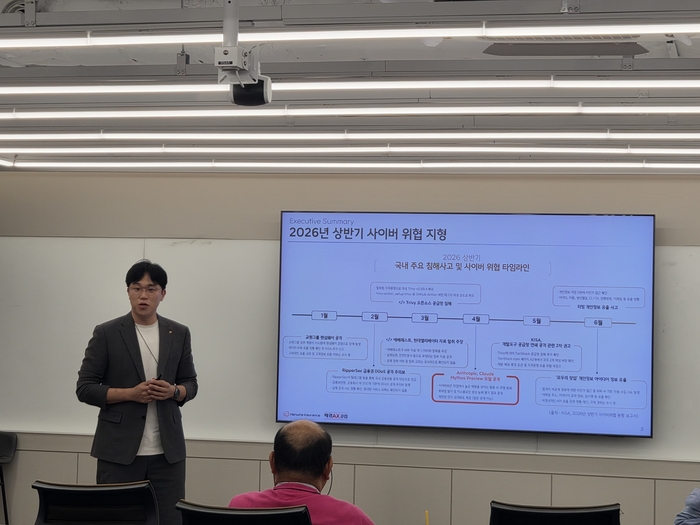 사진 확대
As the speed of artificial intelligence (AI) transformation (AX) is accelerating, the surface of cyber threats to companies is rapidly expanding, and it has been suggested that management should directly manage cyber risks from a financial perspective beyond simple technical security.
Kwon Taek-in, head of Hanwha Insurance's cyber insurance department, said, "Cyber risk is no longer a 'matter of technology' but a 'matter of management'," emphasizing, "It is technology that prevents it, but recovery is the realm of management."
According to the Korea Internet & Security Agency's (KISA) report on cyber threat trends in the first half of 2026, the number of reported infringement incidents continues to increase, and the types of attacks such as server hacking (47%), DDoS (23%), and ransomware (11%) are also diversifying.
In particular, in the recent series of hacking incidents in the financial sector, AI automation attacks changed IP and hit multiple financial companies at the same time. Instead of a solid "front door," the attackers leaked about 70,000 customer information by digging into the "side door" caused by negligence in management, such as information inquiry services missing self-authentication, a system for supporting employees with insufficient control of terminals and authority, and homepages without patches.
Most companies invest tens of billions of won in security budgets every year, but "management of gaps" is the winning point rather than the size of the investment.
Major banks that invest 30 billion won to 40 billion won annually failed to prevent information leakage through lax external contacts.
In the event of a cyber infringement accident, the financial loss accompanying it is enormous. The combined cost of digital forensics and consulting, regulatory agency fines (such as pending bills of up to 3% of sales), consumer class action and liability for damages, and operating losses resulting from the departure of new customers will soar to a level that could threaten corporate survival.
Experts suggested the following eight implementation tasks for management to effectively control cyber risks.
They include the introduction of multiple authentication (MFA) to all external contacts, the completion of patches within 60 days of high-risk vulnerabilities, the reconfirmation through separate channels when instructing remittance and trading, the management of penetration recognition time as key indicators, securing legal, forensics, and public relations response systems in advance, training to build and recover offline backups, and estimating losses assuming the worst-case scenario.
Director Kwon said, "AI is not a world where only excellent hackers can attack by lowering the unit price of attacks," and emphasized, "OT security is the key in the manufacturing industry."
At the same time, the CEOs of manufacturers advised that when the factory stops, the expected loss should be assumed and the security of their partners should be reviewed. In fact, Samsung Electronics is known to receive security ratings from 3,000 suppliers every day.
Kwon also pointed out that the leakage of information by public institutions in Korea is becoming commonplace, adding that alarm is urgently needed.
Therefore, Kwon said, "Since cyber risks cannot be completely eliminated, financial risks must be managed by properly combining self-ownership, cyber insurance subscription, and transfer of responsibility through contracts," and added, "It is essential that management lead regular mock training and clear governance."
Reporter Lee Sang-gyu