
Deezer/Ipsos: 80 % of people agree that all AI music should be labeled, both fully AI-generated tracks and AI-assisted creations
- Many people are still worried about AI music. 67% fear that AI could reduce creativity in music production. 69% believe that music made entirely by AI threatens the jobs and income of current and future artists.
- 72% of music streaming users want to know when their platform recommends music made entirely by AI. Also, 60% believe that fully AI-generated songs should not appear in major music charts alongside songs made by humans.
- 74% of music streaming users do not think their playlists contain music made entirely by AI. However, 57% actually have at least one such track in their playlists,1according to Deezer's internal data about new subscribers who joined from other platforms.
Paris, November 17, 2026 – Deezer, a global music streaming platform, has announced the second edition of its yearly international survey about people's views and feelings about music made with AI. Ipsos carried out the survey. It asked 9,000 people in eight countries: the United States, Canada, Brazil, the UK, France, the Netherlands, Germany and Japan.
Alexis Lanternier, CEO of Deezer, said: “This year's survey clearly shows that most people still want to know when music is made with AI. It also shows a big difference between what listeners think is in their playlists and what is really there. This means we need to keep helping music streaming users understand what they are listening to. More people are worried that AI could harm creativity and artistic work, especially in the United States. Views there have changed sharply since last year. In every country we surveyed, most people also believe that music made entirely by AI threatens artists' ability to earn a living.
In 2025, Deezer became the first streaming service to introduce steps to give listeners clearer information and reduce AI-related fraud and the loss of music industry income. This yearly survey helps us understand the issue better. By listening to our users and people across the music industry, we can improve the listening experience and protect artists and songwriters. There is a lot at stake, but we will keep working to support a healthy music industry and reduce the harmful effects of generative AI.”
Almost three out of four music streaming users (74%) thought their playlists did not contain any music made entirely by AI. However, Deezer's internal data shows that more than half of new subscribers coming from other streaming services already had music made entirely by AI in their libraries. Nearly 57% of more than 53,000 people who joined Deezer in October already had at least one fully AI-generated track in their playlists. Overall, 80% of people agree that listeners should be clearly told when music is either made entirely by AI or created with help from AI.
Attitudes differ between countries. The United States stands out because concern about AI in music has grown considerably. For every question about general views on AI in music, people in the US gave more negative answers in 2026 than in 2025. For example, 69% believe AI will reduce creativity in music production, an increase of 4 percentage points from 2025. 51% believe AI will play a major role in creating music, a decrease of 11 percentage points from 2025. And 37% believe AI is a useful tool for musicians, artists and composers who create music, a decrease of 17 percentage points from 2025.
France is the country where people most want clear information about AI music. 88% of people surveyed want clear labels on music made entirely by AI. This rises to 90% for music made with AI assistance.2 People in France are also the most worried that AI could reduce creativity in music. 76% agree with this concern, an increase of 6 percentage points compared with 2025.
As they did last year, people in Brazil are much more positive about AI music than people in the other countries surveyed. For example, 61% agree that AI could be a useful tool for creating music, compared with 35% across all countries. Brazil also has the highest share of people who believe they have heard music made entirely by AI at least once: 63%, compared with 46% in 2025.
Japan has the lowest reported exposure to fully AI-generated music. There, 46% of people, down 6 percentage points from 2025, say they have never listened to music made entirely by AI. Across all the countries surveyed, the figure is 32%, down 7 percentage points from 2025.
Deezer has been working to make AI-generated music easier to identify and to reduce the harm caused by large amounts of AI-generated content appearing on streaming services. In 2025, it became the first platform to detect and label AI-generated music and remove it from recommendations made by its algorithms.
What are the main findings of the Deezer and Ipsos survey about AI music?
MAIN SURVEY RESULTS
Unless a result specifically mentions “music streaming users” (6,672 people), the figures below refer to all 9,000 people surveyed. If a change from the previous year is not mentioned, the result is either stable or the difference from 2025 is not large enough to be considered statistically meaningful.
How do people use AI, and what do they think about it?
General views and use of AI
- 99% of people have heard of AI, and 84% have used it at least a few times. This is an increase of 12 percentage points compared with 2025.
- 25% use AI every day, an increase of 7 percentage points from 2025. Nearly half use it at least once a week (49%), an increase of 13 percentage points.
- Curiosity is still the most common feeling about AI, reported by 55% of people. Only 17% say they trust AI, down 2 percentage points from 2025.
How could AI change the future of music creation?
Creating music with AI
- 50% believe AI will play an important part in creating music over the next 10 years.
- 54% believe AI will lead to more low-quality, similar-sounding music on streaming platforms. This is an increase of 3 percentage points from 2025.
- 67% believe AI could reduce creativity in music production. This is an increase of 3 percentage points from 2025.
- 54% say it would be unacceptable for their favorite artist to make an entire track with very little human involvement.3
- 45% say it is acceptable for their favorite artist to use AI to produce, mix or finish music tracks.4
How do listeners recognize and listen to AI-generated music?
Recognizing and listening to music made by AI
- 61% of music streaming users say they would listen to music made entirely by AI at least once out of curiosity. This is down 5 percentage points from 2025.
- 41% of music streaming users would like to be able to filter out music made entirely by AI on their streaming platform.
- 43% say they would skip music made entirely by AI without listening if they came across it. This is an increase of 3 percentage points from 2025.
- 43% believe AI can help them discover more music they enjoy. This is down 3 percentage points from 2025.
- 43% believe AI can help them personalize or remix music. This is down 3 percentage points from 2025.
Why do listeners want clearer labels on AI music?
The need for clear information
- 80% agree that listeners should be clearly told when music is made entirely by AI or created with help from AI.
- 72% of music streaming users want to know when their streaming service recommends music made entirely by AI.
- 60% believe songs made entirely by AI should not appear in major music charts alongside songs made by humans. This is an increase of 8 percentage points from 2025.
- Only 7% believe music made entirely by AI should be treated equally in music charts. This is down 4 percentage points from 2025.
- 54% of music streaming users believe their streaming platform has never recommended music made entirely by AI to them. This is down 4 percentage points from 2025. Another 28% are unsure, an increase of 3 percentage points.
How does AI music affect fairness for artists?
Fair treatment of artists
- 66% agree that copyrighted material should not be used to train AI models that create music.
- 69% believe music made entirely by AI threatens the ability of current and future musicians, artists and composers to earn a living.
- 73% think it is wrong for AI companies to use copyrighted material to create new music without clear permission from the original artist.
- 67% believe payments for music made entirely by AI should be lower than payments for music made by humans. This is down 2 percentage points from 2025.
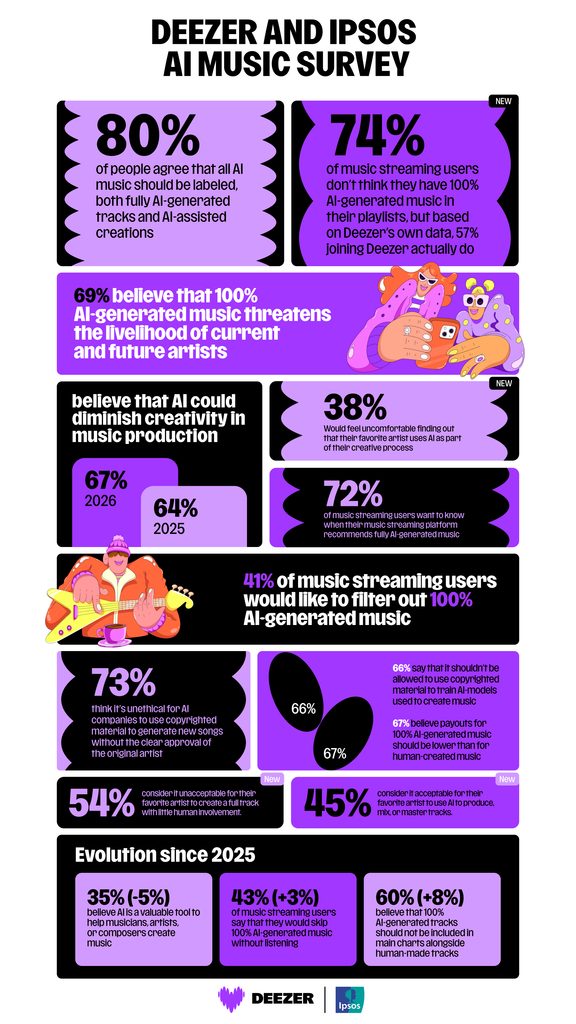
You can download the full scorecards from Deezer's second yearly AI and Music Barometer below:
*** END ***
Notes for editors:
AI tracks are removed from Deezer recommendations – Songs identified as AI-generated are automatically removed from recommendations made by Deezer's algorithms. They are also left out of editorial playlists. This helps stop these tracks from taking a significant share of the money set aside for music royalties.
A new option to remove all AI music from the listening experience is coming – Deezer plans to make an on/off switch available before the end of 2026. It will let users exclude AI-generated music when searching for songs, so they can focus on discovering music made by people.
Deezer's AI music detection tool has set a standard for the industry. It can identify AI-generated music made using major generative AI tools, including Suno and Udio. It may also be possible to add detection for almost any other similar tool, as long as examples of its output are available. The tool has won several awards, including TIME's Best Invention of the Year 2026 and Billboard France's Innovation of the Year 2026. It also helped Deezer earn a place on Fast Company's Most Innovative Companies of the Year 2025 list and Newsweek's Most Trustworthy Companies of the Year 2025 list.
Two new patents – In December 2024, Deezer applied for two patents for its AI detection technology. They cover two different ways of finding unique signs that help tell AI-made content apart from authentic content. The European Union and United States patent offices published the patents in June 2026.
Deezer receives nearly 90,000 tracks made entirely by AI every day. On the busiest days, these tracks make up more than 50% of all the music delivered to the platform. Deezer has used its AI detection tool since the start of 2025, allowing the company to follow the steady growth of fully AI-generated music. In June, Deezer became the first and, so far, only music streaming platform to clearly label AI-generated music. More than 13.4 million AI-generated tracks were detected and labeled on Deezer in 2025.
Deezer now licenses its AI detection technology to other companies in the music industry. This gives them a way to improve transparency and reduce the rewards for AI music fraud. For more information, visit https://business.deezer.com/ai-detection/.
AI and fraud – Fully AI-generated music currently makes up only a small share of all streams on Deezer, between 1% and 3%. However, Deezer says that most of the reason these tracks are uploaded to streaming services is to commit fraud. In 2025, Deezer found that up to 85% of streams from tracks made entirely by AI were fraudulent. When Deezer finds any kind of fake listening activity, it leaves those streams out of royalty payments.
AI is a major challenge for the music industry – A study by CISAC and PMP Strategy, which included several important industry companies such as Deezer, found that nearly 25% of creators' income could be at risk by 2028. This could add up to as much as €4 billion by that year. This is a very serious challenge for the entire music creation industry. https://www.cisac.org/services/reports-and-research/cisacpmp-strategy-ai-study
FAQ: What should listeners know about music made with AI?
Figures updated to include Deezer data from July 2026.
What does the Deezer and Ipsos survey say about labels for AI music?
The survey found that 80% of people agree that listeners should be clearly told when music is made entirely by AI or created with help from AI.
How many music streaming users want to know when a platform recommends music made entirely by AI?
72% of music streaming users want to know when their streaming service recommends music made entirely by AI.
Do listeners know if their playlists already contain AI-generated music?
No. Although 74% of music streaming users do not think their playlists contain music made entirely by AI, Deezer's internal data tells a different story. Nearly 57% of more than 53,000 people who joined Deezer in October already had at least one fully AI-generated track in their playlists.
Should music made entirely by AI appear in major charts alongside music made by people?
Most people do not think it should. 60% believe songs made entirely by AI should not appear in major charts alongside songs made by humans. Only 7% believe fully AI-generated music should be treated equally in the charts.
How much music made entirely by AI does Deezer receive?
Deezer receives nearly 90,000 fully AI-generated tracks every day. On the busiest days, this is more than 50% of all the music delivered to the platform. In 2025, Deezer detected and labeled more than 13.4 million AI-generated tracks.
What happens to AI-generated tracks that Deezer detects?
Songs identified as AI-generated are automatically removed from algorithm-based recommendations and are not added to editorial playlists. Deezer also leaves fake streams out of royalty payments. Before the end of 2026, the company plans to offer an on/off switch that lets users remove AI-generated content from their listening experience.
How much of the music listened to on Deezer is made entirely by AI?
Music made entirely by AI accounts for between 1% and 3% of all streams on Deezer. In 2025, Deezer identified up to 85% of streams from fully AI-generated tracks as fraudulent.
Deezer Press Contact
Jesper Wendel
[email protected]
ABOUT DEEZER
Deezer is a leading independent music platform that creates new ways for people to enjoy music. Founded in Paris in 2007, Deezer is available in 180 countries. It has a team of 530 people working across France, Germany, the UK, Brazil and the United States. They share a passion for music, technology and new ideas.
Deezer offers a large music collection, lossless HiFi sound and special features that help people discover music, enjoy it and make it more personal. Its goal is to help music thrive. The company wants to build a music industry that can support itself over time. It has also been a pioneer in labeling AI-generated music and creating a new payment system that gives artists and songwriters better rewards.
Deezer also works with major brands through Deezer for Business. These partnerships help the company reach more people and create value for brands and users in industries such as telecommunications, media, audio equipment and retail.
Deezer is listed on Euronext Paris (Ticker: DEEZR. ISIN: FR001400AYG6).
For the latest news, visit https://newsroom-deezer.com/
For Investor Relations, visit https://www.deezer-investors.com/
Follow DeezerNews on X and Deezer on LinkedIn for the latest updates.
Deezer – Live the music
ABOUT IPSOS
Ipsos is one of the world's largest market research companies. It operates in 90 markets and employs nearly 20,000 people. Its research experts, analysts and scientists are curious and passionate about understanding people. They study the actions, opinions and reasons behind the choices of citizens, consumers, patients, customers and employees. Ipsos offers 75 research solutions based on surveys, social media monitoring, interviews and observations. Its slogan, “Game Changers,” describes its goal of helping its 5,000 clients understand and respond confidently to a world that is changing quickly. Ipsos was founded in France in 1975 and has been listed on Euronext Paris since July 1, 1999. The company is part of the SBF 120 and Mid-60 stock market indices and is eligible for the Deferred Settlement Service (SRD). ISIN code FR0000073298, Reuters ISOS.PA, Bloomberg IPS:FP