Inside Hellbender, the Pittsburgh startup building physical AI hardware to rival overseas manufacturing
As more startups build devices that can run AI models using their own built-in computers, a technology sometimes called “edge AI,” Hellbender’s Brett Phillips believes this will soon become normal.
“I think eventually it’ll get to the point where we drop saying, ‘Hey, this is physical AI,’” Phillips told Adam Conner, host of the web series Proof Points. “Whether it’s the warehouse inventory tracking drone, or whether it’s the sports camera or whether it’s the stethoscope — eventually, you’ll get to the point where we don’t even care about the fact that it’s physical AI. We care more about the function.”
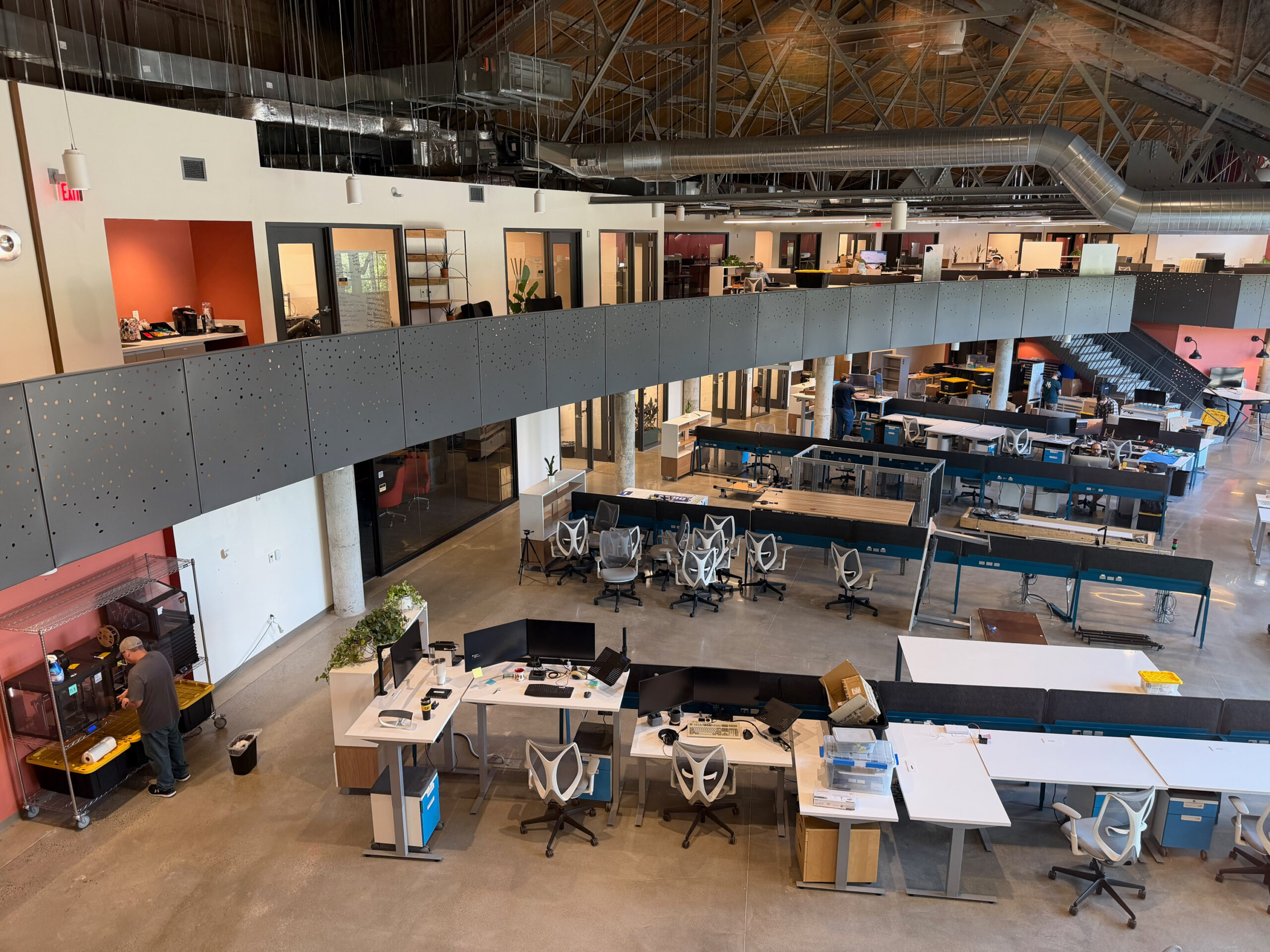
Phillips is the chief revenue officer of the Pittsburgh hardware company, which raised $12.5 million in funding earlier this year. The company works out of the Roundhouse and Mill 19, buildings at a former steel mill site called Hazelwood Green. It designs and makes devices such as mobile robots, medical testing tools and livestream cameras. These devices can work on their own without an internet or mobile phone connection.
“The whole concept of physical AI is really the next evolution of AI.”
Brett Phillips, Hellbender
“Basically, the whole concept of physical AI is really the next evolution of AI,” Phillips said. “And really it’s in direct opposition to the traditional way you use AI, which is entirely based upon the cloud.”
The startup is a strong example of what local leaders have been trying to show: Pittsburgh can combine its long history of industrial work with its current skills in robotics. Together, these strengths could help the city keep and grow important technology manufacturing as AI continues to expand.
Many hardware companies depend heavily on supply chains in other countries, especially in Asia, to keep the cost of workers and parts low. Often, one company designs a product while another company makes it. Hellbender is trying to show that both design and manufacturing can happen in the United States without depending on foreign companies.
Achieving independence from China
To make its physical AI devices, the company built a modern production space and chose equipment from France, Japan and the United States.
“We wanted to be very cognizant and intentional on picking machinery that came from countries other than China,” Phillips said. “And so every single piece of machine you can see here in this line has no ties to China whatsoever.”
The company follows the same independent approach when choosing the small, complex parts inside its devices.
“We have the highest quality, highest yield, first pass printed circuit board assembly line on the east coast and maybe in the United States right now,” said Hellbender President and CEO Brian Beyer, who also took part in the interview.
Competing with manufacturers in other countries takes creative ideas, especially because the company is proud to pay all its workers enough to make a living.
“We actually developed completely in-house these ‘cobotic work cells’ all based around a single UR 3 kilogram arm, and this is essentially how we compete with China,” Phillips said. “This allows us to augment human labor.”
Phillips explained that these robots can work alongside people. With their help, one worker can manage two different production stations at the same time. As the company grows, it also creates new job training opportunities for local workers. This means it can hire people from the area, not just graduates with advanced degrees from local universities.
“Our strategy there has been to hire some contract talent and convert those that are really good,” said Karen Walter, Hellbender’s vice president of people operations and the third team member in the interview. “Train them for IPC electrical training, and we get them up to speed as soon as possible and we keep typically the cream of the crop.”
Building a local ecosystem flywheel
The company is named after the giant North American salamander. This animal is a sign of clean water. Its numbers once fell so low that it nearly disappeared, but its population is now growing again.
“We think it’s a perfect analogy for Hellbender,” Phillips said. “The manufacturing base here in America came very close to being extinct. Now we’re bringing it back, and Hellbender is really leading that path.”
Working with other local technology companies helps this recovery move faster. For several years, Hellbender has worked with another Pittsburgh startup, Velo AI. Together, they have built several early versions of a smart bicycle camera. Its edge AI software watches nearby traffic and helps cyclists stay aware of what is happening around them. It works like the safety system in a self-driving car.
Projects like these help strengthen Pittsburgh’s wider technology community.
“I think Pittsburgh is uniquely situated to be able to capture this — all these various organizations and entities that really create this rising tide that really help the overall Pittsburgh ecosystem, and you start to get a flywheel function,” Phillips said. “And Hellbender is very fortunate and very thankful to be able to support in the way that we do.”