
80% of people want AI music labeled, says Deezer/Ipsos survey – as 37% of Americans now see AI as a ‘valuable
Some 80% of people in eight countries agree that music made entirely by AI should be clearly labeled for listeners. The same number, 80%, also want music made with help from AI to be clearly labeled.
These are findings from the second yearly study about AI music. Deezer asked Ipsos to carry out the study. The results were published on Tuesday (November 17).
The study also shows that people in the United States have changed their views about AI in music.
Deezer says that US respondents were "significantly more negative" about AI in music in 2026 than they were in 2025. This was true for all the questions about their general views on AI in music.
The share of people who think AI will play a major role in making music over the next 10 years fell from 62% to 51%.
The share who think AI is a useful tool that helps musicians, artists, and composers make music fell from 54% in 2025 to 37% in 2026. This was the biggest drop among all the questions about general attitudes toward AI in the US.
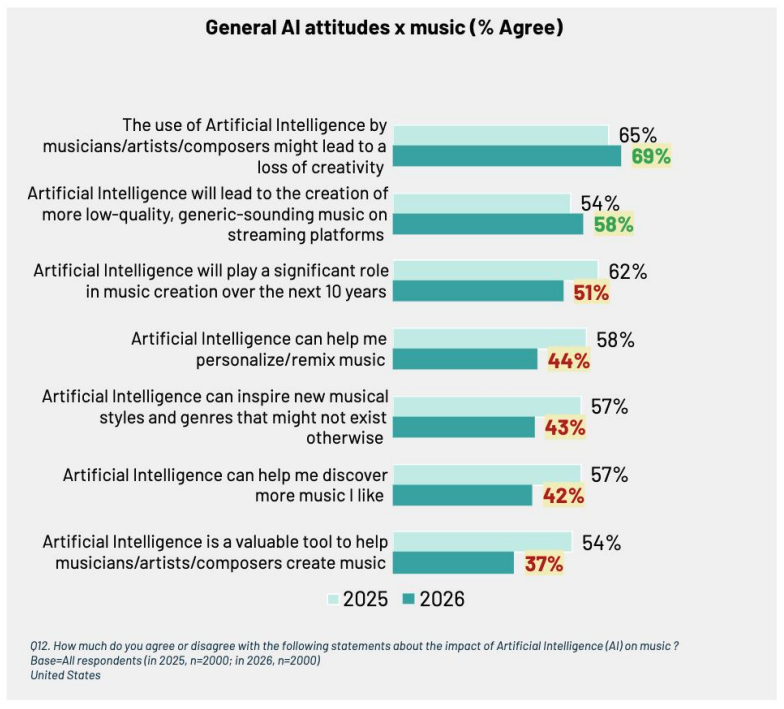
Meanwhile, 69% of people in the US now think that musicians, artists, and composers using AI could lead to less creativity. This is up from 65%.
Among US respondents who had heard of AI, 21% said trust was one of their feelings about the technology. A year earlier, the figure was 32%.
The share of US respondents who said they had listened to music made entirely by AI also fell. It went from 52% to 45%. The US was the only one of the eight countries where this figure went down.
In its summary of the US results, Ipsos said that "people's views have moved from excitement to caution compared with last year."
Ipsos surveyed 9,000 adults online in the US, Canada, Brazil, the UK, France, the Netherlands, Germany, and Japan. The survey took place between October 9 and October 14. There were 1,000 people in each country, except the US, where 2,000 people took part. Of everyone surveyed, 6,672 used music streaming services.
The first version of the study was published in November 2025. It found that 97% of people could not tell the difference between music made entirely by AI and music made by humans in a blind test.
That first study also found that 80% of people wanted music made entirely by AI to be clearly labeled. Asking people about labels for music made with AI help is new to this year's study.
Last year's survey included only adults aged 18 to 65. This year's survey included all adults aged 18 and older.
"This year's survey clearly shows that a large majority of people still want to know when music is made with AI. There is also a big difference between what listeners think is in their playlists and what is really there. This shows why we must keep working to help music streaming users understand what they are listening to," said Alexis Lanternier, CEO of Deezer.
"Worries that AI could harm creativity and artistic work are clearly growing. This is especially true in the United States, where people's views have changed a lot since last year. In every country we surveyed, most people also think that music made entirely by AI is a threat to artists' ability to earn a living.
"Worries that AI could harm creativity and artistic work are clearly growing. This is especially true in the United States, where people's views have changed a lot since last year."
Alexis Lanternier, Deezer
"In 2025, Deezer became the first music streaming service to introduce steps to help fans understand how music is made, prevent cheating with AI, and protect music income from being unfairly reduced. By learning from this yearly survey and listening to feedback from our users and the music industry, we can do a better job for fans and protect artists and songwriters.
"There is a lot at stake, but we will keep doing our part to build a strong music industry and reduce any harmful effects of generative AI."
According to Deezer, 74% of the music streaming users in the survey believed that their playlists contained no music made entirely by AI.
However, Deezer says that nearly 57% of the more than 53,000 people who joined its service in October already had at least one track made entirely by AI in their playlists.
The 57% figure comes from Deezer's own data about new subscribers who moved from other music streaming services. It does not come from the Ipsos survey.
Deezer also said it has adjusted its AI detection tool "to achieve maximum accuracy." However, the tool can sometimes wrongly identify music as AI-generated.
France had the strongest support for labeling among the eight countries. 88% of people surveyed in France said music made entirely by AI should always have a clear label.
Support for labeling music made with AI help was even higher, at 90%.
People in France were also the most likely to agree that musicians using AI could lead to less creativity. The figure was 76%, up six percentage points from 2025.
Ipsos described Brazil as "the country most excited about AI."
In Brazil, 61% of people agreed that AI is a useful tool for making music. Across all eight countries, the figure was 35%.
People in Brazil were also the most likely to say they had listened to music made entirely by AI at least once. The figure was 63%, up from 46% in 2025.
At the other end of the scale, 46% of people in Japan said they had never listened to music made entirely by AI. This was the highest figure among the eight countries, although it was six percentage points lower than last year.
Across all the countries, 32% said they had never listened to this kind of music. This was down seven percentage points.
Across all the people surveyed, 67% believe AI could reduce creativity in music production. This is up three percentage points, according to Deezer.
When asked about music charts, 60% said songs made entirely by AI should not appear on the main charts alongside songs made by humans. This was up eight percentage points from last year.
Only 7% said music made entirely by AI should be treated the same as other songs on the charts. This was down four percentage points.
Among people who use music streaming services, 72% want to know when a streaming service recommends music made entirely by AI to them.
When asked about their favorite artist, 54% said they would not accept it if that artist made a whole song with very little human involvement.
By comparison, 45% said it would be acceptable for their favorite artist to use AI to produce, mix, or master songs.
In all eight countries, the share of people who think music made entirely by AI will become popular in the future fell by an amount that Ipsos says is statistically significant. This means the drops are unlikely to be due to chance.
The biggest fall was in the US, from 60% to 41%. Next came Germany, where the figure fell from 46% to 33%, and the UK, where it fell from 49% to 37%.
The results come as the RIAA and IFPI lead efforts to get music streaming services to label tracks made with AI.
Their proposal, reported in July, suggests using two labels. "AI-generated" would be used for songs made entirely by AI, or songs with main vocals or main instrumental parts created by AI. "AI-assisted" would be used for songs made mostly by humans but with some AI help.
The proposal came one month after MBW published its "Label The Slop" opinion article. It argued that streaming services should put an AI label directly on each track, just as they already label songs with explicit content.
Deezer says it now receives nearly 90,000 tracks made entirely by AI every day. On its busiest days, these tracks make up more than 50% of all the music delivered to the service.
The company first shared the figure of 90,000 tracks a day in July. That was up from the 50,000 tracks a day it reported when it published the first version of the survey.
Deezer says that up to 85% of the streams played for tracks made entirely by AI in 2025 were fraudulent. The company says it leaves these fake streams out when calculating royalty payments.
In October, the company announced a new on/off setting that will let users keep music made entirely by AI out of their search results. The feature is expected before the end of 2026.
The 2025 survey found that 45% of music streaming users wanted the option to filter out music made entirely by AI.
This year, 41% said they wanted the same thing. However, Ipsos says the results cannot be directly compared with those from 2025 because the survey included new answer choices this year.