
BlackRock's AI Outlook: The Next Winners May Not Be the Companies Building It

For much of the AI boom, Wall Street has rewarded companies that spend the most money on technology, build the biggest data centres and place the largest orders for advanced computer chips. But after recent ups and downs in technology stocks, investors are asking new questions about whether these huge investments will actually make money. BlackRock Investment Institute's latest weekly report comes at an interesting time. Stock markets are trying to recover, while US government bond yields are moving in a direction that many growth investors do not like. BlackRock still believes artificial intelligence offers major investment opportunities over the long term. However, its current investment choices show more caution than that belief might suggest. After years of watching markets move from excitement to closer examination, I think this combination is worth studying. AI remains a powerful technology, but making money from it is becoming more complicated. BlackRock's latest views offer useful clues about where investment opportunities may move next.
Key Points from Dark Side of the Boom™
• BlackRock strongly believes in AI over the long term, but it is more careful about taking risks in the stock market right now.
• Two common ways of measuring Wall Street stock prices tell very different stories. Understanding the difference is important.
• The enormous cost of building AI infrastructure is changing another important part of the investment market.
• BlackRock believes the next investment opportunities may spread beyond the familiar technology companies that are building AI. This could change how investors build their portfolios.
BlackRock Still Believes in AI, but the Investment Opportunity Is Changing
Jean Boivin and Wei Li of BlackRock Investment Institute, along with the firm's wider investment strategy team, still prefer US stocks over the long term, meaning five years or more. They believe AI will eventually help many businesses become more productive, improve their profit margins and earn more money. However, last month BlackRock became less positive about US stocks in the short term. It now has a neutral view of them over the next six to twelve months. This reflects growing uncertainty about whether spending on AI infrastructure will lead to real business use and whether the profits companies expect will be enough to justify their current stock prices.
This difference matters because the recent recovery in stock prices has not come with easier financial conditions. During the previous week, US stocks recovered almost all the losses they had suffered after the midterm elections. The S&P 500 had its strongest week since early August, while the Philadelphia Semiconductor Index rose by about 8%. But two-year US Treasury yields also jumped by 33 basis points to 4.86%. This happened after stronger inflation figures and comments from the Federal Reserve that suggested it might keep interest rates high. In other words, investors were buying technology stocks while also accepting that borrowing costs might stay high for longer than they had expected.
BlackRock does not see these opposing movements as proof that the AI investment boom is ending. Instead, it sees a growing difference between the companies building AI infrastructure and the companies that will eventually use it to improve their businesses. Building advanced computing systems still costs enormous amounts of money. But the financial benefits may reach different companies at different times. Companies supplying computing equipment could face pressure on their profit margins as computing becomes cheaper, while their customers may later enjoy productivity gains that make the investment worthwhile.
The opposite problem is also possible. Shortages of electricity, limits on network capacity and a lack of computing power could slow the spread of AI. Companies might then have to spend even more money before they see the expected improvements in profits. Either situation could hurt profits in the short term without changing AI's long-term potential. This is why BlackRock's long-term optimism does not depend on today's biggest technology companies staying on top forever. AI can succeed even if the companies earning the profits change significantly.
The Valuation Problem Depends on Which Earnings Measure You Use
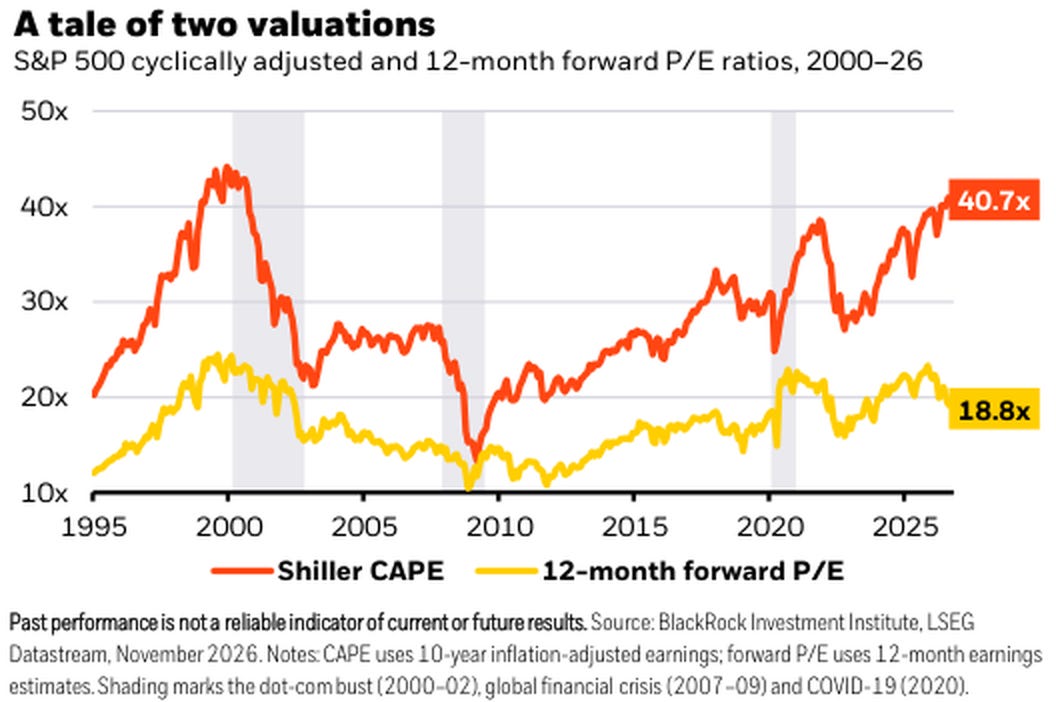
One of the most interesting charts in BlackRock's report compares two ways of measuring the value of US stocks. The results are unusually different.
The Shiller cyclically adjusted price-to-earnings ratio, known as CAPE, compares stock prices with inflation-adjusted company earnings over the previous ten years. It currently stands at about 40.7 times earnings. That is close to the very high levels seen during the technology bubble around the year 2000. But the usual measure of stock prices compared with expected earnings over the next twelve months is about 18.8 times earnings. Compared with more recent market history, this looks much less expensive.
Source: BlackRock Investment Institute, LSEG Datastream, November 2026.
The difference comes from what investors expect companies to earn over the coming year. CAPE reflects how much US stock prices have risen compared with company earnings over a much longer period. The forward price-to-earnings ratio is based on expectations that companies will continue to increase their profits. Neither measure is automatically wrong. They simply show different risks. By looking at earnings over the past ten years, the market appears expensive. By looking at the profits analysts expect next year, it appears more reasonably priced.
This difference is especially important because much of the stock market's recent earnings growth has come from companies connected to AI. If spending on AI infrastructure keeps growing and the productivity benefits eventually spread across the economy, today's stock prices based on expected earnings may make sense. But if the cost of building more computing capacity rises faster than the income it generates, investors may discover that those apparently reasonable stock prices depended on earnings forecasts that were too optimistic.
BlackRock therefore prefers to look beyond the companies building AI infrastructure. It sees possible opportunities in US health care, information technology, businesses connected to technology and financial companies. These businesses may use AI to improve productivity and profit margins without having to spend huge amounts of money on new physical infrastructure.
This could lead to an important change in which companies perform best in the stock market. During the early stages of a technology boom, the companies supplying scarce equipment often benefit most. Advanced chips, electricity connections, computing centres and specialist equipment can command high prices because customers need them immediately. But as more supplies become available and the technology spreads, more of the financial benefits may go to businesses that use the technology to produce more goods and services with fewer resources.
BlackRock is essentially saying that the long-term investment opportunity could become much wider than the small group of companies driving the first wave of AI infrastructure spending.
AI Infrastructure Is Competing with Governments for Money
Another major point in BlackRock's analysis is the growing need for investment money.
Technology companies are spending enormous amounts on AI infrastructure. At the same time, governments are borrowing heavily to pay for budget deficits, defence spending and other major projects. These competing demands are putting more pressure on the money available for investment. Investors are having to think again about what interest rates are needed to balance the amount of money available with the demand to borrow it.
BlackRock has responded by raising its long-term interest-rate expectations. It believes the neutral interest rate, which is the rate that neither strongly slows nor speeds up the economy, will remain higher than previously expected. This means that borrowing may not become extremely cheap again simply because inflation falls from its recent high levels.
This does not automatically make stocks a bad investment. Companies can still increase productivity and profits even when borrowing costs are higher. This is especially true when they have enough cash from their normal business activities to pay for investments themselves. But higher interest rates create more problems for companies that need to borrow money repeatedly to grow. A business that can pay for investment using its own cash is in a very different position from one that must keep refinancing large debts while waiting for future demand to justify its existing infrastructure.
The wider market is already reacting to this change. Higher US Treasury yields have made government bonds more attractive compared with stocks, especially for investors who want income without taking on all the uncertainty of predicting company profits far into the future.
For the first time since 2020, BlackRock has taken a more positive long-term view of interest-rate duration. It has moved developed-market government bonds to a neutral position and increased its preference for inflation-linked bonds. Duration measures how sensitive a bond's price is to changes in interest rates.
This is an important change for a company that has spent several years warning that traditional government bonds may no longer provide the reliable protection against stock market losses that investors enjoyed under the previous interest-rate system.
However, BlackRock does not believe government bonds will automatically protect investors every time stock markets fall. Inflation that stays high, energy shortages and heavy government borrowing could make it difficult for central banks to cut interest rates quickly when the economy weakens. As a result, stocks and bonds could sometimes fall at the same time, especially when markets are worried about rising prices rather than slowing economic growth.
BlackRock therefore recommends looking more carefully at what each investment is exposed to. Investors should not assume that broad categories such as stocks and bonds will always move in opposite directions and protect them from losses.
The Market's Winners and Losers Are Already Changing
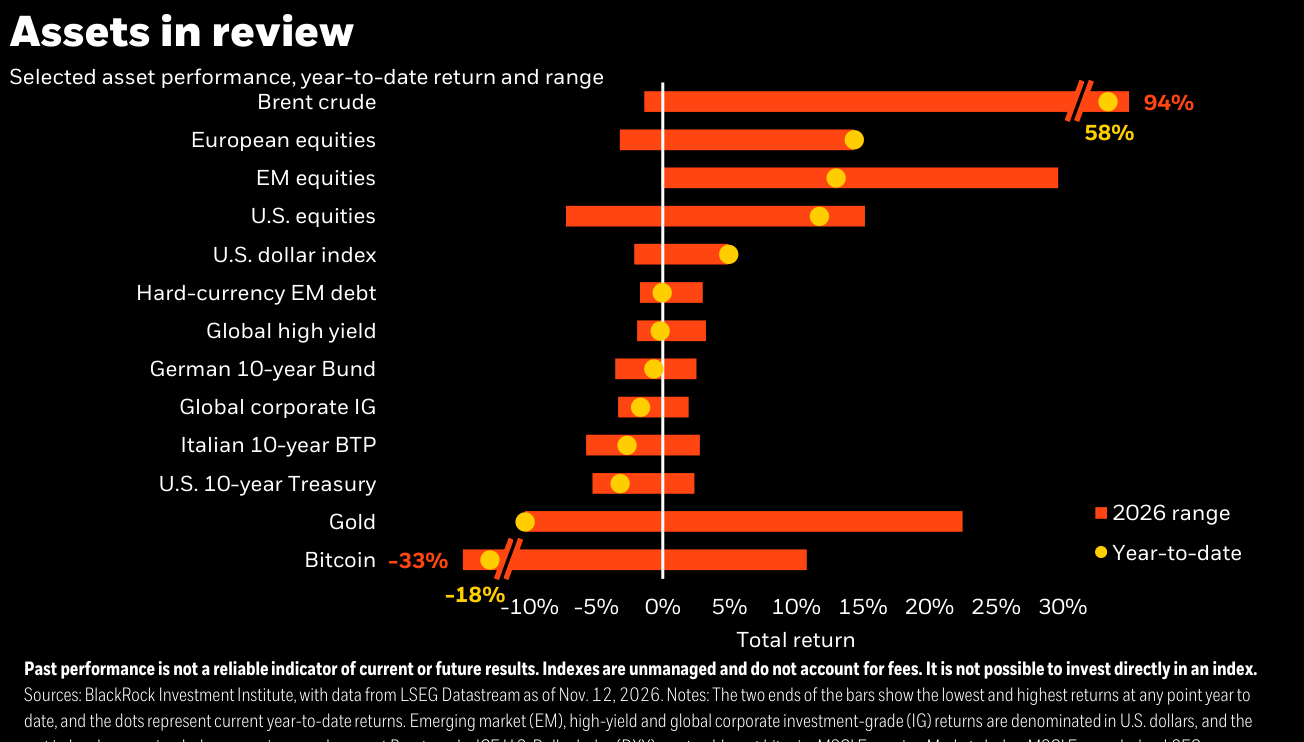
BlackRock's comparison of investment performance since the beginning of the year gives an interesting picture of how different markets have behaved.
Brent crude oil has moved through an unusually wide price range because of the energy shock and changes in geopolitical risks. European and emerging-market stocks have also seen large price movements. Bitcoin has fallen sharply, while government bonds have struggled because interest rates and bond yields have risen.
Source: BlackRock Investment Institute, LSEG Datastream, November 12, 2026.
The most important thing is how differently these investments have performed. Markets have not simply moved together in a general pattern of investors either taking risks or avoiding them. Instead, the relationship between stocks, currencies, commodities and government bonds increasingly depends on the particular economic problem investors are reacting to.
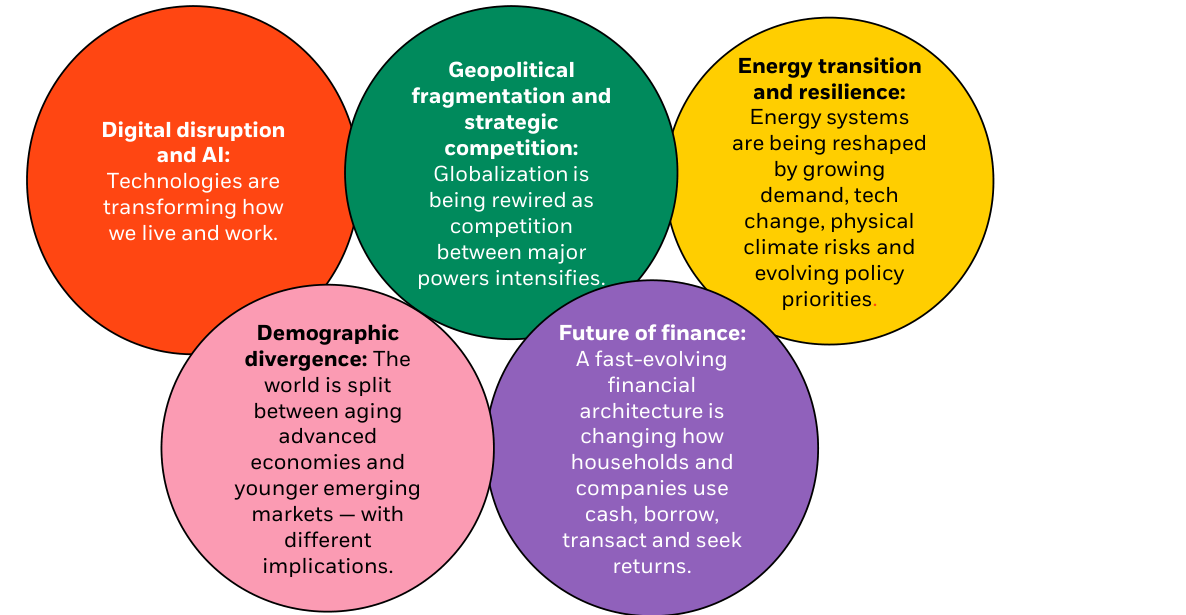
This fits BlackRock's wider view that several major changes are happening at the same time. AI is only one of the forces changing investment opportunities around the world. Political and economic divisions between countries, the need for more reliable energy systems, differences in population trends and changes in the financial system are also affecting where money is invested and how investors measure risk.
Source: BlackRock Investment Institute, November 2026.
The way these forces affect one another is especially important for AI investments. Computing centres need huge amounts of electricity. This creates opportunities for companies that generate power, build electricity networks and supply the equipment needed to increase power capacity. Competition between countries encourages governments and businesses to find new suppliers and reduce their dependence on existing supply chains. Meanwhile, ageing populations and worker shortages make it more important to use technology to help people and businesses become more productive.
These changes can support one another, but they can also create serious problems. A country may have the money and technical skills to build advanced computing centres but not enough electricity infrastructure to run them. A business may see a good opportunity to improve productivity but decide that the cost of borrowing makes the investment too expensive.
BlackRock's response is to focus on particular opportunities created by these problems instead of investing in every company connected to AI.
What BlackRock Actually Wants to Own
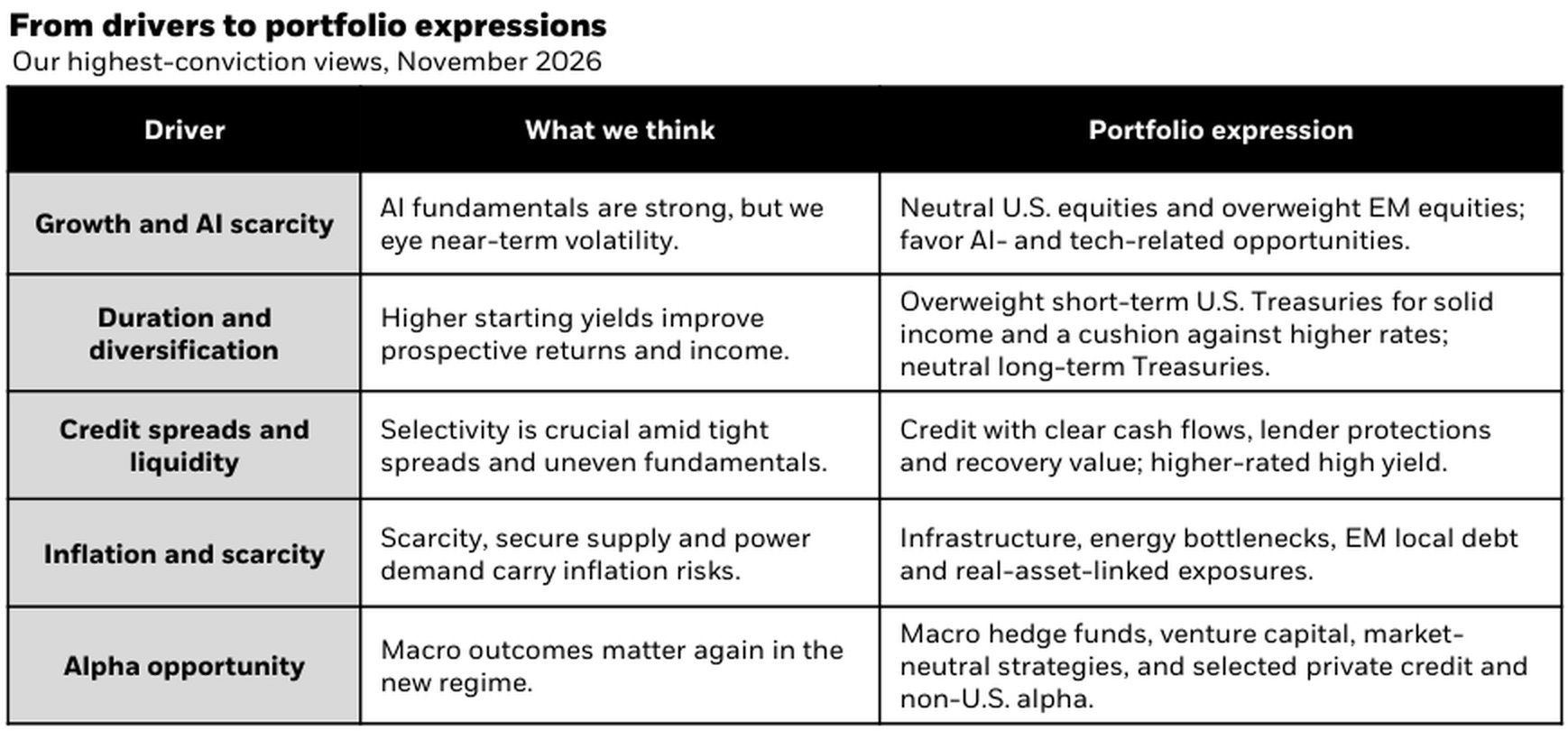
The difference between BlackRock's long-term beliefs and its short-term investment choices becomes especially clear when looking at its current portfolio strategy.
Over the next six to twelve months, BlackRock has a neutral view of stocks in the US, Europe, the UK, Japan and China. However, it prefers stocks in emerging markets. This is because it sees relatively attractive prices, good earnings prospects and opportunities connected to AI infrastructure and limited natural resources in parts of Asia and Latin America.
Japan remains interesting because many companies have strong balance sheets and are improving the way they are managed. BlackRock also sees opportunities in businesses that supply the physical equipment and infrastructure needed to develop AI. In China, the firm recognizes that cheaper AI models with open-source technology could help more people and businesses start using AI. However, more use of the technology does not automatically mean that the companies providing it will make attractive profits.
BlackRock is also being selective with bonds. It prefers short-term US Treasury bonds because it believes much of the expected rise in interest rates has already happened. It also thinks investors may be expecting too much additional interest-rate tightening from the Federal Reserve. For longer-term US Treasury bonds, BlackRock has a neutral position. Their starting yields are now higher, which improves their possible returns, but the large amount of government borrowing could still push yields higher.
When choosing corporate bonds, BlackRock prefers companies with predictable cash flows, strong protections for lenders and assets that could help recover money if the borrower cannot repay. It sees better opportunities in higher-rated high-yield bonds than in bonds from weaker companies. It also prefers emerging-market bonds issued in local currencies because of their interest payments and improving economic conditions.
Source: BlackRock Investment Institute, November 2026.
The thinking behind these choices is fairly simple. BlackRock wants to benefit from AI and other major long-term changes. But it does not want to pay any price for growth when borrowing costs are still high and nobody knows exactly which companies will earn the most money in the future.
This also explains why BlackRock sees a bigger role for other investment strategies. These include selected macro hedge funds, which invest based on big economic trends; market-neutral strategies, which aim to reduce the effect of overall market movements; private credit, which involves lending money outside traditional public bond markets; and investments that can benefit from differences in economic outcomes instead of depending entirely on rising stock prices.

BlackRock's short-term investment positions, November 2026. The full table shows which investments BlackRock prefers, which it views neutrally and which it wants to hold less of. It covers stocks, government bonds and corporate debt. Source: BlackRock Investment Institute.
The important point is that believing in a major technological change does not mean investors must put all their money into the companies most closely connected to that technology.
An investor can remain positive about AI while choosing selected opportunities in emerging markets, investments that pay regular income, companies building physical infrastructure and businesses that benefit from using AI rather than building it.
The Dark Side of the Boom™ Trading View
What interests me about BlackRock's latest investment choices is that they show how the market is beginning to separate the importance of AI from the profits investors can reasonably expect from spending money on it. AI can continue changing businesses without the companies spending the most on infrastructure necessarily delivering the best stock market returns. With US Treasury yields still high and more investors competing for available money, I would prefer companies that can pay for their own investments and businesses that can benefit from using AI without taking on huge amounts of extra debt.
BlackRock's difference between long-term and short-term investment views also makes sense. There are good reasons to remain positive about US stocks over the next several years. But that does not mean investors should rush to buy every time the market recovers in the short term. I would rather build investments carefully across strong companies, infrastructure and assets that generate income, while keeping enough flexibility to take advantage of further market falls. BlackRock's more positive view of bonds is particularly interesting because their higher starting yields now offer investors better returns for holding them over time. However, bonds may still fail to protect investors during every period of rising inflation.
The next stage of AI investing may be less about which company builds the biggest data centre and more about which company makes the most money from the computing power that is already available. I expect some of the most interesting investment opportunities to appear in that part of the market.