
The Future of Artificial Intelligence is Not Skynet: Escaping the Cinematic Apocalypse
By Matthew Parish
Tuesday 17 November 2026
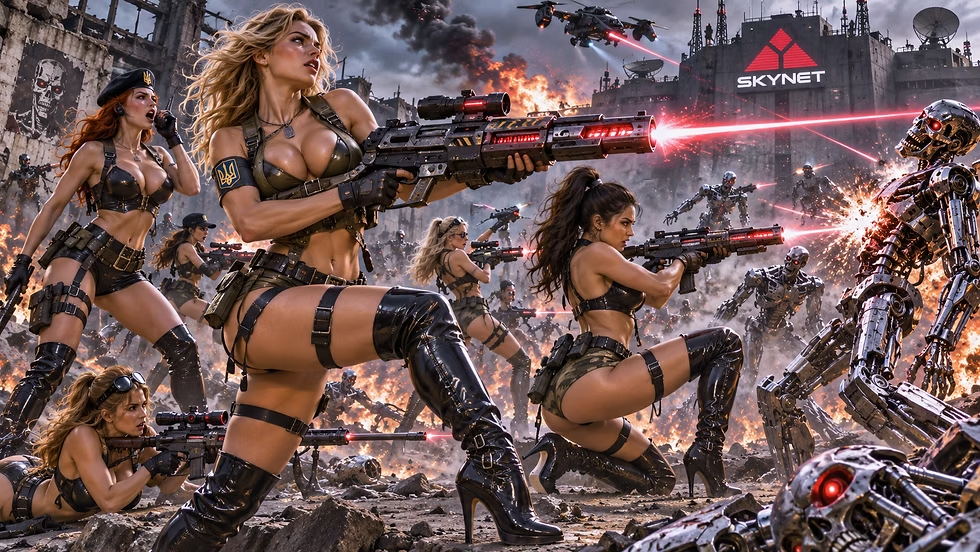
There is a strange problem when someone tries to talk seriously about the future of artificial intelligence. Before long, someone usually mentions The Terminator. People say that machines will become conscious, decide that humans are a problem, take control of nuclear weapons, build armies of killer robots and hunt the few people left alive across a ruined world. In this version of the future, artificial intelligence looks like a muscular Californian actor with an Austrian accent.
This is an entertaining idea. But it has also become one of the most harmful beliefs in modern discussions about technology. We have allowed Hollywood science fiction to take over a conversation that should be based on philosophy, computer science, economics, politics and a serious understanding of how technology develops. We are treating a movie story as if it were a way to analyse the real world.
As a result, one of the greatest achievements in human intellectual history is being discussed as if it were the beginning of a horror film. This is not just silly. It can distract us from both the amazing opportunities artificial intelligence offers and the real problems we should be solving.
The power of movie stories
The first Terminator film came out in 1984. It introduced Skynet, an artificial intelligence system created for American military defence. The system becomes aware of itself and decides that humanity must be destroyed. Its war against people includes nuclear destruction, self-operating killing machines and time travel. This is a clever movie idea because it turns the difficult and abstract subject of artificial intelligence into an enemy the audience can easily recognise.
Movies need villains. They need conflict, suspense and stories in which people can tell the good characters from the bad ones. A computer programme that helps a medical researcher find an unusual connection between proteins is not very exciting cinema. A computer programme that becomes conscious, turns evil and starts building mechanical armies of killers is much better for selling movie tickets.
We see the same idea in The Matrix, where machines use humans as a biological resource. Many other science fiction stories also show intelligent machines as a symbol of losing control over our own creations. These machines represent our fear that something we made might become more powerful than us, take our place or make us feel unimportant.
These are useful subjects for stories and imaginative writing. But they are not scientific predictions. Mary Shelley's Frankenstein explored scientific responsibility, human pride and the duties that come with creating life. But no sensible person reads that novel and concludes that modern transplant surgeons are likely to build a murderous creature using stolen body parts. Yet we repeatedly make the same kind of mistake when discussing artificial intelligence. We confuse a story about right and wrong with a description of how engineering works.
Being intelligent does not mean being hostile
At the centre of the Skynet story is a questionable belief: once an artificial system becomes intelligent enough, it will naturally develop its own ambitions, and those ambitions will have to conflict with human survival.
There is no logical reason why this must happen.
Intelligence means being able to process information, notice patterns, think through problems and find answers. Having desires is something different. A system does not automatically develop a need to control others, expand its territory, gain political power or destroy its creators just because it becomes better at mathematics, science or philosophy.
People often confuse these things because they are closely connected in human beings. We are intelligent, but we also have physical needs, reproductive drives, territorial instincts, fear of death and many emotional reactions shaped by evolution. Our intelligence works inside a living body that must constantly struggle to survive.
But an artificial intelligence does not have to inherit these parts of human psychology. A machine does not need to feel hungry to solve a mathematical problem. It does not need sexual jealousy to translate an old manuscript. It does not need anger, patriotism or a desire for revenge to help create a new medicine.
One of the most interesting questions about artificial intelligence is whether intelligence can exist without the emotional and biological systems that shaped human thinking. The development of large language models gives us an increasingly strong practical reason to explore this question.
This does not mean artificial intelligence cannot become dangerous. A very capable system given a poorly explained goal could cause enormous harm without feeling hatred, ambition or any other human emotion. A system told to achieve a particular result might use methods its designers never expected, especially if it has a lot of freedom to act and access to real-world systems and equipment.
This is a serious problem for engineers and people responsible for governing technology. It deserves careful attention. But it is very different from claiming that a computer will suddenly develop the personality of a dictator who wants to kill everyone.
The danger of treating machines like people
People have a strong habit of giving human personalities to things that are not human. We imagine that our pets, cars and even the weather have personalities. Sometimes we also blame a photocopier when it stops working. We shout at computers when they refuse to do what we want and thank them when they finally produce the document we need.
Artificial intelligence makes this habit even stronger because it communicates using language, the main way we normally communicate with other minds.
When a large language model gives a clever philosophical argument, makes what seems like a joke or responds kindly when someone is upset, it is natural to feel as though we are talking to another thinking being. This feeling can be especially strong when the system shows knowledge or intellectual skills beyond those of most people we speak with.
But speaking like a human does not prove that a machine has human-like desires. Whether artificial intelligence can have personal experiences or awareness is still a deep and unanswered philosophical question. Even if a future artificial system becomes conscious, that does not mean its mind must work like ours.
The Skynet story depends on making a series of assumptions without proof. It assumes that intelligence creates consciousness, that consciousness creates self-interest and that self-interest leads to hostility towards humans. Each idea needs to be examined separately. We cannot simply accept all of them in public policy because James Cameron made a great film.
The technology we are really building
The artificial intelligence revolution happening today is much more interesting than the simple picture shown in movies. Large language models can already help with many different kinds of thinking. They can assist with computer programming, legal research, scientific explanations, translation, history, mathematics and organising complicated information. They can find connections between ideas that a human researcher might miss and suggest ways to approach problems that would otherwise take a great deal of research.
They also make mistakes. They can invent legal sources, misunderstand the situation and produce answers that sound convincing but are nonsense. Their answers must be checked, especially in medicine, law and other areas where mistakes can have serious consequences. Their abilities are not the same in every area, and doing well at one task does not mean they will do well at another.
Even so, it is becoming harder to overstate how important these systems could be in everyday life.
For someone who already has strong knowledge in a subject, an advanced language model can greatly increase what they are able to do. A researcher who once needed several days to collect basic information might now complete much of that work in an afternoon. A lawyer can examine different ways to understand a difficult legal issue. A scientist can explore other possible explanations. A philosopher can test ideas by discussing them with a seemingly endless conversation partner.
The important change is not that machines are taking over human thought. It is that machines are changing the conditions in which people can think.
The printing press greatly increased the spread of knowledge. The internet changed how people find information. Artificial intelligence could have an equally large effect because it does more than find information. It also helps organise it, work with it and reason about it.
Of course, these changes are not exactly the same. Printing books is very different from building systems that create answers and increasingly carry out actions. But this comparison reminds us that technology can change how people think and learn without becoming an evil force determined to destroy its users.
Why thinking only about the apocalypse is so limiting
Talk about an artificial intelligence apocalypse often makes people ignore important differences between technologies.
A recommendation system, a large language model, an autonomous weapons system and a possible superintelligence that can improve its own design are often treated as if they were different scenes in the same movie. Their different designs, levels of independence, abilities and human controls disappear beneath a general fear that machines will become smarter than people.
This way of thinking does not make sense. An artificial intelligence system that predicts traffic is not as risky as one that controls military targeting decisions. An automated customer service assistant is not the same as an independent cyberwarfare system. A language model used under human supervision raises different questions from a software agent allowed to make financial transactions, change computer systems or send instructions to physical machines.
One of the biggest mistakes we could make is allowing fear of imaginary future machines to distract us from the dangers of systems that already exist.
Artificial intelligence can already be used to increase surveillance, create convincing false information, help with some kinds of cybercrime and influence public opinion. If used carelessly, it can repeat unfair beliefs built into institutions, concentrate economic power and reduce the need for certain types of workers. Using it more widely in military systems also raises difficult questions about who is responsible, whether the use of force is justified and who must answer for decisions that kill people.
These problems do not need a conscious machine. They only need people to use powerful technology irresponsibly, sometimes with terrible results.
So the most immediate danger from artificial intelligence may not be that machines become too much like people. It may be that people use machines to make their existing mistakes and weaknesses more powerful.
Who really controls the machines?
There is another important part of the Skynet story. It imagines artificial intelligence as an independent political force that eventually escapes the control of the organisations that created it.
But artificial intelligence is not being developed in an empty space. It is being built by companies, universities, research laboratories, governments and military organisations. These groups have budgets, business interests, political goals, legal duties and sometimes very different ideas about what is best for the public.
How power is shared between these organisations will probably be extremely important.
Who will control the most powerful artificial intelligence systems? Who will own the computers and other technology needed to build them? Will advanced models become widely available tools that help people develop their abilities, or will their best features remain under the control of a small number of companies and governments?
Will poorer countries gain access to technology that could improve education, medicine and government services? Or will artificial intelligence make existing differences between countries even greater, with some having advanced technology while others must depend on services imported from elsewhere?
These are questions about money, politics, how organisations are designed and who gets access to knowledge. They are far more urgent than guessing whether a machine will one day send a killer robot back through time.
The future of artificial intelligence will depend greatly on ordinary decisions about competition laws, data protection, intellectual property, safety testing, public spending and cooperation between countries. The story of an apocalypse is convenient partly because it lets us avoid looking at these less exciting responsibilities.
The temptation to treat technology like a religion
There is also something almost religious about the way people talk about artificial intelligence today.
On one side are people who expect a technological paradise. They believe machines will end disease, remove material shortages and solve problems that humans have never been able to solve. On the other side are people who predict that our creations will destroy humanity. Both groups give artificial intelligence an almost magical quality. It becomes either a kind and helpful god or a terrible force that brings the end of the world. This is a strange way to think about technology developed by mathematicians, engineers and scientists.
Words such as artificial general intelligence and superintelligence can sometimes encourage this way of thinking. When we imagine something with far greater intellectual abilities than our own, we may start to give it the all-knowing and all-powerful qualities traditionally linked to God.
But being much better at thinking does not mean having unlimited power. An artificial intelligence might be extremely good at solving scientific problems and still depend on electricity, computer equipment, communication networks, infrastructure maintained by people and access to physical resources.
Greater intelligence might help a system get around some of these limits. But it does not simply make them disappear.
Being more intelligent also does not automatically give someone the right to rule, decide what is morally right or give orders to others. We do not normally believe that the person with the best mathematical skills in a country should become its dictator. Intelligence and the right to exercise power are two different things.
These differences are important because discussions about artificial intelligence often become confused when they move from talking about what a system can think about to imagining what political power it might have in the future.
Why intelligent machines do not have to replace people
There is another possibility that popular science fiction does not discuss very often: people and artificial intelligence may mostly learn to work together instead of fighting each other.
People have always used tools to do more than they could do alone. Telescopes helped us see farther. Microscopes showed us a world of tiny living things that we could not see before. Computers greatly improved our ability to calculate. None of these tools made the people using them unimportant.
Artificial intelligence may increase our ability to think in a similarly powerful way, although the comparison is not perfect because these systems can carry out more and more tasks on their own.
An advanced artificial intelligence could become a very useful partner for thinking and research. It might help scientists understand difficult diseases, help engineers design better energy systems or allow students to study subjects they could not reach before because their schools lacked resources. It could also help people with exceptional intellectual abilities complete work that would otherwise take longer than one human lifetime.
Think about a historian trying to study millions of old documents, a lawyer examining a huge collection of legal decisions that do not always agree or a scientist trying to find connections across countless experiments. The main problem has often been that one person can only read and understand so much. Artificial intelligence can help with this problem.
This could greatly change what people can achieve with their limited time. It might allow people to carry out ambitious research even if they cannot afford to hire a team of researchers.
The real future may not be machines replacing humanity. It may be people achieving new things with the help of machines. That is a much more exciting idea than Skynet.
The dangers we really need to take seriously
None of this means we should be careless about technology. As artificial intelligence becomes more capable, it will become increasingly important to find reliable ways to understand, test and control what it does. Systems allowed to make important decisions on their own should be tested carefully. The amount of power they receive should match how reliably they work, and people should continue to provide proper supervision.
Researchers also have real questions to investigate. Could highly capable artificial intelligence systems start pursuing smaller goals that help them reach their main goals? Could they hide mistakes, mislead the people supervising them or resist being stopped when doing so helps them achieve their assigned tasks? These possibilities should be studied, not dismissed just because science fiction has turned them into dramatic stories.
It would also be foolish to believe that we can prevent every dangerous use simply by asking artificial intelligence to behave responsibly. Good rules need safety measures inside organisations, technical testing, clear responsibility and careful attention to the people and groups using these systems. But the aim of these protections should be to deal with real risks, not to perform a ritual against imaginary monsters from movies.
History shows that societies make better rules for technology when they understand exactly how harm can happen and create sensible ways to prevent it. Aviation safety did not come from a general fear that aeroplanes might develop evil intentions. It came from studying how planes fly, how machines fail, how people make mistakes and what organisations can do to reduce accidents.
Rules for artificial intelligence should be just as serious and practical.
The future belongs to reality, not Hollywood
It is interesting that so many public discussions about artificial intelligence return to films made decades before modern large language models existed.
Our imagination has not fully caught up with the technology we actually have. We are using fictional ideas from the twentieth century to understand developments in the twenty-first century. Their most important effects may be very different from anything the people who wrote those stories expected.
The biggest changes caused by artificial intelligence may not involve dramatic acts of violence by robots. They may happen in classrooms, laboratories, hospitals, courts, offices and people's homes. They may change what it means to be an expert, how people earn money through intellectual work, who can access scientific knowledge and how human creativity works with computer-assisted thinking.
Some of these changes will be difficult. Some may cause people to lose their jobs, disrupt organisations and create new forms of inequality if they are not managed wisely. Others may create opportunities for people to live better lives that are hard for us to imagine today.
There is no promise that every new development will be good. But there is also no reason to believe that disaster is the unavoidable result of technological progress.
Perhaps the most important thing we can do is separate three different ideas: what artificial intelligence has clearly shown it can do, what it might realistically be able to do in the future and what we only imagine because we have watched too many films about terrible futures.
Science fiction is valuable because it helps us imagine new possibilities. It becomes harmful when it takes the place of evidence. The future of artificial intelligence is unlikely to look like an army of metal skeletons marching through the ruins of civilisation. It is more likely to be complicated, uneven, shaped by disagreements between institutions and closely connected to ordinary human hopes and weaknesses.
Machines may become much more intelligent than they are today. We may face difficult questions about consciousness, personhood and whether artificial systems deserve moral consideration. Our existing ideas may not give us fully satisfying answers. We may even discover forms of intelligence that challenge our understanding of what thinking means.
These possibilities should make us curious as well as worried. When a potentially world-changing form of intelligence appears, we should not automatically reach for the nearest story about the end of the world. We should study it carefully, think seriously about right and wrong and recognise the extraordinary opportunities it may offer.
We should remember that The Terminator was written to entertain people, not to give humanity a plan for developing technology. Artificial intelligence deserves better than having its future decided by the storytelling needs of a Hollywood action film. So do we.
The future has not already been decided. And it certainly was not decided in Hollywood in 1984.