
Wall Street stabilizes after another AI selloff ahead of Nvidia earnings
Wall Street was mixed but mostly steady in early trading before the market opened. This came one day after artificial intelligence stocks fell again. Nvidia, a troubled chip company, was set to release its latest quarterly earnings report.
- By ELAINE LAI and MATT OTT - Associated Press
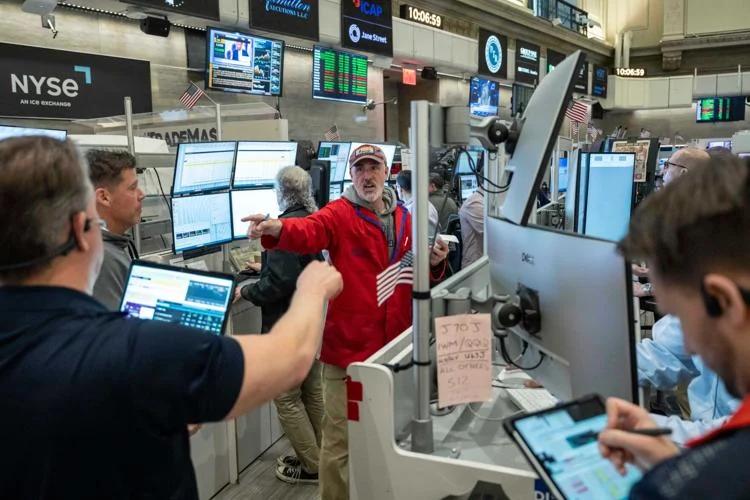
Options trader Kirk Katzburg works on the floor of the New York Stock Exchange in New York, Monday, Nov. 9, 2026.
- Yuki Iwamura - AP
A trader reacts inside a trading room at Hana Bank in Seoul, South Korea, Tuesday, Nov. 17, 2026.
- Lee Jin-man - AP
Wall Street stocks were mixed but mostly steady in early trading Tuesday. This followed another drop in artificial intelligence stocks on Monday, as investors reacted to concerns about Nvidia. The company was scheduled to report its quarterly earnings after the market closed.
Before the opening bell, futures for the S&P 500 fell 0.1%, while futures for the Dow Jones Industrial Average dropped 0.4%. Nasdaq futures rose 0.5%, making up some of the ground lost after the Nasdaq fell 2.5% on Monday.
Nvidia shares rose about 0.7% early Tuesday. They had fallen 4.1% the day before. Investors on Wall Street remain concerned about a leadership crisis at the company.
Nvidia said Tuesday that it is forming a new committee of its board to oversee national security and follow rules for international trade. The announcement came after reports that former CEO Jensen Huang had an affair outside his marriage with a person accused of spying for China.
Nvidia has lost $735 billion in market value since the news about Huang's affair became public.
Huang's resignation as Nvidia's CEO is the latest problem for the artificial intelligence industry. The industry has also faced criticism that its stock prices may be part of a bubble. Investors are also concerned that Democrats, strengthened by their victories in the U.S. midterm elections, may support limits on building more data centers for artificial intelligence.
"The market was already worried about this risk before what happened at Nvidia," said Zhiwei Zhang, president and chief economist at Pinpoint Asset Management, in a commentary. "Now the risk has become even more serious."
The U.S. government is also paying closer attention to the artificial intelligence industry. On Monday, the Trump administration announced new rules that limit remote access to advanced U.S. computer chips and servers.
Nvidia was due to report its latest quarterly results later Tuesday. Interim CEO Colette Kress was expected to speak to investors.
Other chip companies also had small gains. Broadcom and Qualcomm each rose a little more than 1%, while Micron gained 2.5%. Intel's share price barely changed.
United Airlines shares fell 1.2% after the company had a computer system failure that lasted more than 90 minutes. The problem forced the airline to delay flights leaving on Monday. It happened just days after a problem with the Federal Aviation Administration's computer network caused a nationwide stop to flights.
Shares of The Walt Disney Co. fell 2.5%, even though the company reported sales and profits for the fourth quarter that were better than expected. Disney said Tuesday that it plans to save $3 billion in costs by the 2029 financial year. These savings include job cuts the company has made throughout the year.
Shares of major banks moved in different directions after a technical problem at JPMorgan Chase slowed payments at other major banks that use the Zelle money transfer service.
In world news, leaders from countries in the region are meeting this week at two major events: the ASEAN summit in Manila, Philippines, and the APEC summit in Shenzhen, China. Investors will watch for signs that countries are working more closely together and making progress on trade deals. This comes at a time of growing political tensions between countries.
President Donald Trump is in the Philippines on Tuesday. He is expected to arrive in Shenzhen late Wednesday.
At midday in Europe, Germany's DAX and France's CAC 40 index in Paris had each fallen 0.8%. Britain's FTSE 100 had dropped 1%.
Britain will publish its October inflation figures on Wednesday. The report will give people a better idea of whether the Bank of England may raise interest rates again. Britain's inflation rate last month reached its highest level in almost a year.
In Asia, South Korea's Kospi index fell 2.6% to 4,968.48. This was its lowest level in six months. Samsung Electronics, which makes memory chips, lost 3.1%. SK Hynix fell 1.8%. The main stock index in Seoul closed below 5,000 points for the first time since February this year.
Japan's main Nikkei 225 index dropped 1.3% to 58,860.43. Shares in SoftBank Group, an investor in OpenAI, fell 3.9%. They have dropped more than 33% over the past month. Advantest, a company that makes testing equipment, lost 4.4%.
Japan will release its October trade figures on Wednesday. This follows official figures showing that Japan's economy shrank during the July-to-September period. This ended three quarters in a row of economic growth.
In Hong Kong, the Hang Seng index fell 1% to 23,508.17. China's Shanghai Composite index dropped 0.5% to 3,584.58.
Australia's S&P/ASX 200 index fell 1.8% to 8,883.20.
Taiwan's Taiex index dropped sharply by 2.3%.
India's Sensex index rose slightly, gaining 0.6%.
In the bond market, U.S. Treasury yields fell after rising sharply last week. That earlier increase followed a U.S. inflation report that was worse than expected.
The yield on the 10-year Treasury note fell to 5.12%. However, it remained well above the low of 4.80% reached earlier this month.
In energy markets early Tuesday, Brent crude oil, the international standard, fell 49 cents to $92.93 per barrel. U.S. benchmark crude oil dropped 51 cents to $86.23 per barrel.