
Just nine countries back pledge to tackle AI’s environmental footprint
Environment
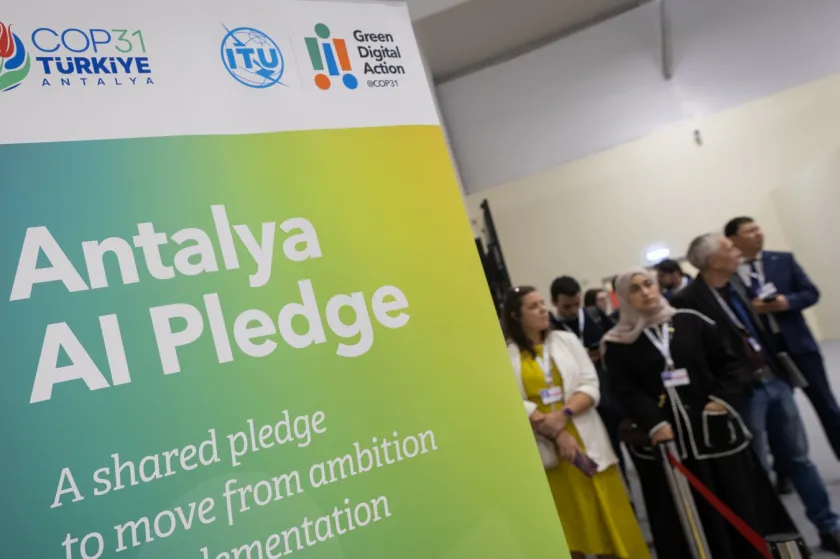
Only nine countries have signed an international promise to make AI more environmentally friendly. This is despite warnings at the COP31 climate summit that AI's growing need for electricity could make climate goals harder to reach.
The Antalya Artificial Intelligence Pledge was launched on 16 November at the summit in Turkey. It was created by the summit's leaders and the International Telecommunication Union (ITU). Its goal is to make AI more sustainable by encouraging the use of cleaner energy, more efficient data centres and clearer information about AI's effects on the environment.
“AI and other frontier technologies are a double-edged sword,” said Simon Stiell, the executive secretary of UN Climate Change, at a press conference on 16 November. “The task ahead is to blunt their dangerous edges, sharpen their catalytic ones and put these technologies responsibly to work.”
But Ketan Joshi, an independent researcher who studies AI's effects on the climate, questions this comparison. He says it mixes up traditional machine learning, which is already used for things such as weather forecasts, with generative AI, which uses large amounts of energy. “You don’t need to have a giant, energy-hungry generative AI chatbot if you want to have better wind forecasting for a wind power developer,” he says.
At the same time, AI is growing quickly and putting more pressure on electricity networks. The International Energy Agency says that electricity use by data centres focused on AI rose by 50 per cent in 2025.
Joshi says there is little evidence that technology companies are building enough renewable energy facilities to meet this growing demand. He says that even companies that have invested heavily in renewable energy, such as Amazon and Google, are turning more and more to fossil fuels to support their rapid growth.
The only countries that have supported the pledge so far are Andorra, Brazil, Colombia, Luxembourg, Sierra Leone, Somalia, South Korea, Turkey and Uganda.
The pledge is voluntary. It does not set any legally required goals for cutting emissions or using less energy. It describes four areas where countries can take action. These include using more energy that produces low or no emissions to power AI equipment, using energy and water more efficiently, and measuring the effects of AI systems on the environment. It also asks for more money and technical help so developing countries can use AI to fight climate change.
However, the agreement leaves a lot of room for different interpretations. For example, its call to use “low- and zero-emission energy” still allows countries to rely on fossil gas. It does not require them to use renewable electricity.
Countries can also choose to make extra promises. These could include requiring AI companies to report how much energy they use and how they affect the environment, or setting rules to make data centres more sustainable.
“I’m surprised that more countries haven’t signed up, given the pledge’s limited demands,” says Joshi. “It’s not a pledge that really strikes at the heart of the problem.” He says voluntary promises are unlikely to be enough unless governments limit the growth of data centres and introduce stronger rules for AI.
COP31 President Murat Kurum defended the plan. He said the rapid growth of AI must be “powered and deployed responsibly, and used for the benefit of climate actions”. The ITU says progress will be checked at yearly UN climate summits until 2030. The first review will take place at COP32 next year.
Joshi worries that the pledge could be used to make the continued growth of AI using fossil fuels seem acceptable. “I think we’re going to be going into an era of a return to greenwashing, a return to sort of empty promises,” he says. “What we really need is stronger and stricter regulation.”