Can apprenticeship fix AI’s junior talent gap?
“The choices we make now about how we invest in our people, use technology responsibly, and help our communities will shape our impact for years to come.”

By Jim Wilson
17 Nov. 2026
As artificial intelligence (AI) takes over more of the everyday tasks that junior employees used to learn from, one of Canada's largest professional services firms has made managers mainly responsible for helping employees build their skills at work.
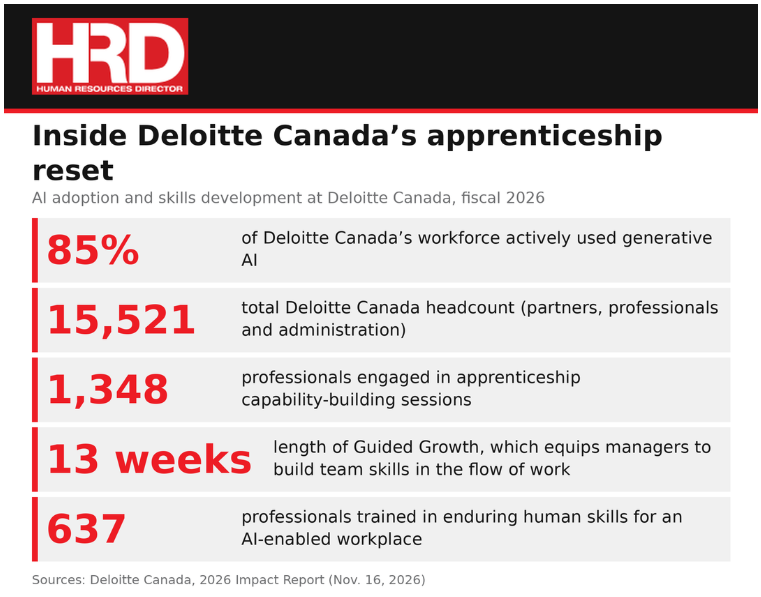
Deloitte Canada has made apprenticeship a central part of how it works in the 2026 financial year, according to its 2026 Impact Report. The firm included 1,348 professionals in sessions to build their skills. It also expanded Guided Growth, a 13-week program that teaches managers how to develop their teams' skills through everyday work.
The report says the firm is adding apprenticeship practices to its everyday tools, team routines and processes for managing talent.
This change comes as AI use is widespread at the Toronto-based firm. In the 2026 financial year, 85% of its 15,521 employees were actively using generative AI.
“We have seen firsthand that technology delivers its greatest value when it amplifies human potential,” Anthony Viel, CEO of Deloitte Canada in Toronto, wrote in the report.
Why apprenticeship is back on the agenda
In professional services, junior employees have traditionally learned by writing first drafts, doing research, checking data and carrying out early analysis under the guidance of more experienced staff. Earlier reports say generative AI can now do many of these tasks. In February 2026, Bank of Canada Governor Tiff Macklem warned that there was “some early evidence that AI is reducing the number of entry-level jobs in some occupations,” Global News reported.
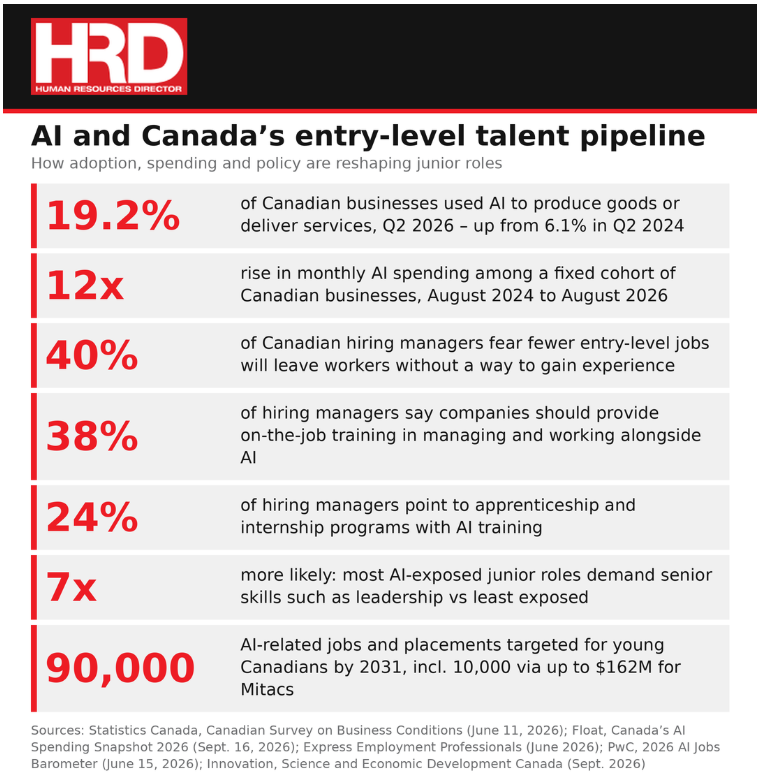
A survey by Express Employment Professionals in June 2026 found that 40% of Canadian hiring managers worried that fewer entry-level jobs would leave workers without a way to gain work experience. In the same survey, 24% said apprenticeship and internship programs that include AI training could help address the problem.
Deloitte is putting this responsibility on managers. Along with Guided Growth, the firm trained 637 professionals in what it calls lasting human skills. The report says its next step is to move beyond training people to use tools. Instead, it will focus on building skills for specific jobs and work processes, changing how work is done and making leaders responsible for these changes.
A national pipeline problem
The rest of Canada's economy is also starting to use AI more widely. Statistics Canada found that 19.2% of businesses used AI to make goods or provide services in the 12 months before its survey for the second quarter of 2026. That was about three times the 6.1% reported two years earlier.
Spending is growing even faster. Float's Canada’s AI Spending Snapshot 2026, released on Sept. 16, 2026, found that monthly AI spending by a fixed group of Canadian businesses grew more than 12 times between August 2024 and August 2026.
The federal government is also working to help young people enter the AI workforce. Under its national AI strategy, AI for All, the government aims to create up to 90,000 AI-related jobs and work placements for young Canadians by 2031.
This includes 10,000 work placements supported by up to $162 million in funding for Mitacs, according to Innovation, Science and Economic Development Canada (ISED). Employers can use federally co-funded AI work placements for students and graduates.
What does this mean for HR leaders?
Other research suggests that junior jobs are changing rather than disappearing. PwC's 2026 AI Jobs Barometer found that junior jobs most affected by AI were seven times more likely than jobs least affected by AI to require senior-level skills, such as leadership.
Employers in the Express survey suggested a similar solution. Of the hiring managers surveyed, 38% said companies should train employees on the job to manage and work alongside AI.
“The choices we make now about how we invest in our people, adopt technology responsibly, and contribute to our communities will define our impact for years to come,” Viel said in the release.
Leaders featured in HRD Canada's Elite Women 2026 special report on leading HR professionals face these same choices.