
I spoke to seven physics experts grappling with the AI revolution
About six months ago, Suvrat Raju, a professor of theoretical physics at the International Centre for Theoretical Sciences in Bengaluru, asked an advanced AI model to solve a physics problem. He did not need the answer because he had already solved the problem himself. But he had never published his solution. That made it a perfect test of how good AI was at physics.
Large language models (LLMs) have been trained on information from across the internet. So if a physics problem has been discussed online, a model may already know about it or have memorized its answer. A fair test of AI therefore needs to use problems that have never appeared online.
The model did not solve Raju’s problem correctly, but it did better than he expected. It did well enough to make him think the test should be repeated in a more organized way. He and a colleague decided to create a test to measure how well AI could handle theoretical physics.
They asked other physicists to share some of their private work: small but real discoveries that they had never taken the time to prepare for publication. These had to be genuine research problems that would take even an expert human about a day to solve.
“Our contributors had to either sacrifice potential publication elsewhere, or else undertake a small research project just for us,” Raju wrote.
By the time the questions and answers were ready, AI models had improved too. At a meeting in September, Raju shared early results showing that leading AI models could solve about 60% of the problems without help. By the time he and his colleagues had finished the full test, things had moved even further: GPT-6 Astra could solve nearly 90% of the problems.
They wanted to understand why Astra struggled with the remaining problems, so they gave it the solutions written by humans and asked it to find its mistakes. To their surprise, Astra said it had not made a mistake. It argued that the human answers were wrong. Astra had found small but important errors in the human solutions. In fact, Astra had correctly answered 49 of the 50 problems. The one it missed was something of a trick question.
Each correct answer cost less than $3 in computing power on average. As Raju said in a talk, that was “less than the price of coffee in Paris.” Each answer also came after just one prompt from a human.
In other words, Raju’s TheoPhysEval test had already become too easy for AI before it was even released. When Raju discovered this, he could not sleep well for a couple of nights. He felt a mixture of amazement, excitement, and fear that was hard to separate.
I asked whether there would be a second version of the test. He said no.

“People gave us the hardest problems they could,” he told me. “We’ve kind of hit the ceiling of well-defined calculations that people can do. Now, there is open research and you can keep asking about open research. But that’s not an evaluation.”
For this article, I spoke with Raju and six other theoretical physicists. All of them described how AI was starting to change their field. Like programmers and mathematicians, physicists are using large language models more and more in their work. For many, this has made calculations and research much faster. It has also led to a huge increase in the number of new papers and raised difficult questions about how to train the next generation of physicists.
But physics is different from mathematics in important ways, so it may not follow the same path. Physics is connected to the real world through experiments. And its biggest unanswered questions are so broad that it is hard to know how quickly AI can help solve them. It is even possible that AI will let physicists spend less time doing calculations, at least for a while, and more time thinking about big ideas in the traditional way.
AI is rapidly changing physics
Raju is not the only physicist who has noticed how quickly AI models are improving. In October, a Turkish physicist posted on X that Claude Opus 5.5 had recreated the main work of his PhD thesis. It had taken him a year and 500 pages of calculations by hand. Claude reproduced the work in 10 hours.
Ed Witten, the most-cited living theoretical physicist, has been giving Opus credit in recent papers. Juan Maldacena, another leading physicist, thanked OpenAI models for helping with two papers this year. He told me he uses AI “to do some calculations, search the literature.” He added that more and more physicists find AI useful for “calculations that in the past were maybe too long.”
Andreas Karch, a physicist at the University of Texas at Austin, runs AI agents all day and night. “It’s pretty much running 24 hours a day. I always have it do something,” he said.
Karch admitted that he had written one of the answers in Raju’s test that turned out to contain a small error. Now he asks Astra to check his old papers for mistakes he may have missed. “I do one paper a day now. Pretty much every paper that I send it, it has something to say.”
Karch gets a free high-level ChatGPT subscription from OpenAI, which wants to see physicists using its models.
Harvard physicist Matthew Schwartz uses AI agents even more heavily. During an interview in October, he stopped to count how many sessions were running on his computer.
“Nine, 10, 11, 12, 13, 14, 15, 16, 17, 18, 19, 20,” he told me. Each session was working on a different problem, with 10 to 20 agents working in each session.
Schwartz does not have to pay for all those tokens. He told me that Anthropic had recently asked him, “‘Suppose you had more tokens, what would you do?’ And I said, ‘I don’t know, let me try.’ And so they just gave me tokens. And now I’m seeing what you can do with tokenmaxxing. There’s a whole bunch of physicists who do this. They have contracts with a bunch of academics.” Schwartz has written a couple of blog posts for Anthropic about his work with AI and physics.
Of course, this is not the whole story. These agents mainly do calculations, and not every theoretical physicist spends most of their time calculating. Daniel Harlow at MIT said that in his area of physics, “the vast majority of the work is figuring out what to do.” By the time he has a calculation ready, he said, “I’m like 95% done already.” Instead, he finds LLMs useful for learning about more distant areas of physics and finding ideas from related fields that he can use. This is helpful, but it has not changed his work in a major way.
A flood of papers
The number of theoretical physics papers being published has risen sharply in recent months. From January to October, physicists sent about 30% more papers to the hep-th section of the scientific website arXiv than during the same period last year. Hep-th stands for high-energy physics theory. Over the previous 20 years, the biggest yearly increase had been 8%.
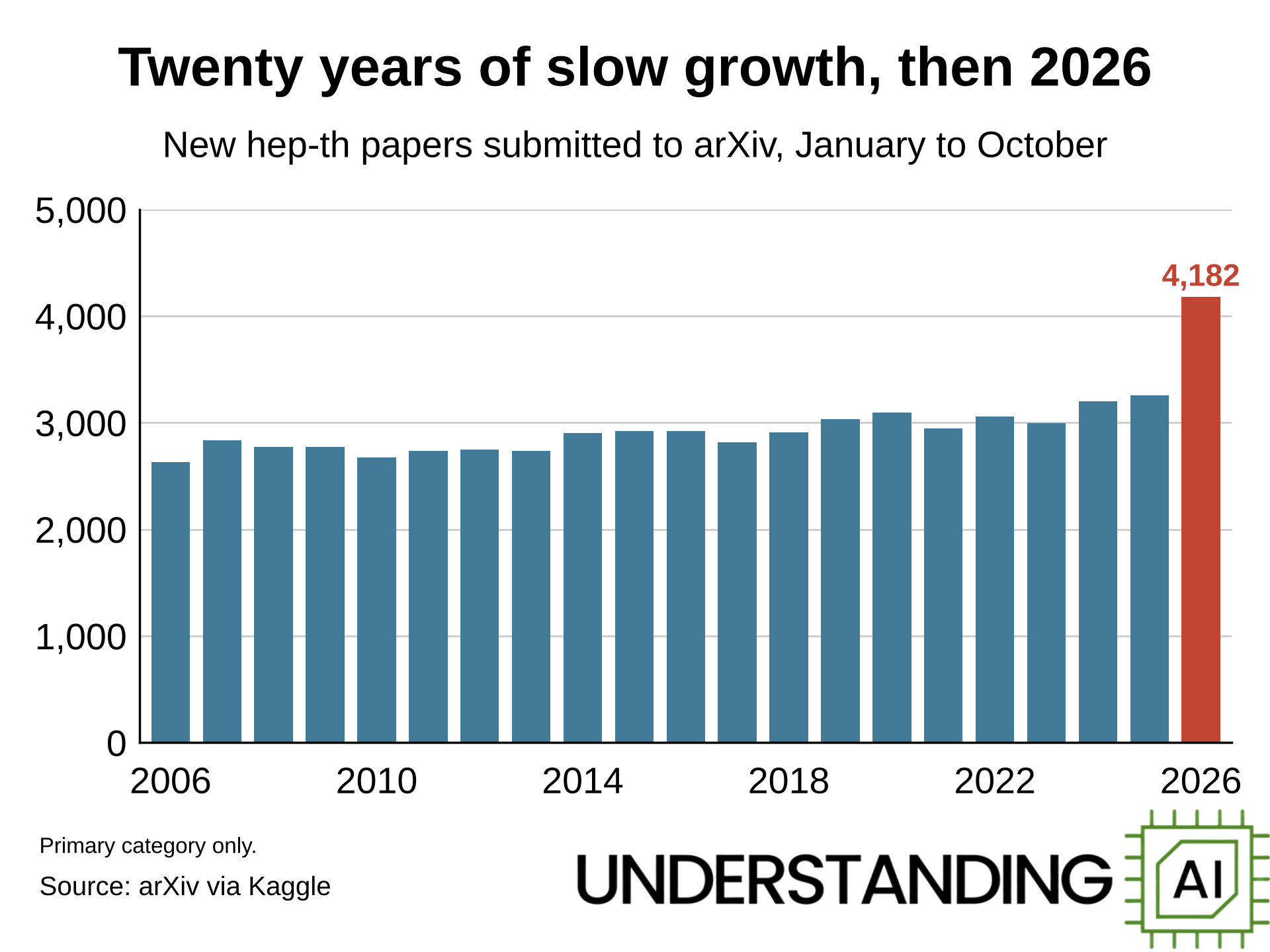
The obvious question is whether all these papers are low-quality work. The answer is both yes and no. Schwartz described many of them as “poorly written, but I think the science is probably pretty solid.”
But nobody knows for sure, because nobody has enough time to read all the papers. “It’s like this endless buffet. Even if it’s the most amazing food, how much of it can you digest?” Scott Aaronson told me. Aaronson is a theoretical computer scientist who has helped connect computer science and physics in important ways over the last 15 years.
Eventually, perhaps quite soon, this endless flow of papers will force the physics community to find new ways to organize its work. Aron Wall, a physicist at Syracuse University, thinks personal connections and recommendations will become more important. “My source for papers on the arXiv usually is somebody tells me about them, and if they don’t, then I don’t need to know,” he said jokingly. Wall works as a consultant for Anthropic.
Maldacena is not sure what the answer will be, but he does not think the problem is impossible to solve. “It’s hard to process. But I think it’s great, and we’ll learn how to do that,” he said.
An uncertain future for young physicists
The flood of papers may be a change that science can manage, as it has managed other changes in the past. But AI could have a much bigger effect on the career opportunities available to young physicists.
Established physicists like Maldacena probably do not have much to worry about. They are likely to keep their permanent university jobs. But people who are still training to become physicists may not be so fortunate.
Until recently, doing calculations was an important step in a young physicist’s training. It helped them build a reputation and develop an instinct for how to approach the hardest problems.
“It’s how we judge students, how we decide students have talent,” Raju said. “I went into physics because I participated in the International Physics Olympiad, and that was considered to be a sign of having talent.”
“If you do enough of this mechanical grinding through problems, at some point, you pick up the concepts behind it,” Karch said.
But Karch said this path may now be changing. “It’s not clear how you jump over that step” if AI does all the routine calculations.
“A lot of them feel like that is being taken away from them,” Aaronson said.
Karch also spoke about a growing fear that someone else will publish a discovery first. “If you tell somebody, they’re going to run and ask the agent to solve it,” he said. “You have to be much more guarded if you think you have some big idea.”
Raju told me that he is not accepting new PhD students until he has a clearer idea of what their futures might look like.
This situation is made worse by cuts to science funding by the Trump administration. These cuts were already putting pressure on a career path that has always been uncertain. Many physics skills can also be used in AI. Both Anthropic and OpenAI have had physicists in senior positions. But the leading AI companies are not hiring large numbers of physicists these days, especially people from outside top universities such as Stanford or Berkeley.
Some students are earning extra money by writing training problems for data companies such as Mercor and Scale AI. They can earn $80 to $100 an hour. “This is good money on the side, but it’s not a career,” Karch said. “No health insurance comes with this.”
Physics might be just months behind mathematics
As far as anyone can tell, the flood of physics papers has not yet produced any major discoveries in physics made with AI. The closest example so far is an announcement OpenAI made in October. The company said one of its models had proved that the mathematics describing gluons, the particles that carry the strong nuclear force, works in four dimensions. Brian Greene gives a helpful explanation here. A group of physicists and mathematicians checked a 1,147-page version of the proof written in Lean, a computer tool for checking mathematical proofs, and concluded that it was correct. This is half of a Millennium Prize solution and a major achievement in mathematical physics. Humans had struggled with the problem for decades. The theory, called pure Yang-Mills, was first proposed in the middle of the 20th century. But most physicists seem to agree that, impressive as the technical work is, the proof mainly confirms something they already believed.
“Existence of Yang Mills? It’s just tying up a [loose] end for the hyper mathematically minded. I don’t think any physicist gives af,” Karch posted on X.
At the same time, nobody I spoke to felt confident enough to say that AI would not make major discoveries soon. They have all seen what just happened in mathematics.1
Aaronson told me that some physicists he knows think physics is about six to 12 months behind mathematics.
“The reason why this has come for math and for programming earlier than for other things is just that we have very, very self-contained ways to verify whether an answer is right or not,” he said. “And that is what AI needs to help to power its training process.”
As Harlow put it, “nobody can just give you a Lean certificate that says, here’s the theory of quantum gravity. So in some sense, that’s the hardest kind of thing for one of these things to try to do because it’s so vague and poorly defined. The rules of the game are completely unclear.”
But Schwartz thinks this situation will not last. “It’s certain by next summer, the AI will be able to do most of those creative steps on its own and really do papers end to end. And then the summer after that, we won’t even understand what it’s doing,” he said.
People inside the AI industry seem to share this view. Last month, the well-known OpenAI researcher called roon posted: “unified field theory / quantum gravity within the next 12 months?”
“The problem isn’t the ideas, it’s the experiments”
When Harlow and roon talked about quantum gravity, they meant the biggest unanswered problem in physics.
In the first half of the 20th century, physicists developed the two main foundations of modern physics. General relativity describes gravity. Quantum mechanics describes the other three basic forces: electromagnetism, the weak nuclear force, and the strong nuclear force.
Most of the work in the second half of the century focused on developing the second theory. This led to what is called the Standard Model of particle physics. It describes the properties of all the known basic particles that make up the universe. The Standard Model was essentially completed in 2012, when the last major particle it predicted, the Higgs boson, was discovered at the Large Hadron Collider.
But general relativity and quantum mechanics do not fit together in every situation. In some places, they even disagree. There is no confirmed theory that explains all the physical things scientists know about. This is where quantum gravity comes in. The name refers to a theory that scientists hope to develop, but that does not yet exist.
The closest possible answer is string theory. It includes both quantum mechanics and gravity, which is why it attracted so much excitement when it was developed a few decades ago. But it also allows for so many possible universes — an estimated 10500 by one common calculation — that nobody knows whether our own universe is one of them.
One reason we do not know is that we cannot test string theory.
The Large Hadron Collider is the most powerful particle accelerator physicists have built so far. But to make the quantum effects of gravity strong enough to see directly, scientists would need a machine roughly a quadrillion times more powerful. A particle collider that powerful would need to have a radius hundreds of light-years wide. Scientists have suggested other ways to test these ideas without a collider, but none has produced an important result so far.
As Karch put it, “the problem isn’t the ideas, it’s the experiments.”
This leaves theoretical physicists working on quantum gravity with a difficult choice. Some have moved on to other questions. Others have made important advances that have not received much public attention, using mathematical consistency and human intuition as their main guides.
As I wrote last year in the Wall Street Journal, this work has caused arguments in some parts of the physics community. That is unfortunate, because I and many others see it as an enormous achievement of human effort and creativity. Several physicists quoted in this article have worked on the black hole information paradox, one of the main problems where quantum mechanics and general relativity clash.
There is an ironic possibility ahead. Imagine that AI improves in physics as it has in mathematics, quickly going from the level of a talented student to that of a master whose work people can barely understand. Perhaps in a year or two, an AI agent will produce a brilliant solution to quantum gravity that agrees with what we know about our universe. But unless technology changes, scientists will still have no way to test that solution.
The end of “shut up and calculate”
Some of the greatest theoretical physicists have never been especially known for their ability to do calculations. Einstein was one example in the past. Today, Leonard Susskind is another.
In the best possible future for human physicists, the job might return to something like Einstein’s famous method, Gedankenexperiment, or thought experiment. This means thinking through an idea and pushing on its contradictions until they become clear.
Quantum gravity, for example, needs both extraordinary imagination and advanced mathematics. There are few ideas to guide scientists, and compared with many other areas of physics, there are not many clearly defined questions that can be solved with calculations. One of Maldacena’s most important ideas, explained in one of the most widely cited theory papers ever written, suggests that everything in our three-dimensional world might be described or stored on a distant two-dimensional boundary.
Wall said that this kind of work needs something beyond raw intelligence. “Science doesn’t just progress through smartness, it also progresses through stupidity in a crucial way,” he said. “Stupid means you’re getting the question wrong, and you have to go back and figure out why you’re getting it wrong.”
Many of the physicists I spoke with think that spending more time on ideas and less time on calculations may not be a bad thing. “I feel like that style of doing physics and math is probably done, or will be soon,” Harlow said. “But I don’t really mourn that too much, to be honest.”
“For a long time we’ve been told to ‘shut up and calculate.’ [Maybe AI] frees us up to stop and think, and it lets us think about ambitious problems that we couldn’t think of earlier,” Raju said in a recent talk. “Shut up and calculate” is a common phrase that describes an attitude toward quantum mechanics that became popular in the middle of the 20th century. Nobody could explain what the theory really meant about the world, but its equations worked extremely well. So the advice was to do the calculations and not worry about the deeper meaning.
Raju thinks this more hopeful way of looking at things will continue for at least the next few months. He does not know what will happen after that.
If this hopeful future does not last, theoretical physics could become more like experimental physics, which has long depended on teamwork. Theoretical physics has traditionally involved more individual work. If progress on important questions requires huge amounts of computing power, physicists may start sharing resources, applying together for grants from governments and large institutions, and deciding as a group which questions to ask AI. Just a few weeks ago, 51 physicists published a proposal for this kind of approach.
Whatever form it takes, Schwartz is excited about what AI might do for physics. “I am excited for the science. I think fundamentally most scientists are interested in answers,” he said. Maldacena agreed. “I’m more excited than concerned,” he said. “That means that we have lots of possibilities and promise for the future.”
Raju was more cautious, but said it would be difficult to complain about discoveries made with AI. “If somebody tells us the nature of dark matter, then I suppose we have to welcome it. We can’t say, ‘Oh, we didn’t want to know it so fast.’”
The trade
If AI meant the end of human physics as we know it, but gave us an answer to quantum gravity or another discovery just as important, would that be a fair trade? “Making a deal with the devil — sell your soul for the answer?” Schwartz asked jokingly. “Yeah, I would. I think you just have to be a little bit more humble.”
Maldacena, who has done as much as almost anyone alive to explore the limits of human knowledge about the universe, said, “I think it doesn’t matter who generates the knowledge,” as long as humans can still understand it.
Harlow would not accept that trade. “No. And I probably wouldn’t even read the result,” he said. “I’d just be off playing piano in a bar somewhere or something.”
In this situation, theoretical physics might start to look more like a subject in the humanities. It might involve knowledge passed down from others, along with results that cannot be proved or understood. That sounds a lot like biblical studies or art criticism.
There would still be physicists in this world. At least on paper, one of their main jobs is to teach physics to other people. But instead of discovering new knowledge, they might spend more time explaining and interpreting it. It could be argued that mathematics is already moving in this direction.
Explaining and interpreting ideas has always been part of physics, though perhaps not as much as it should have been. Take quantum mechanics. Nobody seriously questions that its equations can make accurate predictions. But scientists strongly disagree about what quantum mechanics actually says about the world. The subject has also received far less attention than it deserves, as physicist Sean Carroll often argues.
Wall was fairly comfortable with this possible future.
“People have this idea of physics and mathematics as something where it’s all about just answering the question, making discoveries,” he told me. “But it’s the most common thing in the world for the paper that discovers a thing to be completely incomprehensible to other people because it’s expressed in that person’s language, and maybe the person who translates it into language other physicists can understand gets as much credit sometimes. And that’s actually fair, because that’s an equally important job.”2
We are already beginning to see AI make discoveries in mathematics that could have important effects on theoretical physics. One example concerns a major problem involving black holes. In 2012, a few physicists made an alarming discovery: quantum mechanics seemed to suggest that there must be a literal wall of fire at the edge of a black hole, called its event horizon. This would be impossible under general relativity. Harlow and a colleague found a way around the problem by coming up with an elegant loophole, a kind of solution that physicists often look for. They did not directly prove that the “firewall paradox” was wrong. Instead, they pointed out that, based on what we know about information, testing the paradox would take so long that the black hole would disappear first. So the question would no longer matter. But Aaronson pointed out to me that one of the 722 mathematics papers OpenAI released on October 6 seems to show that if one of the biggest unproven ideas in computer science, a problem related to P versus NP, turned out to be false, testing the paradox would become easier. This makes Harlow and his colleague’s argument for protecting our usual understanding of space and time somewhat weaker, although it is probably still safe.
This is almost the opposite of what many humanities subjects have tried to do in recent decades. They have tried to present themselves as more like science, but with limited success. As political thinker Samuel Goldman recently pointed out, “The conflation of scholarship with ‘creating new knowledge’ has been a disaster for the humanities and social sciences.”