
This Week: Outages, Agent Security and AI Platforms

Outages at Microsoft 365, Workday, JPMorgan Chase and US air traffic control have brought attention back to the need for reliable systems. Cisco is connecting AI security findings with fixes through ServiceNow. IBM and Microsoft have also launched a platform for building and managing AI agents for different industries.

It has been an unusual few days for systems that most people expect to work whenever they need them.
Microsoft 365 users lost access to Outlook, calendars and other services that depend on email. Workday customers then had problems with timekeeping, payroll and benefits after an issue with its disaster-recovery system. JPMorgan Chase customers had trouble with online banking because of a software bug. A router problem also led to a nationwide stop of US flights.
These problems affected different systems, but the results were similar: people could not work, travel or move money. None of the problems began with a cyberattack.
"With AI now woven into work, home, and school, one failure quickly ripples through every supporting and adjacent workflow," John DiLullo, CEO of incident management platform PagerDuty, told UC Today.
"Resilience is built before the outage, not during it. Organisations that recover fastest pair the right technology with preparation, so they can detect issues instantly, automate their responses where possible, and mobilise the right people in the darkest moments following an incident."
When Essential Systems Go Down
Microsoft said the Microsoft 365 outage was caused by a technical problem linked to an earlier upgrade to network capacity. It was not caused by AI agents or a cyberattack. The problem affected Exchange Online and services that depend on it, including email and calendars.
Microsoft said it had restored service for the remaining affected customers and regions. It also promised to publish a report about the incident.
JPMorgan Chase said a software bug in a hardware system at its own site caused a temporary technical problem. The bank said it was not related to a cyberattack and that it was working to restore services.
The problem affected Chase customers trying to use their online accounts. It also caused problems for people trying to make transactions with Chase through other banks. Customers of other banks reported difficulties, and Zelle payments involving affected institutions were delayed.
Workday's outage began when its disaster-recovery services unexpectedly connected to live production databases. This caused differences and errors in the data. Affected customers were put into maintenance mode, which stopped them from using timekeeping, payroll and benefits systems. The company said services had been restored.
The FAA outage showed how a network problem can affect a whole country. A nationwide stop of flights began after problems affected air traffic-control communications and radar data feeds.
Transportation Secretary Sean Duffy said workers were replacing copper lines with fibre at a remote facility in El Dorado, Arkansas, when a router started sending data across the network. According to Duffy, a router at a recently upgraded site in Amarillo, Texas, also began sending too much data into the system.
Officials have turned off the broadcasting function on all 69 routers of this type while they investigate. The routers from Arkansas and Texas are being examined at an L3Harris laboratory in Florida. The FAA and FBI are involved in the investigation.
"Once we shut the ability to broadcast down on the routers, the issue is resolved," Duffy said. "So we're going to take a hard look at it."
The timing has also raised questions about the FAA's SMART AI-supported air traffic-management system. The system had been expanded across the country shortly before the incident. However, the FAA, Department of Transportation and supplier Air Space Intelligence said SMART was not involved in the flight stop. FAA Administrator Bryan Bedford said investigators had found no evidence that AI was connected to the incident.
The main lesson is not that cloud systems, systems kept on company premises or networks cannot be trusted. It is that every organisation needs a tested plan for what to do when a normal technical problem stops an important service.
Cisco Links AI Security to ServiceNow Remediation
Cisco has announced new AI security and monitoring features. They are designed to give security and IT teams more information when an AI agent, a system setting or a network device creates a risk.
The update adds Model Context Protocol and ServiceNow connections to Cisco's AI security products. Cisco says these tools can turn security risks into problem records linked to specific devices and systems. Teams can then send the work into their usual repair processes instead of having to match up security weaknesses, lists of devices and details about who is responsible by hand.
Cisco IQ and Cisco Data Fabric are designed to bring information about threats, product lifecycles and system settings into Splunk. This helps teams investigate which parts of their systems may be at risk.
The company says its evaluation models and Evaluation Tuner are now generally available. Tokenomics, a tool designed to link AI spending with the quality of its results, is planned for a private preview.
This idea is especially important now. Alerts alone cannot fix an outage. Teams need to know which service has a problem, which device or system is involved and who should take the next step.
IBM and Microsoft Launch Imagine Enterprise
IBM and Microsoft have launched Imagine Enterprise, a platform designed to help organisations build, run and manage AI agents for tasks in specific industries.
The platform brings together Microsoft products for AI, cloud computing, data, identity and security. It also includes more than 6,000 ready-made AI agents and other resources from IBM Consulting. Its first industry plans cover financial services, insurance and retail. Plans for manufacturing, energy, the public sector and mobility are expected later.
IBM says Imagine Enterprise is designed to connect AI agents to the data and processes that companies already use. It also includes controls, monitoring and support for following AI rules. Customers can use the platform through projects led by IBM Consulting, joint development projects or options that allow them to manage it themselves.
This may be the direction enterprise technology is taking. But this week's outages have made another, less exciting question impossible to ignore: what happens when the basic platform, identity service, data source or network connection stops working?
In Other News
Zoom has launched AI Launchpad. It offers eligible startups that build AI-based products up to $150,000 in credits without giving up company ownership. The credits can be used for application programming interfaces for speech, language, voice and decision intelligence.
Does this reflect your experience?
opening the room…Why a Voice Estate Map Matters Before Modernisation
16 Nov 2026
Why a Voice Estate Map Matters Before Modernisation
For banks, updating communication systems is not as simple as replacing one platform with another. Before deciding what to move, keep or redesign, they need a detailed picture of their older systems, user groups, local rules and important services.
Christopher Carey · 16 Nov 2026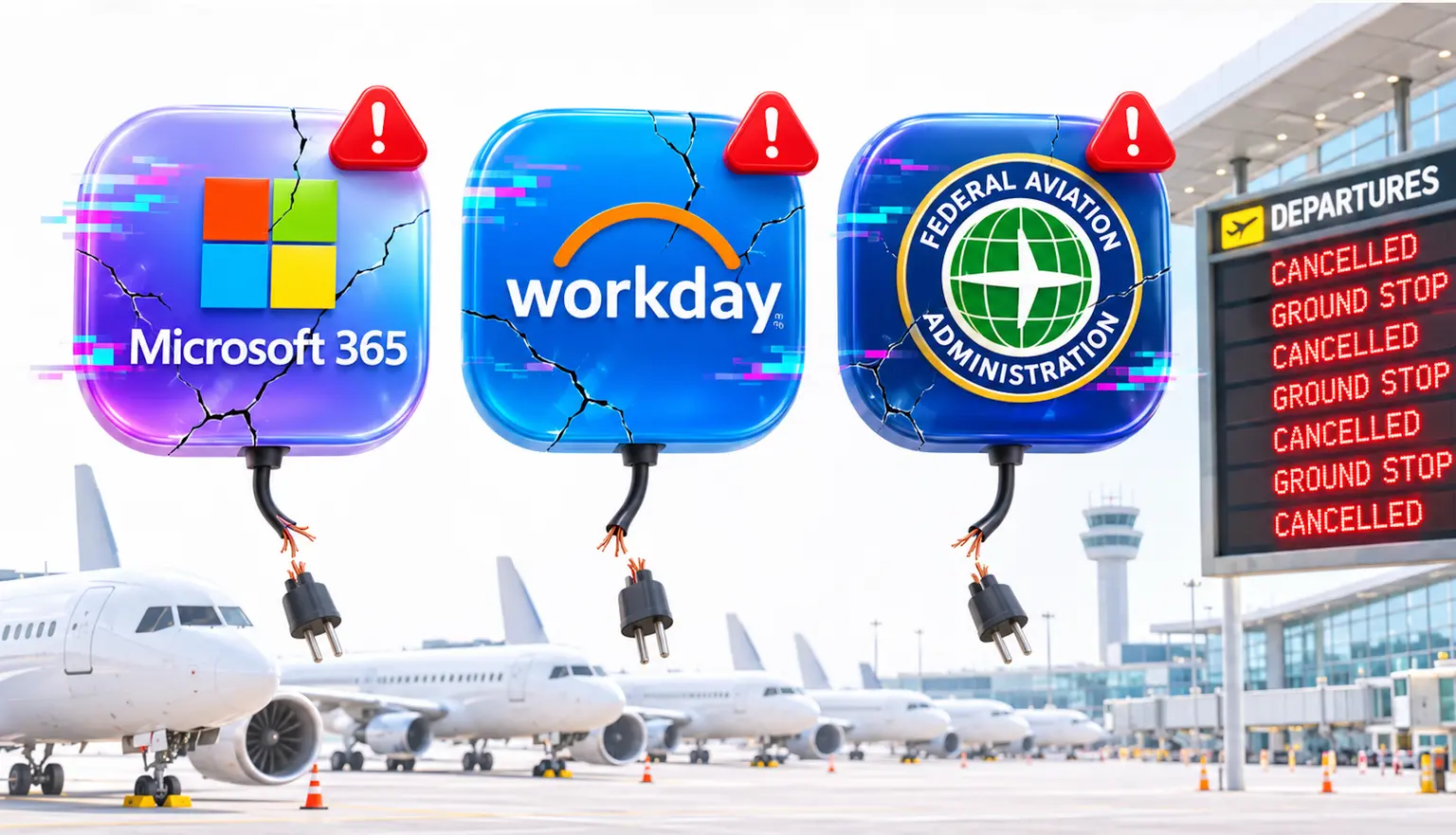
The Week Everything Broke
Everyone is chasing AI, but nobody is watching the systems that keep everything running. Microsoft 365, Workday and the FAA all stopped working within days of each other. As I prepare to attend Microsoft Ignite, I believe CIOs need to focus again on the cost of outages and what happens when AI agents stop working.
Rob Scott · 15 Nov 2026
When Workplace AI Fails, Who Is Accountable for Fixes?
Support for workplace AI is becoming a test of data quality, access controls and shared responsibility. Nishanth Sirikonda of FirstDay Foundation explains why IT teams should check the source information, permissions and systems behind an AI answer before blaming the AI tool.
Christopher Carey · 10 Nov 2026