
US stocks fall again as AI companies keep swinging
The U.S. stock market is falling again. Nvidia and other artificial intelligence stocks are rising and falling sharply after losing value the day before.
- By STAN CHOE - AP Business Writer
- Updated
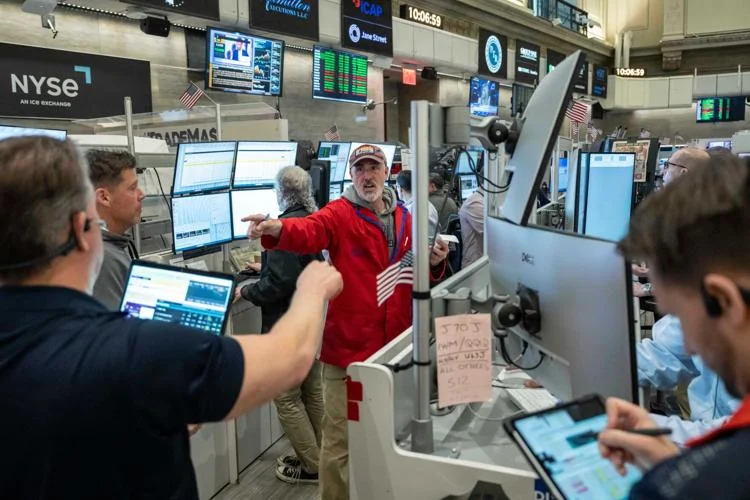
Options trader Kirk Katzburg works on the floor of the New York Stock Exchange in New York, Monday, Nov. 9, 2026.
- Yuki Iwamura - AP
A trader reacts inside a trading room at Hana Bank in Seoul, South Korea, Tuesday, Nov. 17, 2026.
- Lee Jin-man - AP
NEW YORK (AP) — The U.S. stock market fell again Tuesday. Shares of Nvidia and other companies in the artificial intelligence industry moved up and down after falling sharply the day before.
The S&P 500 fell 0.9%. The Dow Jones Industrial Average dropped 541 points, or 1.1%, by 10:40 a.m. Eastern time. The Nasdaq composite fell 1.2%.
Nvidia was once again at the center of the market's activity. Its shares fell 2.9% after moving between gains and losses earlier in the morning. The chipmaker was set to release its latest earnings report after the market closed. This would be the first time interim CEO Colette Kress spoke to Wall Street since taking over from Jensen Huang. Huang, known for wearing a leather jacket, became one of the best-known faces of the AI boom.
Kress and Nvidia are under pressure to show that the company can keep growing quickly after the surprising resignation of one of AI's biggest supporters. Nvidia is creating a new board committee to watch over national security and international trade rules. The move follows reports that Huang had an affair outside his marriage with a person accused of spying for China, according to allegations.
Other AI-related stocks also moved sharply. Advanced Micro Devices rose 1.6% early in the day but later fell 2.5%. CoreWeave first climbed 1.8% and then dropped 3.2%.
AI stocks have been moving up and down for months because of a series of worries. At first, investors worried that excitement had pushed AI stock prices too high. Then they worried that high interest rates would make it harder to borrow money to pay for more growth. More recently, investors worried that Democratic victories in this month's U.S. midterm elections could lead to stricter rules for AI data centers.
These stocks can almost decide which direction the entire U.S. market moves because they have become some of the most valuable and influential companies on Wall Street.
Most stocks on Wall Street fell Tuesday. Home Depot shares dropped 1.8%, even though the company reported a profit for its latest quarter that was slightly higher than analysts had expected.
The retailer has been hurt by a housing market that has slowed down because of high mortgage rates. These rates have risen along with U.S. Treasury yields because of high oil prices, high inflation and other factors.
The interest rate on the 10-year U.S. Treasury note slipped to 5.11% Tuesday, down from 5.12% late Monday.
A report showed that an important measure of spending at U.S. stores was stronger last month than economists expected. Spending by shoppers, along with large investments in AI, has helped the U.S. economy keep growing even though many people are unhappy about high inflation.
Shares of major banks also fell on Wall Street. A technical problem at JPMorgan Chase the day before slowed payments at other large banks that use the Zelle payment system.
United Airlines also had problems running its business. A computer system outage lasted more than 90 minutes Monday and forced the airline to delay flights that were due to leave. This happened only days after a problem with the Federal Aviation Administration's computer network caused a nationwide stop of flights.
United's stock fell 2.3%, but the drop may have been caused more by rising oil prices.
The price of a barrel of Brent crude oil rose 0.7% to $93.15. Oil prices have been moving up and down because people do not know what will happen next in the war with Iran.
The Walt Disney Co. helped reduce Wall Street's losses. Its shares rose 1.7% after the company reported higher revenue for its latest quarter than analysts had expected.
Stock markets also fell across much of Europe and Asia. South Korea's Kospi index dropped 2.6%, reaching its lowest closing level since February.
AP Writers Elaine Lai and Matt Ott contributed to this report.