
Slaves and Other “Artificial Intelligences”: What the Classics Warn Us About AI

The first artificial intelligence belonged to the Greek gods. In Homer's Iliad, the god Hephaestus had golden robot helpers shaped like young women. They moved quickly and could speak and think better than humans. As historian Adrienne Mayor has written, ancient automatic machines usually had three main purposes: work, sex, and entertainment or public display.1 Hephaestus's golden helpers did all three. They worked in his workshop, helped with his divine creations, and also pleased the reader's imagination.
The dream of artificial intelligence is that machines can do work without effort from people. But for thousands of years, artificial intelligence has depended on hidden human labor. Stories and history from the ancient world show us the human suffering that can come when people try to gain superhuman abilities by handing their thinking over to others.
And these artificial beings were not only part of myths. Even more surprising and disturbing is the real history of ancient people turning human minds into intelligent machines. For example, powerful Romans used the work of enslaved people to increase their own knowledge and abilities.
Consider Herodes Atticus, a Roman senator who raised a group of enslaved children to help teach his own family. When he learned that his son could not learn the alphabet, possibly because of dyslexia, Herodes came up with an unusual plan. He decided to raise 24 enslaved boys alongside his son. Each boy was the same age as the son and was given the name of one letter of the alphabet.2 This required a huge amount of money and human effort. Herodes had 24 enslaved playmates for his son, even though he had only six biological children of his own. But the most striking part of the story is that each enslaved boy was treated like a living letter, a tool to help the free-born child learn. Imagine Herodes's son arranging the boys into syllables and groups of sounds, just as children in the ancient world practiced writing with pens and papyrus.
These boys had been brought into the household only to help one rich child remember the alphabet. Once Herodes's son understood how letters worked, the boys would no longer be needed as learning tools. No record tells us what happened to them. Even their names and their futures disappeared from history.
Another example is Calvisius Sabinus, an extremely wealthy man who owned enslaved people. According to letters by Seneca the Younger, Sabinus created a kind of human library. He kept enslaved people who had memorized all the Greek poets. Whenever he wanted a book that no one in his collection had learned yet, he ordered a new enslaved person who was trained for that purpose. Sabinus did not build this collection to improve his own knowledge. He wanted to impress his dinner guests. At parties, he would call on his enslaved people to recite the right poems so that he could repeat the lines himself.
His friends joked that it would have cost less to buy the books and learn them himself. But why bother learning anything personally when you can have a computer in your pocket? Sabinus defended his approach by saying that anything known by someone in his household could be counted as something he knew.3
Today, Bill Gates predicts that "intelligence will be completely free." But Seneca's letter points to a darker possibility: intelligence that seems to require no effort may always depend on someone else's work.
Seneca tells the story of Calvisius Sabinus for much the same reason that college teachers like me warn students against depending on ChatGPT. People who use a library of enslaved workers do not truly learn or understand the information those workers provide. Seneca wants us to see that Sabinus uses a kind of artificial intelligence but gains no wisdom from it.
But Seneca also seems to predict a modern dream: having access to all the knowledge in the world without making an effort or taking responsibility for how we use it. In Seneca's time, creating a human alphabet or a library of enslaved people was extremely expensive. Only the very rich, such as Herodes Atticus and Sabinus, could afford it. It is easy to imagine how horrified Seneca would be by a world in which almost anyone could ask for the right lines from Homer and hear them whispered through tiny headphones.
Today, Bill Gates predicts that "intelligence will be completely free." Perhaps he is right. Perhaps one day everyone will be able to use AI without facing any real barriers. But Seneca's letter warns us that intelligence that seems effortless may still depend on other people's labor.
Our main question is no longer what large language models (LLMs) can do. It is what we are willing to do with them. What will we decide is acceptable as automation becomes cheap, easy, and obedient?
We cannot say that no one warned us.
The Greek poet Hesiod tells how the gods once created an artificial woman named Pandora from earth and water. They gave her a beautiful face and decorated her with golden jewelry. But hidden inside her, where only the gods could see, were the "lies and clever words and dishonest character"4 that Zeus had designed for her. Her name, Pandora, means "all-gift." This is an unhappy joke, because each god gave her a special quality that would bring trouble to humanity.
Perhaps this is too dark a way to tell Pandora's story. Perhaps it is too gloomy a comparison for the "all-gift" that today's technology leaders hope to give humanity. A more hopeful version begins with the titan Prometheus and his desire to make life better. According to Hesiod, the gods had hidden away the tools that made life easy.5 But Prometheus knew that a small amount of Zeus's fire could give humans enough food and resources for a whole year in a single day. So he stole the fire, lighting a flame that promised to make human work much easier.
The technology optimists of 2026 have the same hope for a future filled with AI-powered abundance. "Technology brings incredible benefits, but we must ensure everyone has access to them," says Sundar Pichai, the CEO of Google. He presents this new technology as a way to improve human life. "We have the opportunity to improve lives at a once-in-a-generation scale."6 Who can blame Prometheus for wanting the power of the gods and freedom from hard work? Who among us has never wanted to play with fire?
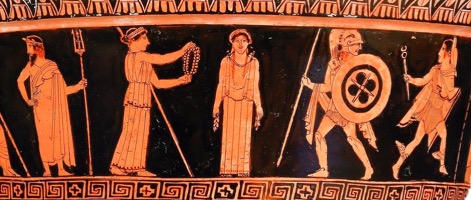
Artificial intelligence is most tempting when its attractive appearance makes us believe that work can happen without effort. We can see this danger in a famous painting of Pandora by the Niobid Painter, made around 450 BC (fig. 1). Something about Pandora's appearance against the dark background feels disturbing. Unlike the other figures on the vase, she faces directly forward. Her arms hang stiffly at her sides, and she looks out with a lifeless, pleasant expression. Like many of the greatest artists in Athens, the painter shows us the moment just before the main action. Before Pandora comes down to earth. Before she attracts Prometheus's brother. Before she opens her jar and releases all the suffering of humanity. Hesiod called Pandora a kalon kakon, meaning a "beautiful evil."7 We can sense the danger she carries, but we cannot stop it.
Appearance is never just about appearance. This is true in Greek mythology and in today's race to build the most attractive intelligent machines. Big technology companies have long understood that people are drawn to virtual assistants with human names and personalities. During the 2010s, these assistants were mostly presented as helpful women who followed orders. Microsoft's Cortana and Amazon's Alexa joined the conversation that Apple's Siri had already made popular.8
In the 2020s, people using large language models have started looking for oracles more than simple assistants. In response, Anthropic named its AI system "Claude" after Claude Shannon, the famous inventor and thinker who worked in many fields. Shannon had named his own artificial mouse "Theseus," after the Greek hero who escaped a maze. Interestingly, Shannon seems to have depended on his wife's mathematical skill, Betty's, much as Theseus depended on the help of Ariadne. But that is another myth for another day.
Before Google introduced its chatbot Gemini, it first called its generative AI "Bard." A bard is a storyteller who creates epic poems, a word closely linked to ancient poets such as Homer and Hesiod. The ancient world is deeply connected to the ideas behind modern technology.
Human beings have always reached for the fire of the gods. We use every skill and every tool we can find. In Greek, the word techne can mean both art and the skill of making things. We use these abilities because we want to gain divine power.
The craftsman Daedalus must have faced these same truths when he watched his only child fly too close to the sun and fall. Icarus's artificial wings were even more dangerous tools than the enslaved boys used by Herodes Atticus. These clever inventions could also bring terrible results. Each generation of fathers has tried to create ways to help their sons rise higher.
In Carlo Saraceni's painting of Icarus, the boy reaches into empty space with his fingers. He tries to catch loose feathers as gravity pulls him down toward the earth (fig. 2). Even as he falls, he reaches toward the sun's fire. We think we know the lesson of this story: humans should not try to rise too far above their natural limits.
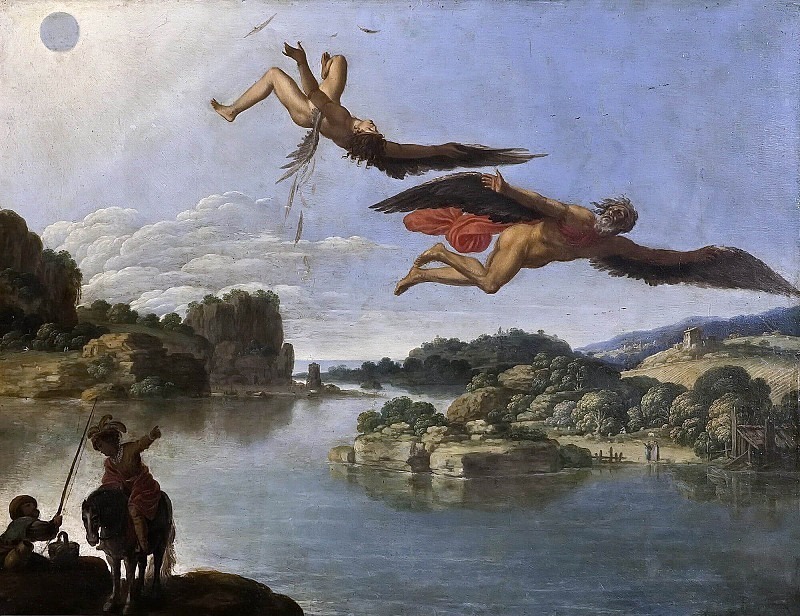
But what about the excitement before the fall, when Icarus flies beyond the limits of the earth? The Roman poet Ovid says that a shepherd and a fisherman saw Icarus flying. They looked up and thought they were seeing a god. For a brief moment, they were right. With wings made from wood, string, and wax, Icarus truly entered the sky.
The bright light of the sun makes all of us forget the costs of ambition.
The story and lesson of Icarus are famous. Less well known are reports that people in ancient times acted out his flight as part of public shows and religious events. The cruel emperor Nero, for example, encouraged young Greek men to act out shocking scenes from their own myths. One young man was chosen to play Icarus. During his first attempt to fly with artificial wings, he fell to his death and "splattered the emperor with blood."9 This story has survived because it shows how cruel and dangerous Nero was.
But there is an irony in this performance. The young actor was never meant to die. The plan was to use stage tricks and a flying harness to make it look as if the myth had become real.
Testing and testing again. Creating newer versions of human inventions. And when Sam Altman spoke about safety measures for new technology in 2023, before AI-related deaths involving young men in Florida, Texas, and California, he admitted that "there will be mistakes."10
Or perhaps these modern Icaruses are not mistakes. Perhaps they are sacrifices that we are willing to make in the name of making technology more efficient. On the Greek island of Lefkada, people are said to have sacrificed one criminal each year to honor Apollo. They attached wings to the person and threw him from a high rocky cliff. The wings are a strange detail. According to Strabo, they may even have attached living birds to the person.11 Why would they prepare someone who had been sentenced to die to fly? Did the people of Lefkada hope that one of these unlikely Icaruses might stay in the air, proving that the gods favored him and that humans could fly? As far as we know, none succeeded. Instead, the people of Lefkada collected the bodies of those who fell into the water below. They used fishing boats to carry the bodies away from the island so that the sacrifice would not pollute their community. This was a familiar idea in Greek religious practice: making a community pure by removing things believed to bring pollution.
And yet, perhaps after every flight and every fall, the people of Lefkada could not bear to look at the remains of another Icarus. Bodies and broken wings sank to the bottom of the sea or washed up on distant shores, like waste left behind by a failed experiment.
People in the modern world exploit human minds and bodies just as people did in ancient times. The difference is that today we make less of a public show of it. Today's equivalent of Herodes's "letter-boys" are workers who label data and check harmful online content. They work in windowless offices in Kenya and Uganda.12 Today's Icaruses travel through city streets in robotaxis that secretly depend on remote human drivers and helpers in the Philippines.13 The strange truth about our AI revolution is that it depends on "a hidden army of workers kept behind the curtain by companies interested in maintaining the fiction of smart and autonomous machines."14 In this way, we too become dependent on the human archive.
The ancient world does more than give us myths that help explain how artificial intelligence is designed and discussed today. It makes us face the human work that supports intelligence itself. If we continue believing that artificial intelligence can exist without human labor, we may end up permanently bowing before artificial gods.

This article was commissioned by Mona Sloane.
- Adrienne Mayor, Gods and Robots: Myths, Machines, and Ancient Dreams of Technology (Princeton University Press, 2018), p. 180. ↩
- Philostratus the Elder, Lives of the Sophists 558. All translations of Greek and Latin sources are by the author. ↩
- Seneca the Younger, Epistle 27.8. ↩
- Hesiod, Works and Days 78. ↩
- Hesiod, Works and Days 47. ↩
- Sundar Pichai, "Keynote Address," India AI Impact Summit 2026, YouTube video, 6:33. Posted by Business Standard, February 19, 2026. ↩
- Hesiod, Theogony 585. ↩
- Yolande Strengers and Jenny Kennedy, The Smart Wife: Why Siri, Alexa, and Other Smart Home Devices Need a Feminist Reboot (MIT Press, 2020). ↩
- Suetonius, Life of Nero 12.2. ↩
- Sam Altman, interview by Connie Loizos, "StrictlyVC in Conversation with Sam Altman, Part Two," YouTube video, 34:23. Posted by Connie Loizos, January 17, 2023. ↩
- Strabo, Geography 10.2.9. ↩
- Kelly Makola, "There Is a Dark Side to Content Moderation in East Africa," London School of Economics Blog, November 3, 2025. ↩
- Victor Tangermann, "It Turns Out That When Waymos Are Stumped, They Get Intervention from Workers in the Philippines," Futurism, February 6, 2026. ↩
- James Muldoon, Mark Graham, and Callum Cant, Feeding the Machine: The Hidden Human Labor Powering A.I. (Bloomsbury, 2024), p. 189. ↩