
QuEra exec on AI-designed quantum circuits, and why he doesn’t expect drug discovery to be quantum’s first big win
By Brian Buntz |
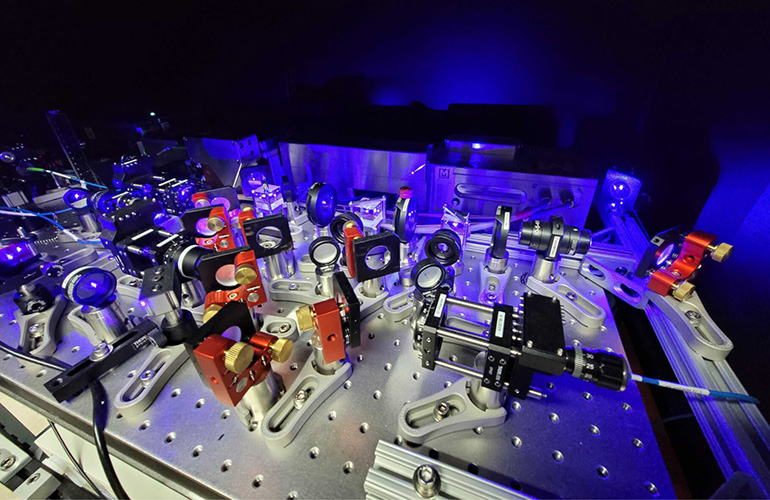
QuEra’s optical layout. Credit: QuEra Computing
Anthropic, the company that makes the Claude AI models, reported on November 9 that its newest advanced model, Claude Fable 5.2, is good at designing hardware. The model designed a speakerphone, a hub for a voice assistant and a handheld virtual pet. It also designed their circuit boards, outer cases and software that runs inside them. According to Anthropic, human engineers built working versions of these devices without needing to change their circuit boards.
Claude has also been helping with quantum hardware at QuEra Computing, a quantum computer company based in Boston. In August, QuEra said earlier versions of Claude had helped automate laser controls. Then, in October, a research paper published by researchers from Harvard, Anthropic and QuEra described quantum circuits designed by Claude that need fewer gates and fewer qubits. QuEra's computers use lasers to control individual neutral atoms. These atoms act as qubits, the basic units of quantum information. The lasers must stay at very precise frequencies for the hardware to work properly.
“People often expect drug discovery to be the first big win. I don’t.”
Yuval Boger, chief commercial officer, QuEra
In the following interview, Yuval Boger, QuEra’s chief commercial officer, says that materials research could bring some of the first major scientific benefits from quantum computers that can correct their own errors. Boger explains how AI is helping engineers operate quantum computers and make their calculations require fewer resources. He also discusses what researchers still need to prove.
R&D World: In August, QuEra reported that a controller built with Claude restored a laser's frequency lock in 695 out of 700 tests. What has happened since then, and what safety checks did your engineers put in place before trusting the code?

Yuval Boger
Boger: The laser control work got people's attention, but it is only one part of a much bigger story. AI is now helping us in three areas: designing algorithms, correcting errors and running the systems themselves.
The biggest development since August is in algorithm design. In October, we published a research paper with Harvard and Anthropic showing that Claude could find fault-tolerant circuits that worked better than designs made by people. In seven out of eight main tasks, the new circuits needed fewer gates and fewer qubits. I think of this as making algorithms more compact. Take FeMoco, a well-known chemistry test problem. Researchers reduced its estimated cost by about 150,000 times, and it took them eight years. Could AI achieve something similar in just a few months? For some basic parts of the problem, this paper gives us an early sign that it might.
Work on error correction is also moving forward. Computer programs trained with machine learning are helping quantum computers get better results from the same hardware. The cascade-decoder result we discussed in October came from our Harvard partners, and they deserve the credit for it.
I would add two warnings. AI is also making traditional computing methods better, so quantum computers have to keep improving to stay ahead. Also, I won't claim that AI has moved our development schedule forward by a certain number of years. Libra is still planned for 2028.
As for the laser, the controller that restores its frequency lock has moved beyond the trial stage. It is now a separate production script. This is ordinary software that people can read line by line, and it does not need AI when it runs. We still use AI to tune the system, and our next step is to turn that work into a standalone tool. After that, we will use it on live systems. I would be surprised if the laser were the last part of the system we handled this way.
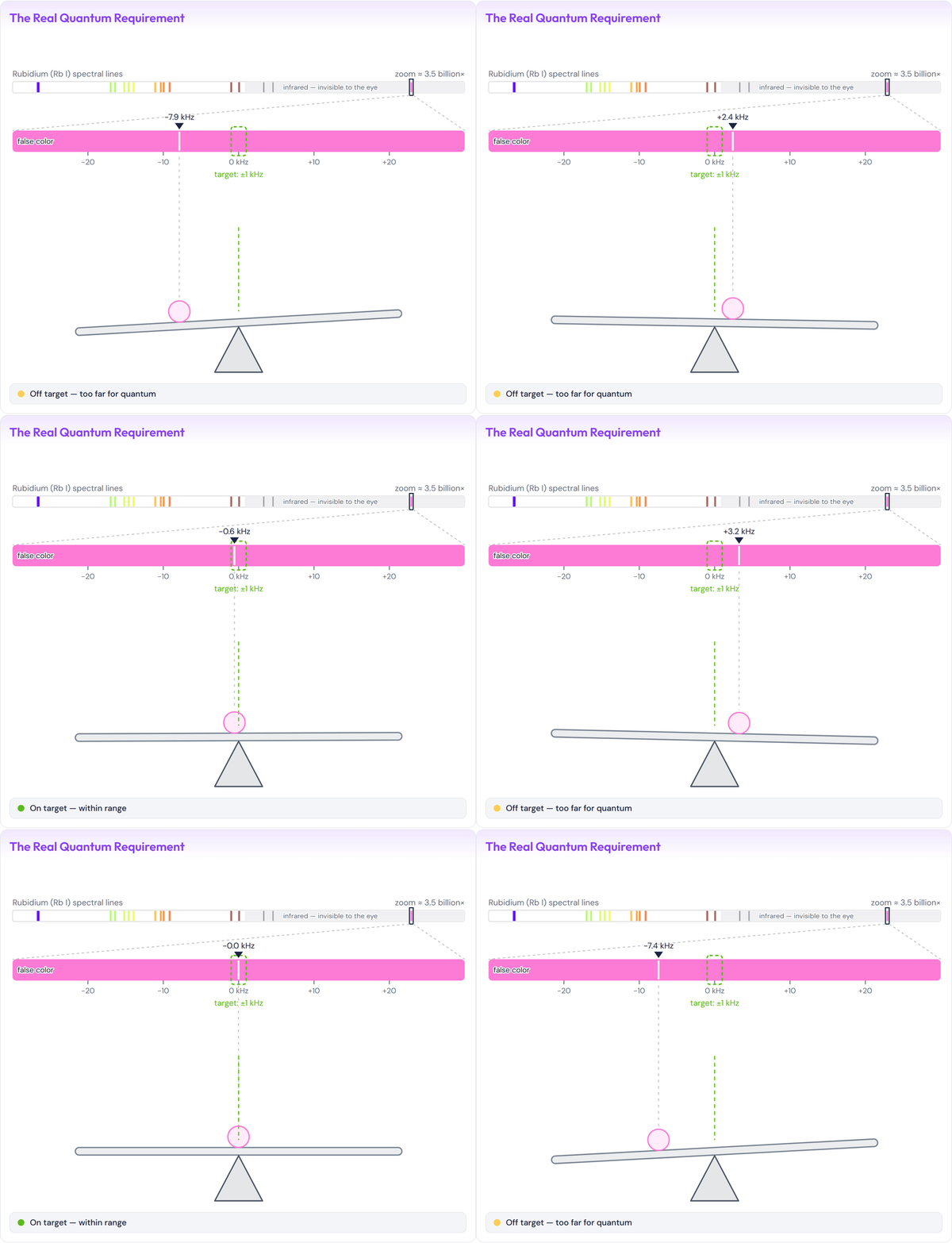
The laser must keep its frequency within about ±1 kHz of a rubidium spectral line. Credit: QuEra Computing
Claude was never allowed to control everything without limits. Our Model Hardware Standard sets limits, safety locks and emergency stops at the hardware connection. The AI model cannot change or bypass these protections. Our engineers decide what those limits are. To show how strict they must be, a laser used for logical-qubit operations has to keep its frequency within about ±1 kHz. That leaves very little room for error. People were in control throughout the project. They decided what the AI could do, checked every step and decided what evidence would count as proof.
We were also very careful about how we defined success. The controller only says that the laser is locked when the cavity signal confirms it and the wavelength matches the target. We ran 100 timed tests for each of seven types of faults. That is how we got the result of 695 successful tests out of 700. All five failures came from one problem with the test equipment, not from the control software. During the tests, the laser also changed to the wrong operating mode by itself 43 times. The controller detected and handled all 43 events.
A disturbance pushes the laser into the wrong mode. A broad adjustment brings it back toward the target, and fine control locks it into place again. Credit: QuEra Computing
R&D World: The October research paper from Harvard, Anthropic and QuEra researchers (arXiv 2610.22367) reports that the circuits needed fewer resources in seven of eight tasks. These are estimates of the resources needed, not results from running the circuits on a quantum computer. What did the chemistry tasks show, and when might you run these circuits on real hardware?
Boger: The paper includes two chemistry results. The first involves Fe2S2, an iron-sulfur group that chemists use as a test problem. The AI-designed method improved the product of the Toffoli gate count and the number of qubits by 4.1 times. The second involves the Coulomb potential, where the improvement was 9.9 times. The number of Toffoli gates fell from 6,355 to 1,140, and the number of qubits fell from 252 to 142. I want to be clear about what these results mean. These are circuit designs that have been checked, along with estimates of the resources they would need for basic parts of larger calculations. They have not been run on quantum hardware, and they are not complete applications.
Why is this important? Every fault-tolerant quantum computer has a limited amount of computing power available. For example, Libra is designed to have 256 logical qubits and perform about one million reliable operations. If AI reduces the resources needed for each basic part of a calculation, the same computer can handle a larger problem. It could study a bigger molecule, include more parts of a molecule in a calculation, or run a more detailed simulation. Think of it like improving how files are compressed on a phone. The phone has the same storage space, but you can fit more files on it. However, the benefit to a complete application depends on how much of its total cost comes from the parts that have been improved. We need to check each application separately.
These circuits are designed for fault-tolerant quantum computers, so Libra is the natural machine to run them on. We plan to make Libra available in 2028 through Amazon Braket and at high-performance computing centers. Before then, we can test the circuits using computer simulations that imitate quantum hardware.
R&D World: Density functional theory (DFT) and force fields trained with machine learning are already very powerful. What molecular problem will a fault-tolerant quantum computer solve first that these methods cannot solve, and how many logical qubits will it need?
Boger: People often expect drug discovery to be the first big success. I don't. DFT and machine-learning force fields work very well, and AI is making them better every year. I expect fault-tolerant quantum computers to show their first benefits in the study of materials with strong quantum interactions. These are problems where traditional computing methods can give different answers depending on which method researchers use. Fermi-Hubbard lattice models with sizes up to 10×10 are a good example. These problems fit the planned abilities of Libra: 256 logical qubits, a logical error rate of 10⁻⁶ and about one million reliable operations.
Molecular chemistry will come later. One example is calculating the lowest energy state of molecules with strong quantum interactions and small-to-medium active spaces. These include the active sites of metalloproteins and chemical systems involving transition metals. This work will need our next-generation quantum computer. It is designed to have more than 1,000 logical qubits, a logical error rate of 10⁻⁹ and about one billion reliable operations. We are aiming for 2028 or 2029. That is a goal in our development plan, not a guaranteed delivery date. The amount of computing power needed is also falling. Estimates for FeMoco have dropped from about 50 trillion Toffoli gates to about 340 million over eight years. Our research paper suggests that AI could help speed up this progress.
We are not working on these questions alone. Chemistry experts in the QuEra Quantum Alliance, especially QC Ware and Phasecraft, are studying exactly which molecular problems are too difficult for traditional computers and what resources those problems would need on our systems. We want to have these answers before the hardware is ready.
R&D World: Are you working with pharmaceutical companies or AI drug-discovery companies to create data using quantum computers? What might that data look like if it were used to train AI models?
Boger: Yes, although I would not call it quantum-generated training data just yet. In 2025, Merck, Amgen, Deloitte and QuEra published a study that used quantum reservoir computing to predict properties of molecules. The work ran on our hardware and used more than 100 qubits. A traditional computer model learned from features produced by the quantum system. This is the closest example we have to what you are describing. Two of the six finalists in Wellcome Leap's Quantum for Bio Phase 3 program also run their work on our hardware. One project studies covalent inhibitors for myotonic dystrophy and involves researchers from Nottingham and Phasecraft. The other studies how strongly molecules bind to each other and estimates NMR results. It involves researchers from Harvard and MIT.
What might the data look like? It would probably be a fairly small collection of very accurate energy values and other molecular properties. Each value would include an estimate of its possible error. The data would cover molecules and molecular arrangements where traditional computing methods are least reliable. Researchers could use these results to train or improve traditional computer models. In this way, a small number of expensive quantum calculations could help improve millions of much cheaper predictions. I like this idea, but it has not been demonstrated yet. To produce data that traditional computing methods cannot provide, we need fault-tolerant quantum hardware.