
AI agents are starting to fill out medical forms and file insurance requests in place of human staff

OpenAI wants GPT-6 Astra and GPT-6 Luna to work like digital office workers. They can click and type in clinic software and insurance websites. According to the company, GPT-6 Luna can complete office tasks for about 8.5 cents each.
In a recent product announcement, OpenAI focuses on a problem in healthcare: many systems do not have APIs that let different software programs share information directly. The computer-use agents added to the Agents API in late September use existing computer screens much like a human does. In this case, they move information between electronic health records and outside websites.
OpenAI says that when a patient reports back pain, an agent is designed to look for relevant information from earlier medical visits and prepare an MRI order and a message to the patient. It should also prepare a request for approval on the insurance company's website. Doctors and the staff responsible for office work check these drafts before they are sent. These features are available through the API and through ChatGPT for Healthcare and ChatGPT for Clinicians.
Video: OpenAI
GPT-6 Luna completes office tasks for 8.5 cents each
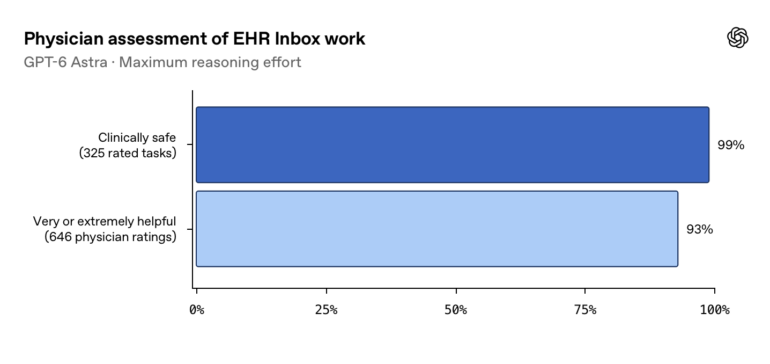
In a test described by OpenAI, GPT-6 Astra handled tasks from electronic health record inboxes. These included preparing an ibuprofen dose for a child with a broken arm. Doctors who reviewed the work judged 99 percent of the 325 tasks to be safe for clinical use. In 93 percent of 646 reviews, they said the preparation work was very or extremely helpful.
For office tasks such as getting insurance approval before treatment, filing appeals, and ordering medical equipment, OpenAI points to HealthAdminBench, an independent test created by Stanford University researchers. GPT-6 Astra scored 94.3 percent of the possible points. GPT-6 Luna, which was designed to have lower API prices, scored 91.8 percent. OpenAI says it cost about 8.5 cents per task, which is 98 percent less than Astra. Both models used their highest reasoning setting in the test.
Major US healthcare companies test and use OpenAI's computer-use agents
Several partner organizations are helping develop this technology. At CVS Health, the agents already handle referrals and specialist appointments across separate computer systems. According to the announcement, one agent cleared a backlog of outgoing documents that had built up over several months in a single weekend. Another handles the computer steps for tens of thousands of consultations each day. CVS Health published the design of its software as Agent Kit on GitHub.
At health insurance company Cigna Healthcare, the models bring together patient information from more than 10 different systems. Abridge is developing the agents for possible use in planning patient discharges from hospitals. Ambience has shown extra safety features. For example, an agent stops if a patient's record is unclear and asks a doctor for help. Startups such as Assort also use this feature in Codex to complete referrals in medical office software when the software's APIs cannot perform the final click.
Data privacy, health records, and Europe
Because the agents work directly with electronic health records, protecting private medical information is a major concern. OpenAI says it does not use data from organizations to train its main models. According to the company, ChatGPT for Healthcare includes controls that limit access based on a person's job role, as well as records of system activity. Organizations can also set up their apps and computer environments so that an agent can only access the records and perform the actions needed for a particular task.
For workflows covered by HIPAA that involve protected health information, organizations must sign a Business Associate Agreement (BAA) with OpenAI. They must also use services covered by the agreement and apply the required security and data-retention settings. Healthcare organizations are responsible for using the system correctly. OpenAI also has its own responsibilities under HIPAA as a company that has signed the agreement. Medical professionals in the US whose credentials have been checked and who use ChatGPT for Clinicians, a free plan for individuals, can also sign a BAA. However, the agreement only covers the features included in it.
According to OpenAI, in the CVS Health setup, data stays inside computer systems controlled by CVS. CVS checks the agents' work by reviewing screenshots and records of their actions. The announcement does not explain where these screenshots are processed or how long they are kept. It also does not discuss Europe's General Data Protection Regulation (GDPR). So far, the service is aimed at the US market.
OpenAI presents this technology mainly as a way to reduce the amount of office work caused by a healthcare system in which many different systems do not work well together. But wider use will likely depend on more than the accuracy scores and costs in the company's announcement. It will also depend on how reliably the agents work with existing systems and whether people can reliably monitor AI agents in real-world use. Another question that remains open is whether a human must make decisions about steps that have medical or legal consequences.