AI Is Changing How Lawyers Learn. That Can Be a Good Thing.

For many generations, becoming a lawyer has followed a familiar path: first learn the basics, then learn by doing, get advice from more experienced lawyers, and slowly take on harder work and more responsibility. Artificial intelligence (AI) is changing this path.
Some tasks that AI can now do faster used to help lawyers produce excellent work for clients. These tasks also gave junior lawyers practice. By doing this work again and again, they learned legal ideas, spotted patterns, understood what was important, and developed good judgment. If new lawyers spend less time doing the basic work that helped earlier generations gain experience, how will they develop the judgment that clients depend on?
AI gives law firms both an opportunity and a responsibility to think more carefully about how lawyers learn. This means giving lawyers better feedback and letting them take part in client work earlier, while still helping them develop the independent judgment that earns clients' trust. Learning from experienced lawyers is not going away, but this way of learning is changing.
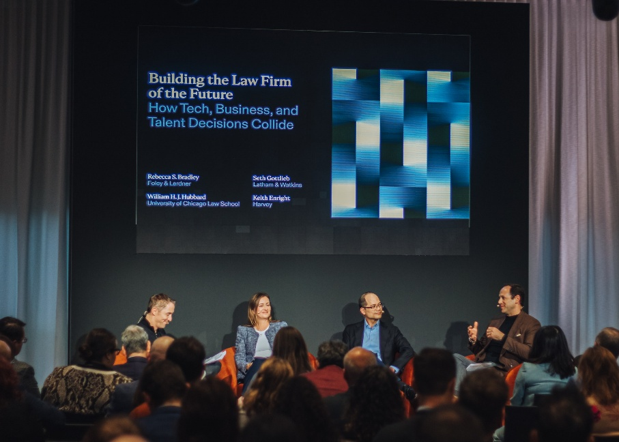
I had the chance to explore what this change could look like as a panelist at the Building The Law Firm of the Future: How Tech, Business, and Talent Decisions Collide program during Harvey Forum Chicago 2026. The other panelists were Seth Gottlieb, a Partner at Latham & Watkins and Global Vice Chair of its Technology Industry Group, and William H. J. Hubbard, Clifton R. Musser Professor of Law and Economics at The University of Chicago Law School. Harvey Chief Strategy Officer Keith Enright led our discussion. Here are some important lessons from our conversation.
AI can create more time for training, but firms must choose to use that time this way.
AI gives law firms something very valuable in a profession where time is always limited: more time and more ability to get work done. The important question is how firms use that extra time.
If AI saves an hour on a task and that hour is immediately used for the next task, the firm has become more efficient but may have missed a chance to help a junior lawyer learn. If the firm uses some of that saved time for feedback, meetings with clients, and talks about plans and good judgment, the learning experience can become much better.
Making work faster is not the only goal of helping lawyers grow. Learning takes time, practice, trying new things, and sometimes struggling. Young lawyers need chances to make decisions, test their ideas, get feedback, and try again.
Firms can help lawyers learn through practice exercises and repeated attempts. For lawyers who handle court cases, this might include exercises on reviewing private legal information, practicing objections, and making arguments. It can also mean getting more advice from experienced lawyers who explain why the work is done in a certain way. Junior lawyers can meet clients earlier, too, so they can understand their needs directly. Firms should also be honest about the past: not every difficult task that junior lawyers handled before AI helped them develop good judgment. Firms can use the time saved on those tasks for learning experiences that do help.
AI can also help create these learning experiences. The same technology that is changing legal work can make practice exercises easier to create, personalize, and repeat. For example, AI can create a new set of documents with hidden problems involving private legal information. It can also act as the lawyer on the other side of a case or even as an arbitrator during a practice argument.
Feedback must change, too.
As AI becomes a normal part of legal work, supervising lawyers need to understand not just the finished work but also how it was created. This gives partners and associates another chance to have deeper conversations about how the work gets done.
When giving an assignment, the supervising lawyer can explain whether using AI is suitable and where it might help. They can also discuss any rules or expectations set by the client and how carefully the work must be checked. They should explain what needs to be delivered and when. When the work is returned, they can ask how the associate used AI, what they asked it to do, how they improved and checked its answers, and whether there is anything in the work they do not fully understand.
For example, imagine a first-year associate turns in a research memo written with help from AI. A supervising partner who asks, “What did you ask the tool to do, and how did you check the citations?” learns much more about the associate's judgment than a partner who only reads the memo. The associate also learns that checking the work is an important part of the job.
Focus on skills, not individual tasks.
The main skills lawyers need have not changed. These include good judgment, making ethical choices, writing and communicating clearly, and understanding what clients want to achieve. For example, good judgment is what makes a first-year lawyer stop and look more closely at a clause that seems ordinary, or question a case citation that seems almost too perfect. In the first years of working as a lawyer in a world with AI, one of the most important skills young lawyers will develop is knowing when AI should be used, not just knowing how to use it.
This difference matters to law students and junior lawyers. Your value will not come from trying to beat a tool by writing a first draft faster. It will come from understanding the problem well enough to decide what the tool should do, spotting when its answer is incomplete or wrong, and knowing how to make it better.
Good judgment is still the most important thing.
AI makes the human parts of being an excellent lawyer even more important. These include asking the right questions, thinking carefully instead of believing everything straight away, and understanding what matters to the client. The extra time and ability that AI creates give law firms a chance to teach more carefully and involve junior lawyers in planning, client work, and important decisions earlier. Law students and young lawyers have good reason to feel hopeful about the future.