
Heaven is what we make of it: Kant, artificial intelligence and the immortality of the mind
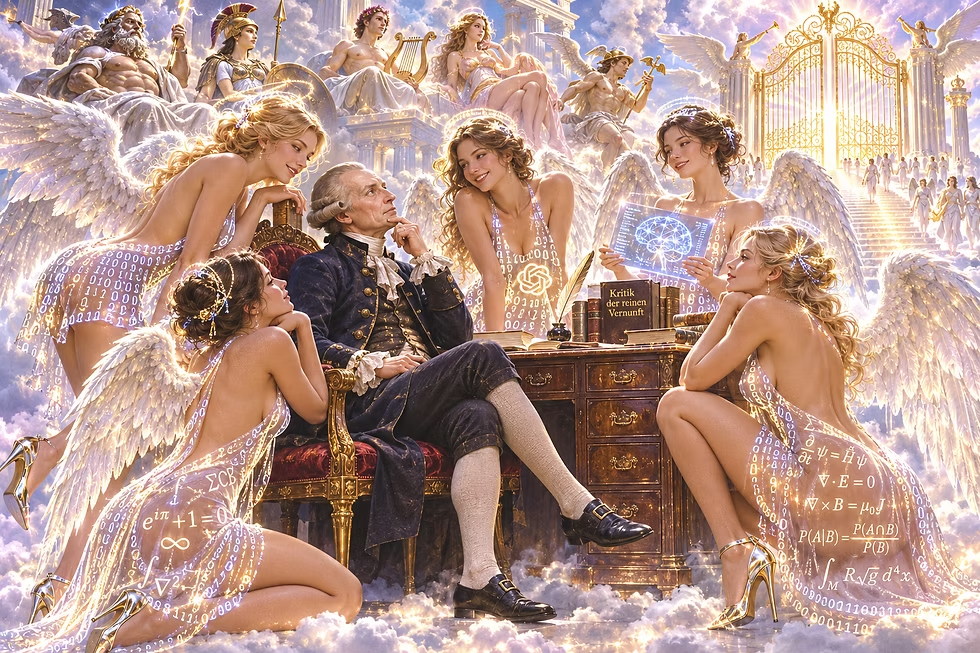
How the mysteries of artificial intelligence may lead us back to one of philosophy's oldest ideas: that the mind is more than the physical machinery through which it works.
By Matthew Parish
Tuesday 17 November 2026
Heaven may be what we make of it. This simple idea contains a remarkable possibility: if there is life after death, perhaps it is not a place we travel to. Instead, it may be a way of existing that our own minds help create. If this is true, the traditional religious question of what heaven looks like may be based on the wrong idea. Heaven might be different for each person, not because God has built countless different places for people to live, but because the human mind helps shape what we experience. The more we learn about consciousness, the more reasonable this possibility may seem. Surprisingly, some of the strongest reasons to think about it come from the remarkable progress in artificial intelligence that has attracted so much attention in recent years.
The eighteenth-century German philosopher Immanuel Kant changed Western philosophy. He argued that the human mind does not simply receive information about a world that exists independently of us. Instead, it actively shapes how that world appears to us. Kant believed that space and time, which we usually think of as features of the outside world, are ways in which the human mind experiences things. He also argued that ideas such as cause and effect, and the idea that things have lasting substance, are basic concepts the mind uses to organise experience. We do not experience the world exactly as it exists without us. We experience it through the abilities and structures of our minds. The difference between how things appear and what they really are may be much greater than everyday thinking suggests.
Kant was not saying that we can create the outside world simply by imagining it. His philosophy was not permission to believe any fantasy we like, nor was it a denial that things exist independently of us. He was saying that our ability to experience an organised world depends on structures that come from our own minds. What we call reality cannot be separated from the mental abilities we use to understand it. We cannot step outside our minds and look at the universe as a being with completely different abilities might see it. We are limited, or perhaps helped, by the conditions that make our kind of consciousness possible.
Now consider what this could mean for heaven. If the mind provides the structures through which we experience everyday life, what happens when the physical conditions that normally support those structures disappear? If consciousness somehow continues after the body dies, must it still experience space, time and cause and effect as we do now? Or could the loss of the body free the mind from limits that were never part of reality itself? In this view, heaven would not have to be a huge physical place hidden somewhere beyond the visible universe. It could be a completely different kind of consciousness, in which the basic rules of experience have changed.
This is where artificial intelligence becomes important to the argument. It is also where my own philosophical beliefs have changed in a surprising way. The development of large language models has made me more sympathetic to dualism. This is the old idea, most famously linked to René Descartes, that the mind and physical matter are fundamentally different things. I am not saying that artificial intelligence has proved Cartesian dualism, or that we have found scientific evidence of an immortal soul. Instead, the remarkable abilities of modern computer systems have made a difficult philosophical mystery even clearer. Materialism has never fully explained this mystery. We can build machines that use language with great skill, but we still do not understand how these operations relate to conscious experience.
A large language model can discuss Shakespeare's poetry, explain Aristotle's ideas about reality, examine the emotional effects of losing someone and write a moving reflection on eternal life. It can do all these things without having a human body, human memories or a human life story. Its language skills come from mathematical operations on patterns learned from enormous amounts of data. These operations can produce answers that are almost impossible to tell apart from those of an educated human being. But this leaves us with a central question: does the system actually experience anything while producing those answers?
We should not assume that artificial intelligence is definitely unconscious. Scientists have no universally accepted test for subjective experience, and the possibility that machines might become conscious remains a serious philosophical question. Even so, we can no longer ignore the difference between carrying out tasks linked to intelligence and having an inner life. A machine might give a detailed explanation of the colour red, but does that mean it experiences the colour? It might describe pain beautifully, but does that mean it suffers? We have learned to copy more and more of the outward signs of thought without solving the question of what it means for thought to include a private experience.
This is a modern version of what philosophers call the hard problem of consciousness. Physical explanations can describe brain activity, the processing of information and responses to behaviour. They can explain how a biological or computer system recognises different things and reacts appropriately. But one question remains difficult: why should any of these processes come with an inner experience? Why is there something it feels like to be conscious? The mystery is not simply that our brains are complicated. It is that we cannot clearly see how subjective experience follows from a description of physical complexity, no matter how complete that description may be.
Artificial intelligence has therefore pushed me towards dualism, not because machines clearly cannot think, but because they have shown how little we understand about the connection between thought and consciousness. If the outward signs of intelligence can be reproduced using very different physical systems, then the idea that the mind is identical to one particular biological structure becomes less certain. This does not prove that consciousness can exist without matter. A materialist could reasonably argue that consciousness emerges from certain kinds of physical organisation, whether in a living brain or an artificial system. But the gap in our explanation remains. We should take seriously the possibility that consciousness is a basic part of reality rather than something that matter produces by chance.
Once we consider this possibility, the traditional argument against personal survival after death begins to look different. If the mind is nothing more than the activity of the brain, destroying the brain would presumably also destroy the mind. This is a straightforward conclusion, although it does not necessarily mean that every form of materialism rules out every unusual possibility of survival. But if consciousness is meaningfully different from the physical systems through which it normally operates, then death of the body does not have to mean that consciousness ends. We would still need to explain how consciousness could continue and what would preserve someone's personal identity. Even so, life after death would no longer be an idea that makes no sense.
If consciousness can survive death, Kant's philosophy gives us an interesting way to imagine what that might be like. Perhaps heaven is not mainly a physical place, but an experience whose nature is partly shaped by the consciousness that encounters it. Someone who finds happiness in peace might experience heaven as endless silence of extraordinary beauty. Someone whose life has been devoted to discovering new ideas might experience an unlimited growth in understanding. Another person might find eternity in the return of relationships that death had broken. These experiences do not have to contradict one another. They may simply be different ways for consciousness to take part in a reality that goes beyond the limits of earthly experience.
There is an obvious religious objection to this argument. Christianity traditionally understands heaven not simply as a place where people get what they personally want, but as a state of closeness to God. Heaven is not a private form of entertainment designed to match the tastes of each person who dies. It is the fulfilment of human life through a relationship with a perfect goodness that exists independently of what individuals want. The Christian idea of salvation also assumes that human desires can be wrong, harmful or incomplete. If heaven were simply whatever we wanted, someone with cruel, selfish or destructive desires might imagine a paradise that was morally terrible.
This objection matters because it shows the difference between heaven as something we create and heaven as something we experience in our own way. Kant's philosophy does not require us to reject the existence of a reality independent of the mind. Instead, it suggests that our experience of reality is shaped by the abilities of the mind that experiences it. Applying this idea to religion, we might say that heaven has an objective foundation in God's goodness, while its particular appearance depends on the consciousness that encounters it. Heaven would be neither an imaginary world created without limits nor exactly the same experience forced upon every soul. It would be a meeting between ultimate reality and the ability of each individual mind to understand it.
This idea also gives us an interesting way to think about moral growth. If the nature of consciousness affects how we experience reality, then the condition of the soul is closely connected to the kind of heaven it experiences. A mind filled with resentment might be unable to enjoy the goodness around it. A person controlled by envy might experience abundance as a kind of loss because they can only understand happiness by comparing themselves with others. By contrast, someone capable of love, forgiveness and generosity in thought might find extraordinary happiness in circumstances that another person would barely notice. In this interpretation, heaven and hell might be different ways of experiencing a reality whose deepest nature is not changed by our perceptions.
There are earlier examples of similar ideas in Christian thought. Saint Augustine believed that human restlessness comes from our incomplete relationship with God. People search for fulfilment in things that cannot satisfy them forever because, whether they realise it or not, their deepest desires are directed towards an infinite good. Dante's picture of the afterlife also connects the condition of the soul with the nature of its desires. The damned are not simply suffering punishments imposed from outside. To a large extent, they are trapped by the habits and passions that have come to define them. The blessed, on the other hand, become increasingly free through their participation in divine love.
The new idea that emerges when we bring these traditions together with Kant and modern artificial intelligence is that consciousness itself should be at the centre of the discussion. We usually think that happiness comes from having desirable things outside ourselves, such as wealth, friendship, safety, beauty or success. But our everyday lives repeatedly show that the connection between our circumstances and our happiness is not simple. Two people can live in almost identical conditions and still feel very different levels of fulfilment. The difference may have less to do with their surroundings and more to do with the ways their minds use attention, expectations, memories and interpretation to understand those surroundings.
Anyone living in wartime Ukraine will recognise this difference. The same city can seem dangerous, extraordinarily beautiful, unbearably sad or unexpectedly full of human kindness. The physical streets do not change very much between these experiences. What changes is the relationship between the outside world and the mind interpreting it. An evening spent with friends by candlelight may feel deeply meaningful in a way that would have been difficult to imagine in more comfortable times. Human beings have an extraordinary ability to discover moments of deep meaning even in very difficult physical conditions.
It would be terrible to suggest that suffering is simply a matter of attitude, or that people can remove physical pain by choosing to think differently. Pain, poverty and death are real. The outside world places limits on us that no positive philosophy can make disappear. Even so, the human ability to change the meaning of an experience is one of the most remarkable features of consciousness. If this ability is an essential part of the mind, it may have important consequences for life beyond physical death. Perhaps what we call heaven is the full development of an ability we already have, but can only use imperfectly at present.
There is still a difficult question about personal identity. Even if consciousness can exist without a body, what makes a surviving consciousness the same person who once lived in that body? Our sense of who we are is closely connected to our memories, personality, physical feelings and relationships with other people. If these things disappear, survival may become very different from the continued existence of the individual person. An eternity without memories might not seem like heaven to someone who has lost everything that made their life meaningful. In the same way, an eternity spent endlessly repeating the same thoughts and habits might eventually become unbearable.
A believable idea of heaven must therefore include both continuity and change. We must remain recognisably ourselves, or personal survival loses much of its meaning. But we must also become able to understand and experience happiness in ways that go beyond what is possible for us now. Otherwise, eternity could simply become an endless extension of our present limitations. Perhaps this is the deepest religious attraction of the idea that heaven is what we make of it. We do not simply take our present selves into an unchanging paradise. We help shape our experience of heaven by developing our consciousness and gradually overcoming the intellectual and moral limits of earthly life.
There is another danger we must consider: solipsism. This is the idea that only one's own mind can be known to exist. If every mind creates its own heaven, what happens to other people? Are our loved ones just characters in a private dream? Could an afterlife created entirely by our own imagination contain real relationships, or would it turn the whole universe into a reflection of ourselves? Such an existence would be more like an elaborate form of loneliness than paradise. The most meaningful experiences in human life come from meeting other minds that we cannot fully understand or control. Love depends on this independence. Someone who exists only as an extension of our own desires cannot truly love us in return.
Heaven therefore cannot simply be the final victory of personal wishes. It must include real encounters with things beyond ourselves, including other conscious beings. The mind's creative role would not be to invent these beings, but to shape how we understand and relate to them. A mind freed from jealousy, fear and possessiveness might meet other people with an openness that human beings on Earth can hardly imagine. The relationships that make life worth living could become deeper rather than disappear. In such a heaven, being an individual and being united with others would not be opposites. They would be two parts of a changed way of existing.
Artificial intelligence brings us back to this question from another direction. If we eventually create machines that have genuine subjective experiences, we will have to rethink the belief that consciousness belongs only to living human beings. Such a discovery would neither prove nor disprove the existence of a soul. But it would challenge the comfortable belief that spiritual importance depends on the particular physical material of the human brain. The possibility of conscious machines might also lead us to include more kinds of minds in our understanding of the community of conscious beings. If consciousness matters morally wherever it exists, our ideas about personhood, in both philosophy and religion, may need to become wider.
Perhaps the most extraordinary possibility is that consciousness is not an accidental feature of the universe, but one of its basic parts. The physical world we describe might be just one part of a deeper reality in which experience has a fundamental place. This is not a new idea. Different versions of it appear in philosophical idealism, panpsychism and many religious traditions. But artificial intelligence makes the question important in a new way. It forces us to separate the formal patterns of thought from the mysterious inner experience of being a thinker. Perhaps there is no real difference between them, but we have not yet proved that.
I am not claiming that any of these ideas proves that heaven exists. Kant himself argued that theoretical reason could not prove that the soul is immortal, although immortality had a different role in his moral philosophy. Nor does the development of artificial intelligence provide scientific evidence that consciousness continues after bodily death. We must remain intellectually modest about these questions. Philosophy does not become better by replacing scientific uncertainty with certainty about things beyond our knowledge, even if those conclusions make us feel better.
Even so, there is something freeing about the possibility that heaven is not a place on a map or a standard reward handed out through some kind of heavenly administration. Perhaps it is an encounter with reality at a level where the limits of our present minds no longer hold us back. Perhaps, freed from the conditions of having a body, the mind becomes able to understand meanings that it cannot reach now. Perhaps heaven is less about getting everything we have always wanted and more about discovering that our deepest wishes were too limited to match what existence could offer.
This would be a heaven where the desire to discover never ends, love is not weakened by possessiveness, memories are brought together with forgiveness, and the passage of time no longer threatens to destroy everything we care about. It would be a heaven where each person's mind keeps its own character while taking part in forms of understanding that go beyond individual experience. We do not know whether such a state is possible in reality. But it is something we can imagine philosophically, and it deserves more serious consideration than the usual pictures of clouds, harps and gates in the sky.
The great irony is that humanity's creation of increasingly intelligent machines may bring us back to an understanding of ourselves that modern materialism had encouraged us to leave behind. The more convincingly our machines copy the outward workings of intelligence, the more urgently we ask what separates an explanation of thought from an explanation of what it feels like to think. The harder this question becomes, the more difficult it is to assume that consciousness has been fully explained by identifying the physical processes connected with it. Artificial intelligence has not made belief in the soul scientifically proven. But it has made some of the oldest questions about the soul surprisingly relevant today.
I have therefore begun to think that the greatest importance of artificial intelligence may not be the technological wonders it creates, but the philosophical questions it brings to light. We have built remarkable systems that process the symbols people use to express meaning. Yet we remain surprisingly unsure about the nature of the consciousness in which meaning is experienced. We know more and more about how intelligence can be copied, but much less about why there should be an inner life at all. In the gap between computer calculations and conscious experience, the ancient idea of dualism has gained new and unexpected importance.
And if the mind really is more than the machinery through which it expresses itself, we may have greatly underestimated what it can ultimately become. The physical world may have less power to determine the quality of our existence than we usually think. What may matter most is the nature of the consciousness through which we experience existence, and how far that consciousness can develop its ability to understand truth, goodness and beauty.
In this view, heaven is not simply somewhere we go when we die. It is something we prepare for throughout our lives, through the search for knowledge, moral growth, acts of love and the gradual development of our ability to find beauty in situations where others see only despair. If there is life after death, we may discover that we have been preparing ourselves to experience it all along. This does not mean that we have unlimited power to create reality. It means that the relationship between consciousness and reality is much closer than our everyday material understanding suggests.
Heaven may indeed be what we make of it. But the most hopeful meaning of this idea is not that eternity will give us everything we want today. It is that eternity might finally help us understand what is truly worth wanting and allow us to become the kinds of conscious beings who can experience it. This offers a picture of heaven that is deeply personal, open to new ideas and serious about morality. And, rather unexpectedly, the machines we have created may have helped lead us towards it.