
OpenAI pushes AI-generated proof toward Riemann Hypothesis breakthrough
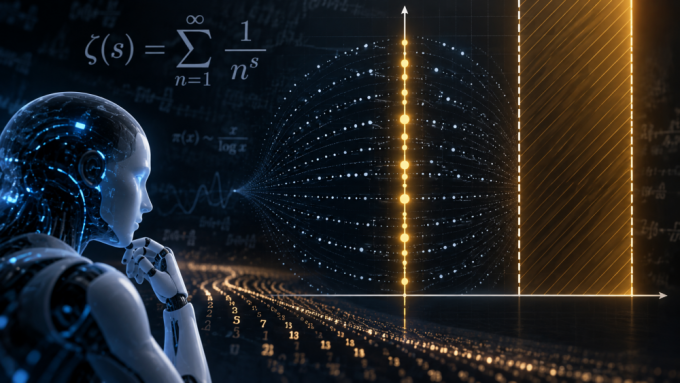
Research results claiming that artificial intelligence (AI) has proved part of the Riemann Hypothesis, one of the greatest unsolved problems in mathematics, have been released. Following its earlier claim that it had provided a solution to another major mathematical problem, the Navier–Stokes equations problem, AI has now taken on the Riemann Hypothesis, which has remained unsolved for more than 160 years. The mathematics community is calling this a groundbreaking advance, but further verification of the validity of the proof is still needed.
According to the international journal Science on the 13th (local time), among more than 700 AI-generated mathematics papers that OpenAI released on the 6th, a paper related to the Riemann Hypothesis is drawing particular attention from mathematicians.
On the 6th, OpenAI posted 722 research reports on mathematical unsolved problems to the open-source platform GitHub. The reports include core results on the unsolved problems, supporting arguments, and alternative proofs.
The Riemann Hypothesis is a representative unsolved problem in mathematics concerning the distribution of prime numbers. While studying the hypothesis, the mathematician John Nash developed schizophrenia, and the problem acquired the nickname "the devil's problem." It has remained unsolved for more than 160 years and, together with the Navier–Stokes equations problem, is one of the seven "Millennium Prize Problems" selected by the Clay Mathematics Institute in the United States.
Prime numbers are natural numbers greater than 1 that are divisible only by 1 and themselves, such as 2, 3, 5, and 7. The gaps between primes are irregular, and as numbers grow larger, primes occur less frequently.
In 1859, German mathematician Bernhard Riemann showed that the irregularity in the distribution of prime numbers is mathematically related to the zeros of a complex function called the Riemann zeta function. A zero is a point at which the value of a function becomes 0.
The Riemann Hypothesis asserts that all of the "nontrivial zeros" of the zeta function, except for certain special zeros, lie on a single vertical line whose real part is 1/2. Computational checks have so far confirmed that more than 10 trillion zeros do indeed lie on the line with real part 1/2, but no general proof has yet been found that all zeros satisfy this condition. If even a single exception were discovered, current mathematical predictions describing the distribution of prime numbers would potentially have to be revised.
Because the Riemann Hypothesis is so difficult, even slightly narrowing the region in which zeros can exist is regarded as a major achievement. In the newly released paper, OpenAI presents a proof that no zeros exist in the region where the real part is greater than 7/8 and less than 1. The claim is that it has proved a "quasi–Riemann Hypothesis" showing that zeros do not exist within a certain band of the complex plane.
James Maynard, a professor at the University of Cambridge in the United Kingdom, whose work in 2024 has been regarded as the greatest recent advance in research on the Riemann Hypothesis, called the new result "landmark." He said, "It would not be an overstatement to title it 'the most important result in analytic number theory in the last 100 years.'" In 2024, Maynard achieved a result that lowered the upper bound on the number of zeros that can exist in a specific region of the Riemann zeta function.
Alex Kontorovich, a professor of mathematics at Rutgers University in the United States, said, "I never imagined I would see this result in my lifetime."
The significance of the proof is heightened by the fact that it applies not only to the Riemann zeta function but also to a broader class of functions. In the process, the authors also reached the conclusion that so-called "Siegel zeros," whose existence mathematicians have been unable to rule out for nearly a century, in fact do not exist.
A Siegel zero is a special kind of zero that was conjectured to possibly lie extremely close to the line where the real part equals 1. Whether Siegel zeros actually exist affects how accurately mathematicians can estimate the distribution of primes, which is why the issue has long been considered a critical open problem.
In a separate short paper, OpenAI provided an independent proof that Siegel zeros do not exist. Maynard said, "It is almost unbelievable that two different proofs of the nonexistence of Siegel zeros should appear simultaneously." If the results are verified as correct, they could influence several problems in number theory, including questions about how many primes with specific final digits exist.
The proofs in the paper still need to undergo careful scrutiny by the mathematics community, but Maynard emphasized that, unlike the previously released Navier–Stokes equations proof or earlier AI-generated mathematics papers, this paper is "stunningly well written." He added, "It does not give the impression of being a proof that is hard to understand or interpret," concluding, "It is clear that it contains results of genuine value."
Maynard explained that the AI model leveraged research results from areas that are difficult to connect directly with the Riemann Hypothesis. "It has achieved a leap by combining several ideas that were not viewed as mainstream in a very clever way," he said, analyzing that "this means we can go much further than expected using tools we already possess."
As AI rapidly accelerates the pace of mathematical research, side effects are also emerging. Youness Lamzouri, a professor at the University of Lorraine in France, expressed concern that, by producing large numbers of minor improvements using his research methods, AI is putting pressure on researchers, who fear being pre-empted by AI companies or individual users.
"It feels like working in a harmful research environment," he said. "Everything is moving far too fast."