
Pony.ai's Q3 Report: Revenue Surges, Losses Narrow — What Are the Key Takeaways?
Pony.ai released its financial report for the third quarter of 2026 on November 18. The company reported total revenue of 299 million yuan, up 75.2% from the same period last year. This was its highest quarterly revenue ever. Robotaxi revenue rose by 165.4% and made up nearly 40% of total revenue for the first time. While revenue grew quickly, operating expenses increased by only 3.1%. This helped the company become more efficient as its business grew and reduced its losses.
Pony.ai's technology investments are now leading to real business progress. Its Robotaxi service area in Guangzhou covers more than 1,000 square kilometers. It has also started Europe's first passenger test using fully driverless Robotaxis.
Robotaxi Revenue Approaches 40% of Total, While Business Growth Improves Efficiency
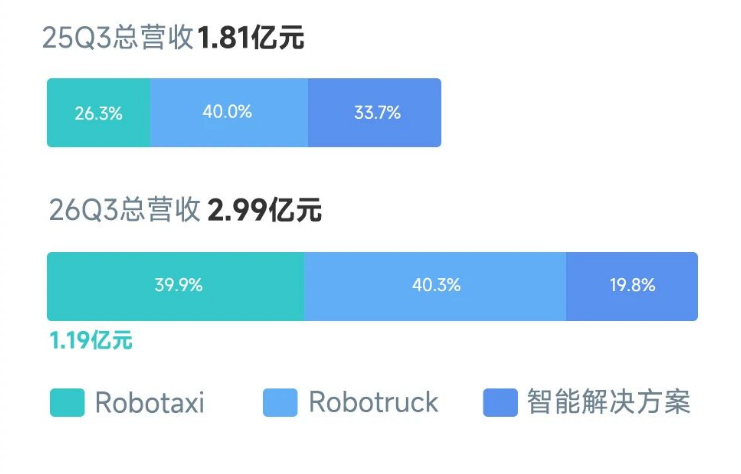
Pony.ai's total revenue reached 299 million yuan in the third quarter. This was 75.2% higher than a year earlier and 23.1% higher than the previous quarter, setting a new record. Both its Robotaxi and Robotruck businesses helped drive this growth, with Robotaxis making the biggest contribution.
Robotaxi revenue reached 119 million yuan during the quarter. This was up 165.4% from a year earlier and 47.1% from the previous quarter. The quarter-on-quarter growth rate was even faster than in the second quarter.
One important change is the growing share of Robotaxi revenue. It reached 39.9% of total revenue, close to 40% for the first time. A year earlier, it was 26.3%. This shows that Robotaxis have become one of the company's main sources of income. Revenue from passenger fares alone increased by nearly 400%, showing that demand for its ride-hailing services remains strong.
Source: Pony.ai (same below)
There are two main reasons for this growth. First, Pony.ai has put its entire seventh-generation Robotaxi fleet into fully driverless commercial service. These vehicles were developed with Toyota, BAIC, and GAC. Their deployment provides a base for expanding the service on a larger scale. Second, the company's "co-built fleet" model, used in China and overseas, has increased revenue from vehicle deliveries.
Although revenue grew quickly, expenses increased much more slowly. Operating expenses rose by only 3.1% year-on-year in the third quarter, far below the 75.2% increase in revenue. Gross profit rose 69.5% to 53.1 million yuan, while operating losses became smaller. Under the Non-GAAP accounting method, operating losses fell by 7.6%.
CFO Wang Haojun said these results show that the company is starting to benefit from operating leverage as its Robotaxi business grows. This means research, development, and operating costs can be shared across a larger fleet of vehicles and a growing number of orders.
Smaller details also show that costs are falling. Insurance premiums for seventh-generation models dropped 19% from a year earlier. The company had previously said that each vehicle's business had become profitable in Guangzhou and Shenzhen. Meanwhile, its global Robotaxi fleet grew from 2,000 vehicles at the end of the second quarter to 2,768 vehicles by September 30. This suggests that the company's business model may prove profitable across a larger fleet.
The Robotruck business is also growing. Revenue reached 120 million yuan in the third quarter, up 76.3% from a year earlier and 34.7% from the previous quarter. Growth came from freight services and a partnership with Sinotrans. The T9 heavy truck, developed together with GAC Lingcheng, was shown in Hanover, Germany, in September. It began coming off the production line in Conghua in late October.
Pony.ai has put self-driving heavy trucks into service at Mawan Port in Shenzhen and Jiangmen Port. It plans to move toward regular commercial operations there. The company's first self-driving light truck, introduced this year, has also entered production. It is now being tested with logistics customers in China's largest cities. Revenue from smart driving solutions reached 59.4 million yuan, up 3.4% year-on-year. Customers come from areas such as low-speed delivery, smart cleaning, and logistics, where demand remains steady.
Growing in China and Launching Overseas: Two Paths to Reach Annual Targets
Pony.ai is expanding its operations in two directions: the domestic market and overseas markets.
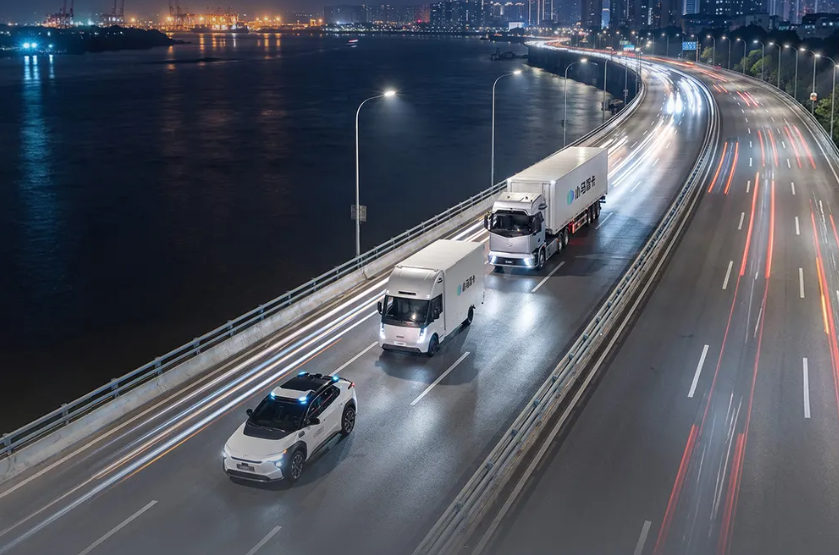
In China, the company is focusing on cities with strong business potential. Its Robotaxi service area in Guangzhou now covers more than 1,000 square kilometers. It connects Nansha with the city center, allowing passengers to travel across different districts of the city. These trips across districts and over rivers can bring in valuable long-distance orders. They also test whether the company's technology can work reliably in different surroundings.
In Shenzhen, Pony.ai is currently the only company offering fully driverless ride-hailing services at Bao'an International Airport. This is the first such service in a major Chinese city. The company has also started deployment tests in Hangzhou, Chongqing, and the Hengqin district of Zhuhai.
This expansion follows the company's view of China's domestic market, which it explained during its second-quarter earnings call.
At that time, Founder and CEO James Peng said China's taxi and ride-hailing market had more than 10 million vehicles. Demand is mainly concentrated in major first-tier cities and the largest second-tier cities. These markets are large, and their rules are relatively well developed. As more vehicles enter service, passenger waiting times become shorter and more customers continue using the service. This can increase the daily revenue earned by each vehicle and create a positive cycle: more vehicles lead to larger operations, lower costs per vehicle, and better profits. Vehicles can also use shared parking spaces and park or charge themselves. Standardized processes reduce the number of staff needed for each vehicle. This means the company does not need to increase its workforce in proportion to the number of new cities it enters.
Overseas, Pony.ai mainly uses its "co-built fleet" model to expand. As explained during the second-quarter earnings call, Pony.ai provides vehicles equipped with its self-driving system. Mobility platforms connect the vehicles with passengers, while local partners take care of fleet maintenance. Pony.ai avoids owning and managing large numbers of physical assets overseas. Instead, it earns technology licensing fees or a share of revenue throughout each vehicle's service life. This can provide a steady source of income with high profit margins.
Pony.ai has partnered with Uber on a plan to put more than 2,000 Robotaxis into service across five European cities. The company is targeting markets with higher fares, including Zagreb, London, and Manchester. Zagreb has already achieved two firsts for Europe. In April, it launched the continent's first commercial Robotaxi service. In September, it began Europe's first fully driverless passenger test. Local passengers can book rides through the Uber and Verne apps. By the end of October, the fleet had traveled more than 200,000 kilometers and completed thousands of orders. So far, Uber and other partners have committed to putting more than 4,000 vehicles into service in total.
During the second-quarter earnings call, Founder and CTO Tiancheng Lou introduced "World Model 2.0." This system uses AI to find problems automatically, create possible solutions, and check those solutions before they are put into use. This makes it faster for the company to adapt its technology to new cities. The same system can also work across different vehicle platforms, including Robotaxis and Robotrucks. This makes it easier to reuse technology. By September, Pony.ai's self-driving vehicles had traveled more than 120 million kilometers on public roads around the world during testing. More than 58 million of those kilometers were driven without a human driver.
For the full year, Pony.ai plans to put 3,500 Robotaxis into service in 20 cities worldwide by the end of 2026. It aims to increase full-year Robotaxi revenue to 3.5 times its 2025 level. Company leaders had previously said they were confident of beating their annual revenue targets. The third quarter's 165.4% increase in Robotaxi revenue and the fleet's growth to 2,768 vehicles have added support to that confidence.
Looking ahead to next year, James Peng said recent progress in both the Robotaxi and Robotruck businesses has made the company more confident about greatly expanding its self-driving operations across different markets.