
“Building the Future AI Ecosystem Around Memory”: SK hynix Presents Its Technology Vision at Supercomputing 2026 | SK hynix Newsroom
As AI handles more and more data, memory technology is changing faster to help store and process that data efficiently. Memory is no longer just about keeping data and finding it when needed. New ideas are becoming real, such as placing data in different levels of memory based on how often it is used, and connecting several servers to one shared memory pool so data can move more easily between memory and the computer system. Improvements in design and manufacturing are also making memory larger and faster. At the same time, the industry is working to give memory more abilities by adding computing functions to it.
SK hynix has worked hard to understand these fast-changing technology trends early and provide customers with the best solutions. Supercomputing 2026, held from November 15 to 20 in Chicago, Illinois, in the United States, gave the company a chance to show the results of this work.
Supercomputing 2026 is an international conference where people share the latest developments in high-performance computing (HPC) and AI. Around 10,000 people visited this year's exhibition, which included about 500 companies and institutions.
During the event, SK hynix used live demonstrations to explain its next-generation solutions and share its vision of building an AI ecosystem with memory at its center. The company also strengthened its relationships with customers and partners around the world, studied the latest trends in next-generation computing, and looked for new business opportunities.
Showing the Next-Generation MARS Server Rack System and Its Improved AI Performance
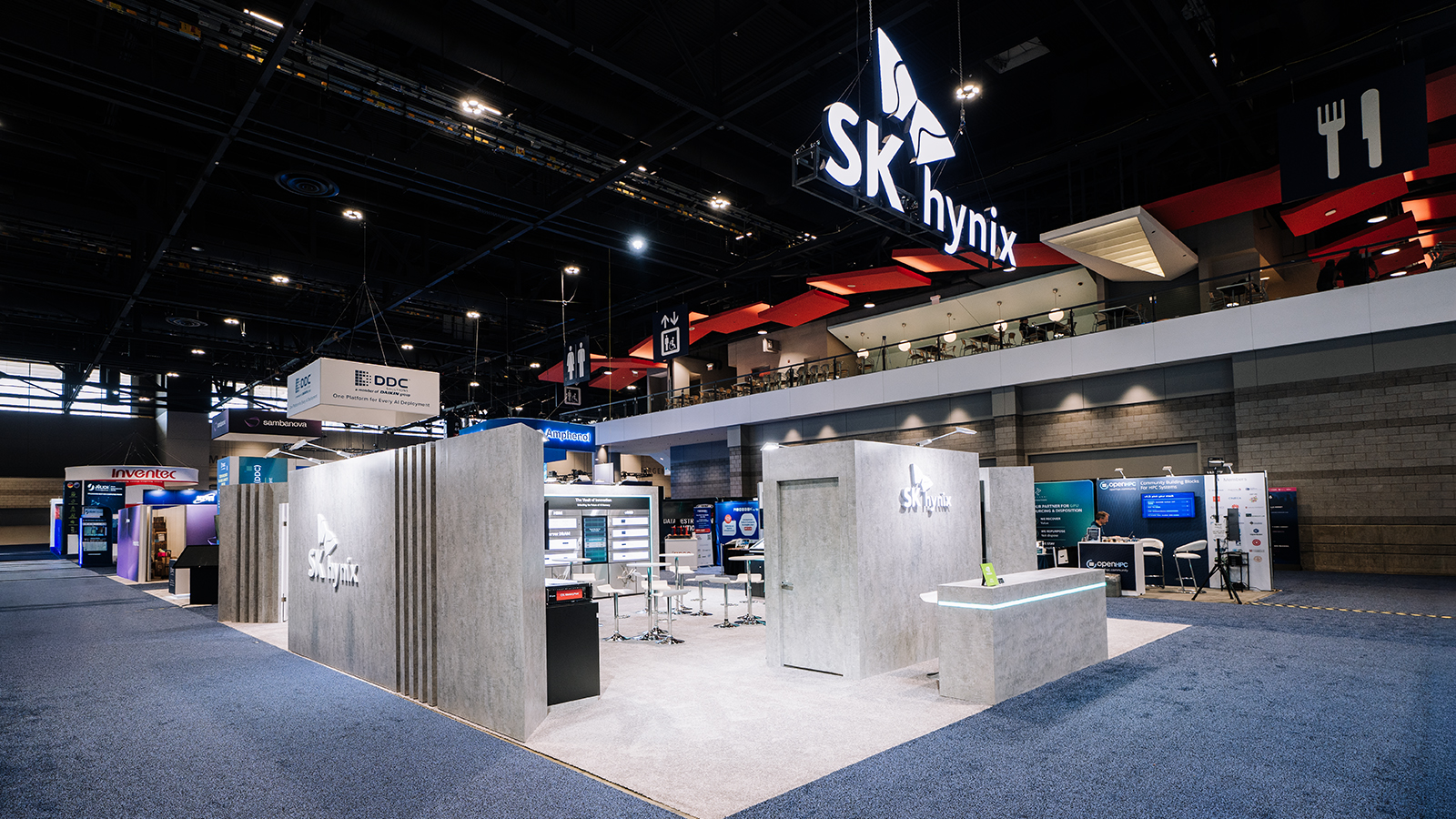
▲ SK hynix's exhibition booth
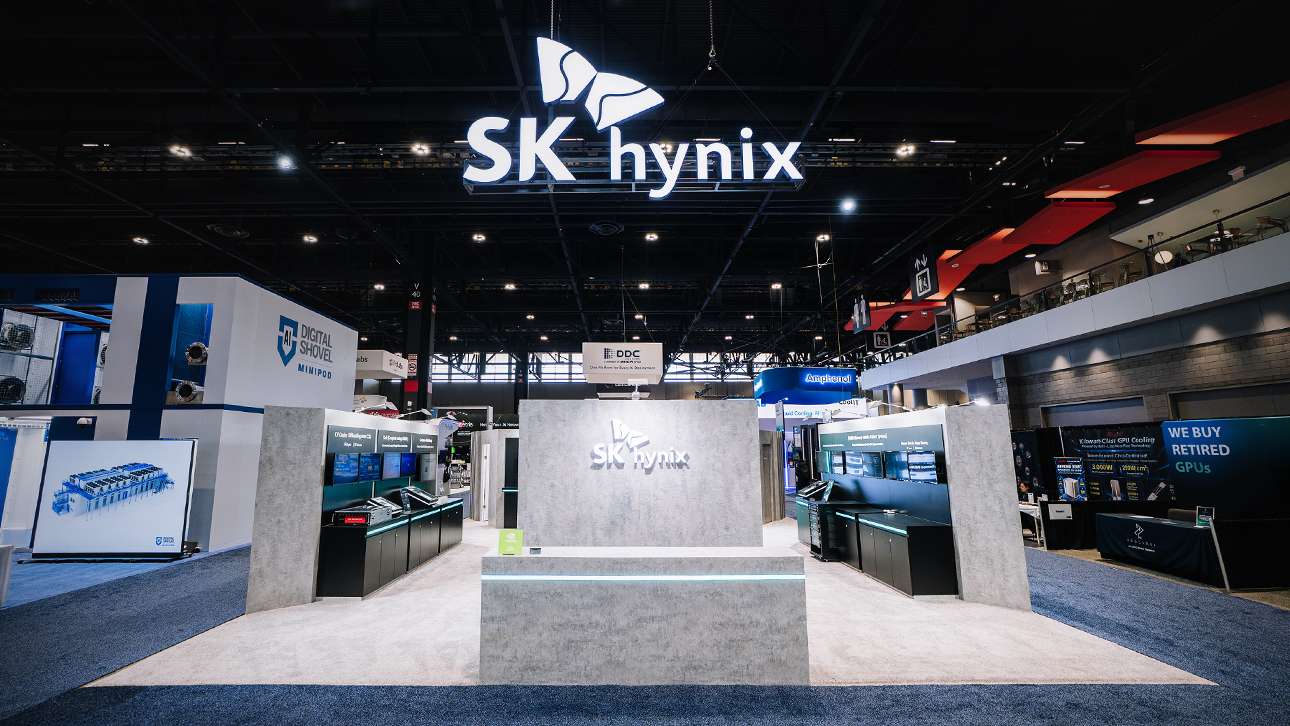
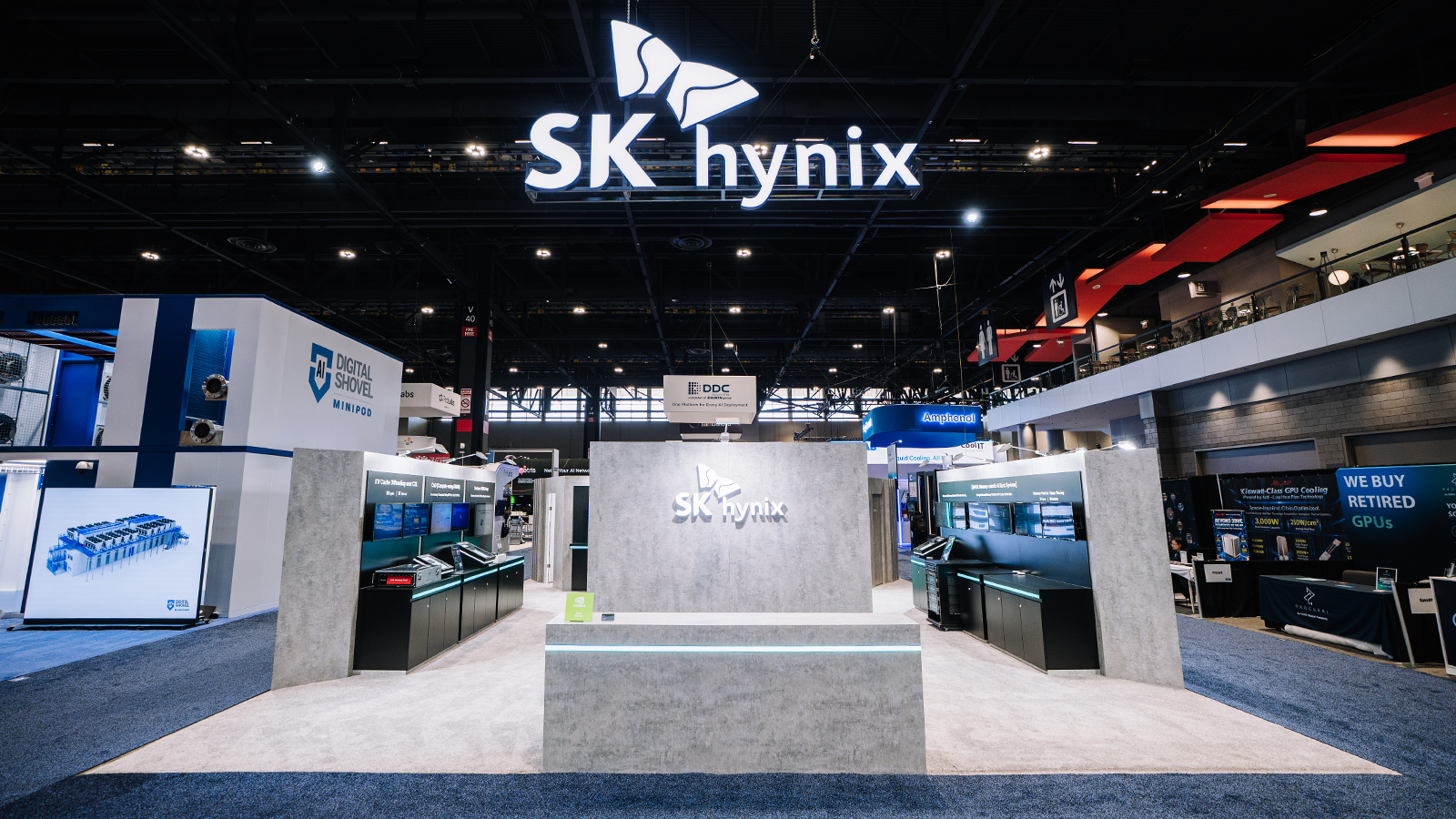
SK hynix designed its booth with neon-blue lights outlining rough, gray walls. This design gave visitors a picture of what next-generation memory technology could look like. The booth stood out brightly in the dark exhibition hall and caught the attention of people walking by.
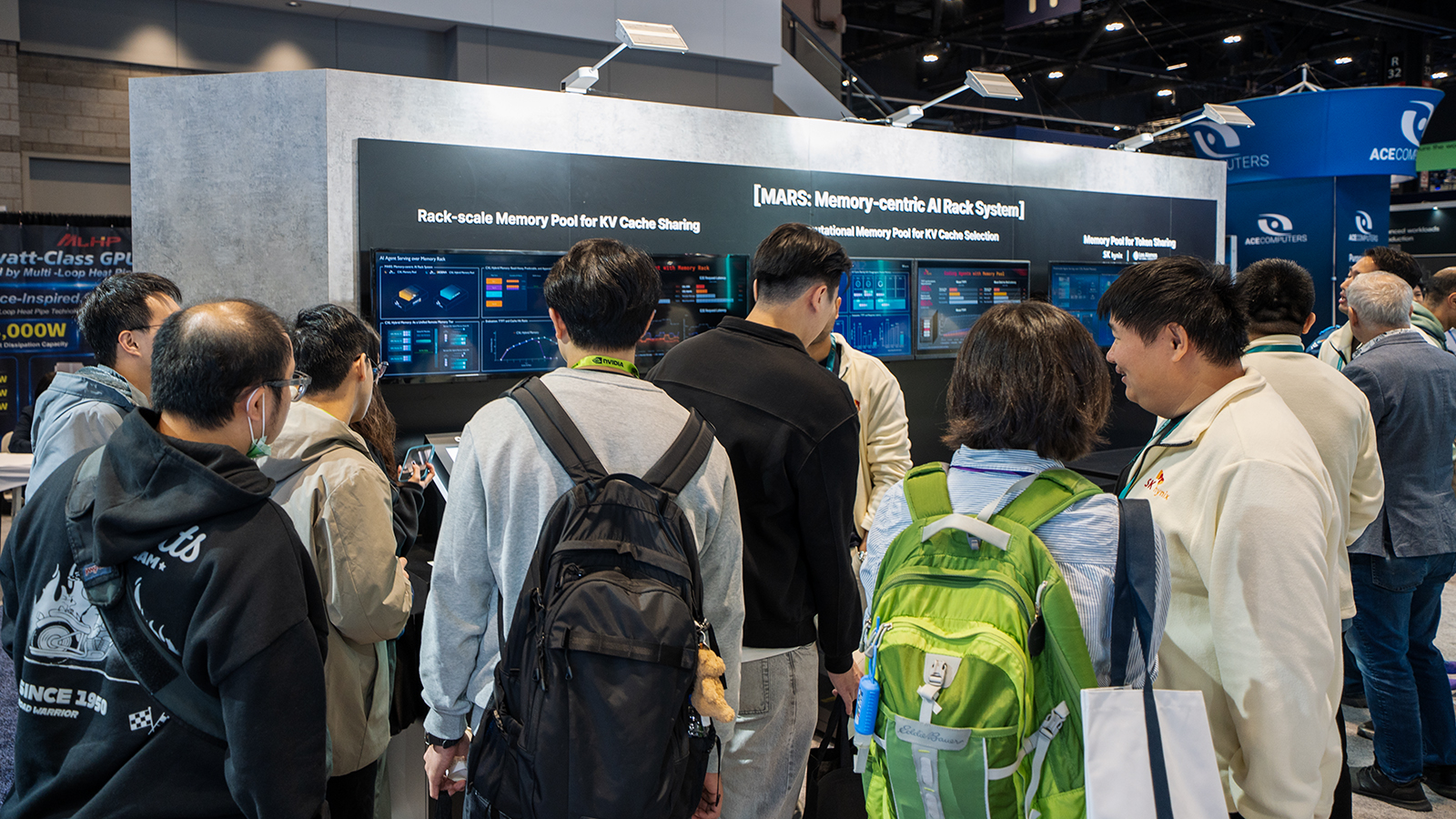
▲ Visitors looking around the MARS section
Visitors entered the booth and walked toward the wall on the right. There, they first saw the MARS section. MARS (Memory-centric AI Rack System) is a next-generation system designed to make computing more efficient. It brings solutions from different partners together in one rack*, with memory at the center. SK hynix showed three related demonstrations in this section.
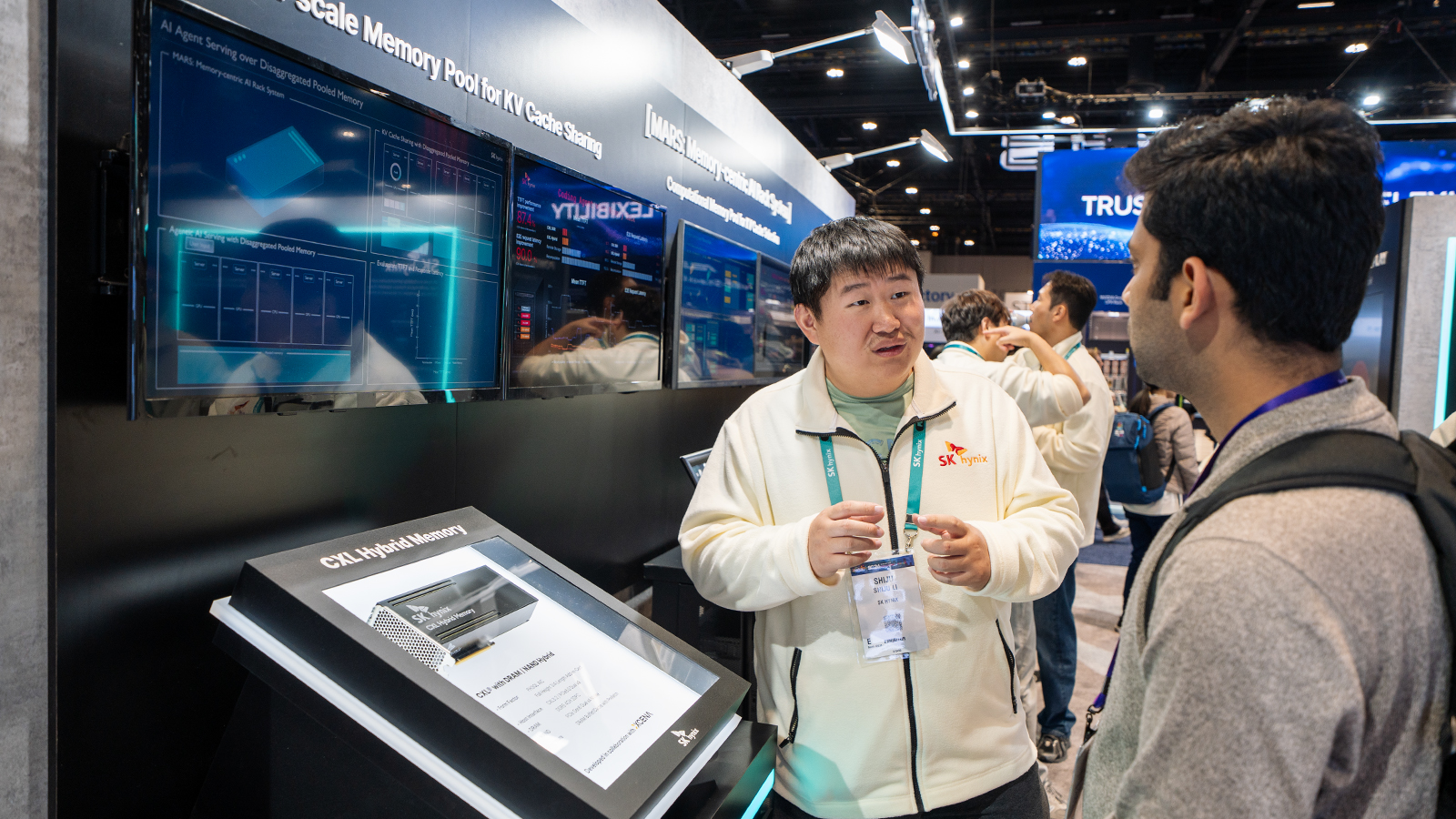
▲ A demonstration of pooled memory sharing a KV cache across an entire rack
In the first demonstration, SK hynix combined CXL* memory with CXL hybrid memory* to create pooled memory* that could share a KV cache* across an entire rack. Large KV caches are created continuously. The system stores them on the SSD inside the CXL hybrid memory. When the information is needed again, the system uses earlier conversations and task history to predict which KV caches will be needed. It then quickly loads those caches into DRAM. This demonstration showed that the solution can store the huge amount of information needed to run AI while also reading that information quickly.
* CXL Hybrid Memory: A type of CXL memory that goes beyond DRAM-only CXL memory by combining DRAM and SSD.
* KV Cache (Key Value Cache): Temporary memory that saves results already worked out by an AI system based on a large language model. The cache grows quickly as conversations get longer and the AI handles more tasks. Storing and processing it efficiently is very important for AI performance.
* Pooled Memory: Technology that combines several CXL memory units into one shared pool. Several computer systems, called hosts, can use the available memory, helping make better use of its capacity.
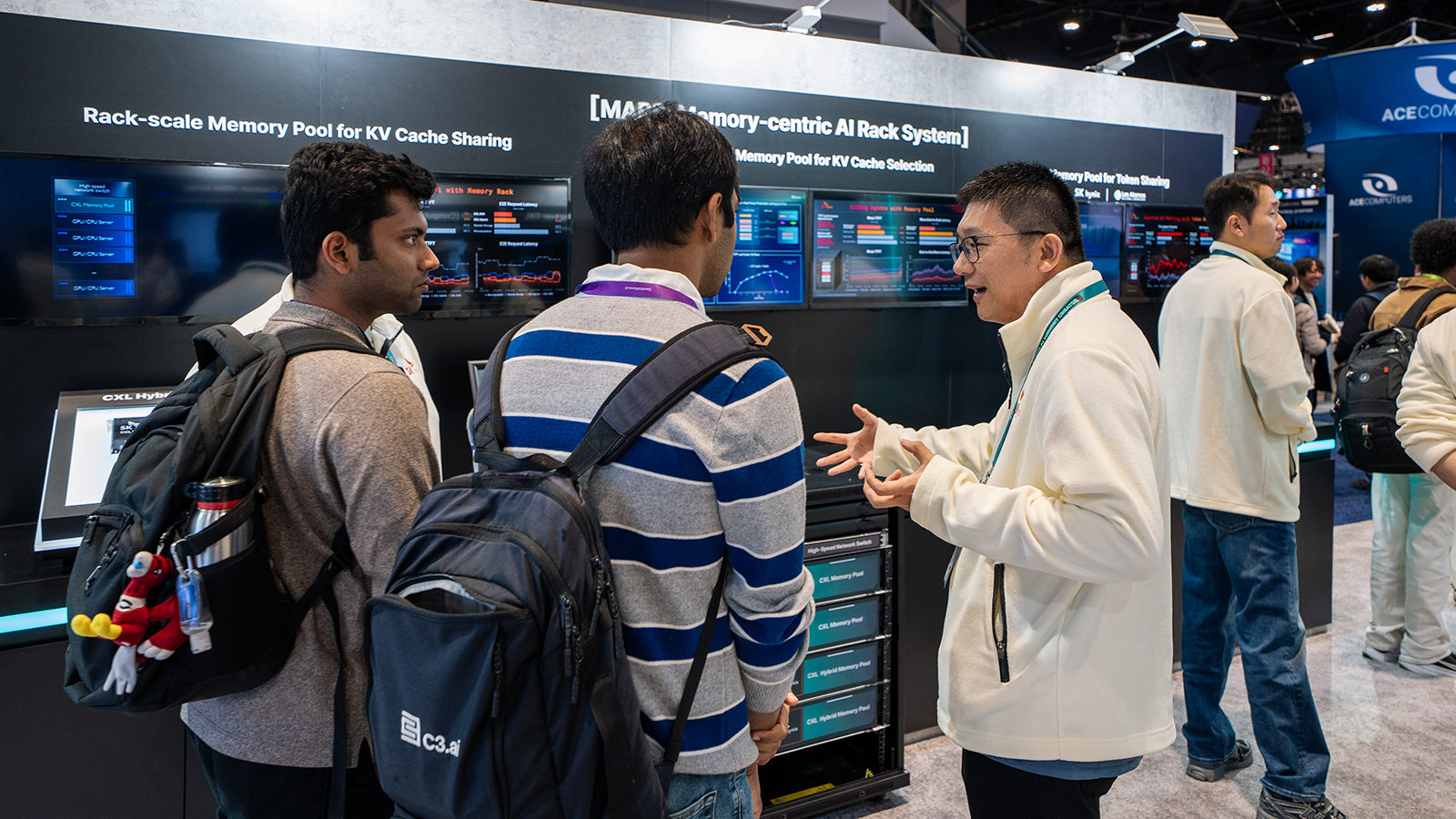
▲ A demonstration of technology that uses computational pooled memory to run AI agents
In the second demonstration, SK hynix showed an AI agent serving system that uses a computational memory pool* to connect several servers and GPUs more efficiently. The demonstration showed that using CXL-based computational pooled memory to select, transfer, and reuse KV caches can improve system performance by a large amount compared with older methods that depend on network communication.
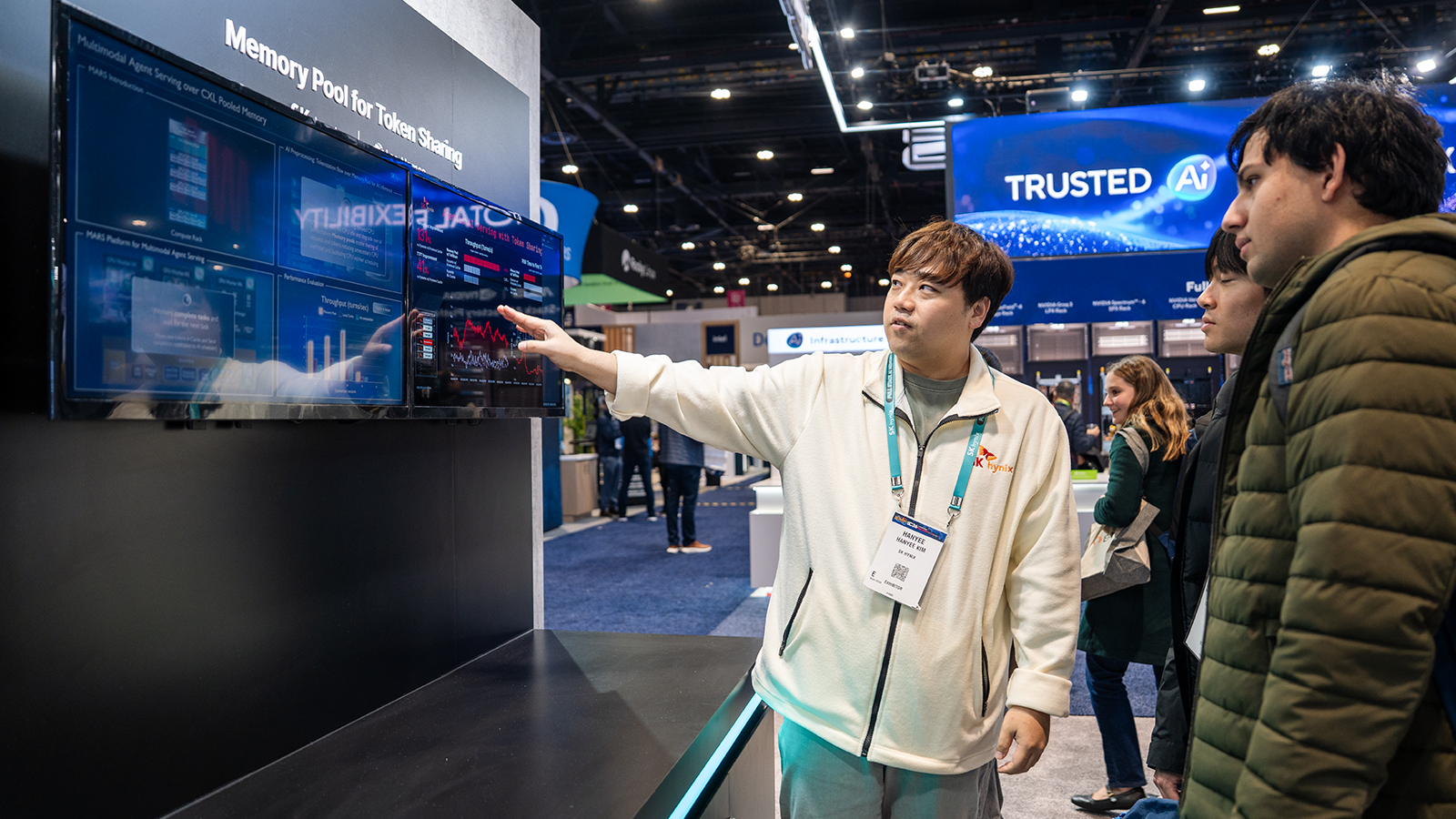
▲ A demonstration of token-sharing technology using CXL pooled memory
In the third demonstration, SK hynix showed how CPU servers can share the tokens they create through CXL pooled memory. This helps improve the performance of multimodal* AI services. Tokenization* time is especially important for these services. If CPU preprocessing takes too long, GPUs spend more time waiting and become less efficient. By using CXL pooled memory to share request data and tokens among CPU servers, SK hynix reduced repeated work. This helped the system use CPU resources more efficiently, organize worker tasks better, and improve preprocessing. As a result, GPUs spent less time waiting, and AI serving performance improved.
* Tokenization: The process of breaking information, such as text or images, into small pieces called tokens so an AI model can process it.
Making Storage More Efficient and Adding Computing Functions: Showing the Future Direction of Memory Technology
On the opposite wall, visitors found the system demonstration area. Three technologies were presented from left to right: KV Cache Offloading over CXL, Compute-using-DRAM, and Custom HBM Array. The displays caught the attention of many visitors.
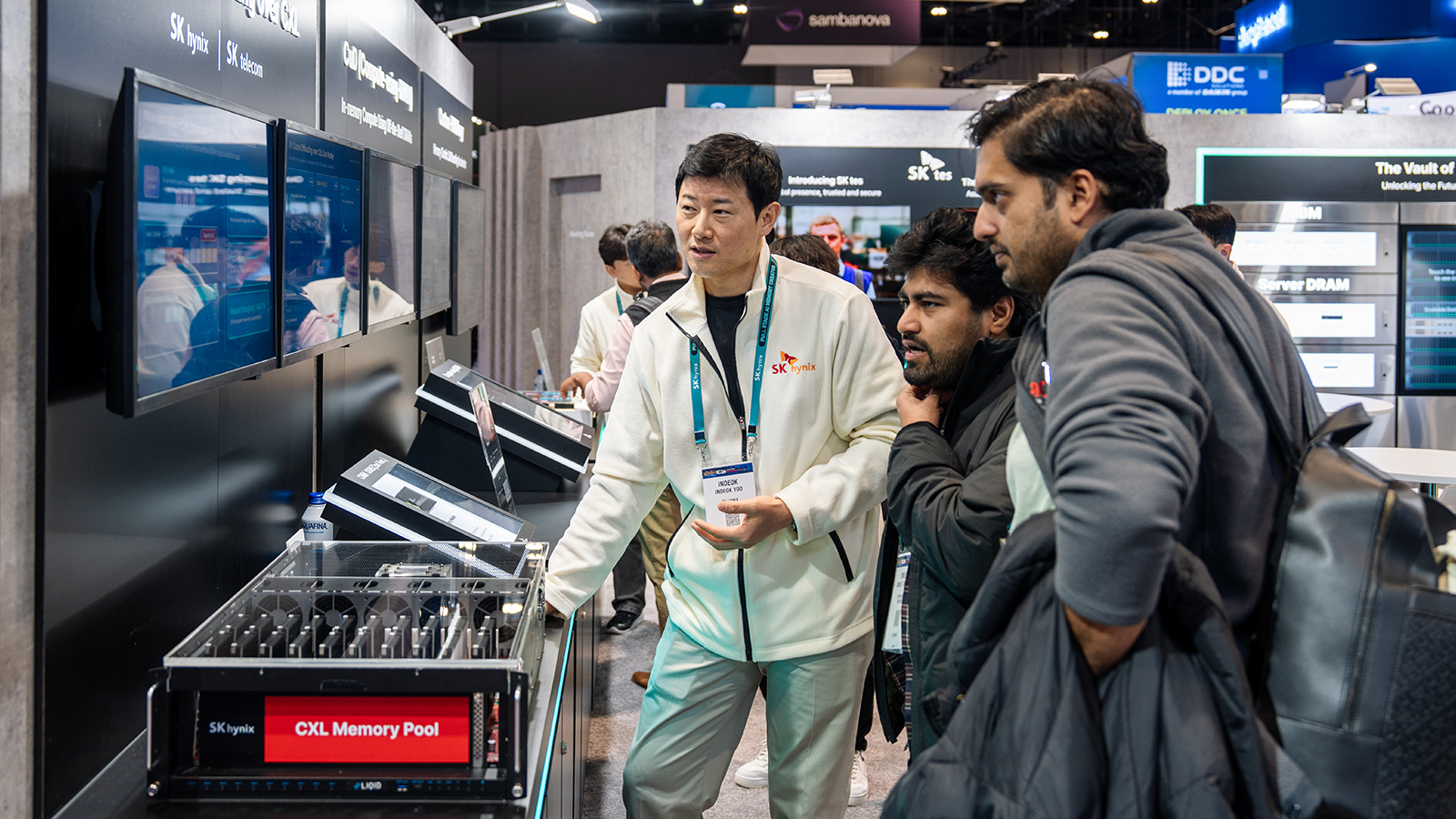
▲ Visitors watching a demonstration video in the KV Cache Offloading over CXL area
The KV Cache Offloading over CXL area showed a video explaining the basic idea behind the technology, another video demonstrating it, and a banner describing the products used in the solution. KV Cache Offloading over CXL is a new AI memory technology that helps AI data centers place and share memory efficiently as needs change. It adds a CXL memory pool to an AI memory system that previously used only HBM* and DRAM. KV caches that will be needed soon are placed in HBM and DRAM. Caches that may be needed later are stored in the CXL memory pool. The system chooses where to store each cache by considering how often it is reused, how recently it was used, how large it is, and how much it would cost to bring it back. This approach does more than simply add storage space. It also allows the system to move resources around as needs change and lets several hosts share memory capacity. SK hynix worked with SK Telecom, which is leading the AI data center business, to test the technology in a real LLM* inference environment. At the exhibition, a demonstration video helped visitors quickly understand the improvements in efficiency.
* LLM (Large Language Model): An AI model trained on large amounts of data so it can understand human language and create natural-sounding sentences.
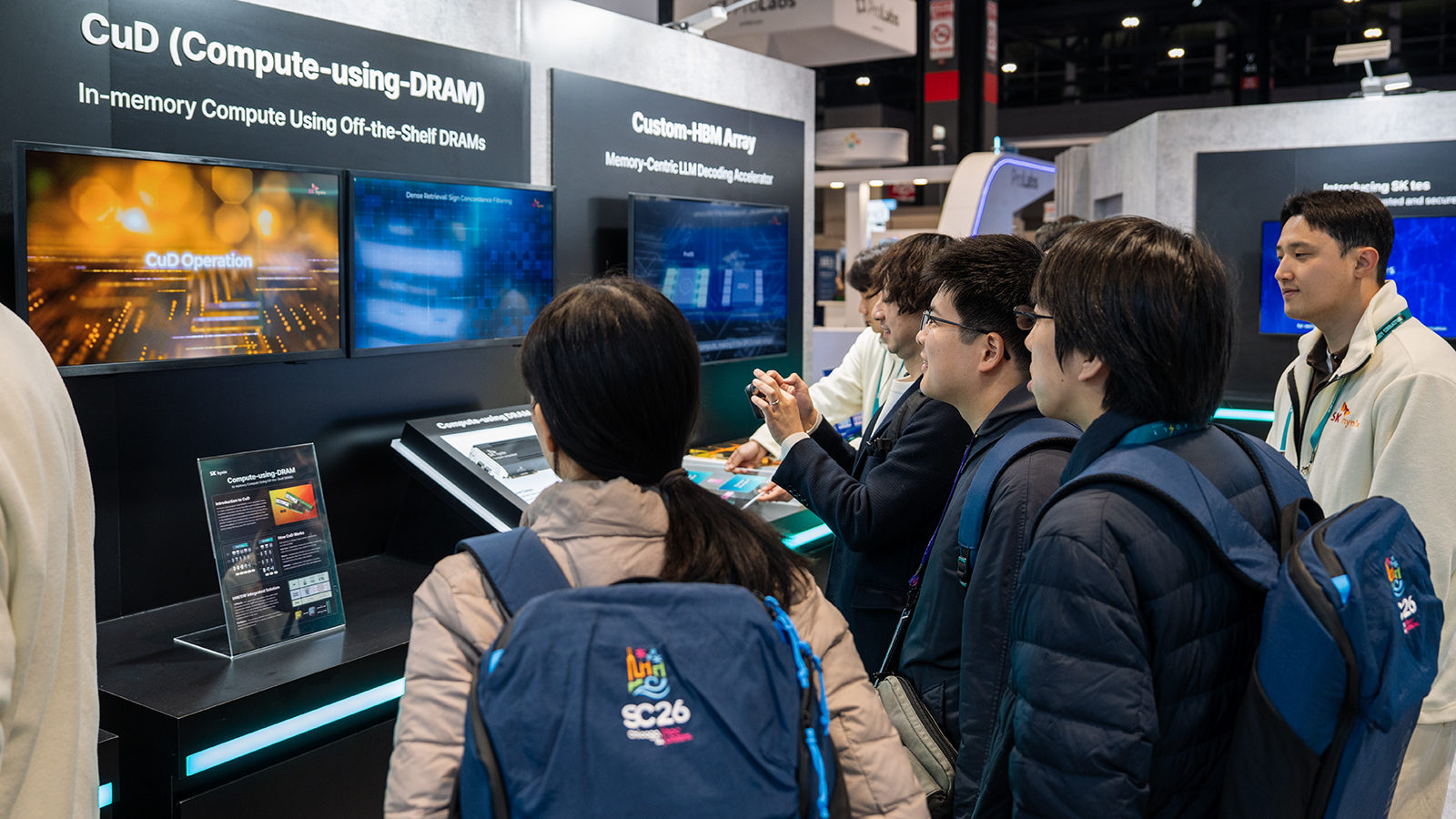
▲ Visitors looking at a brochure about the Compute-using-DRAM solution
The Compute-using-DRAM area included a video explaining the technology, a demonstration video, and brochures about the products and solution. Compute-using-DRAM is a technology that performs calculations inside memory by using a natural feature of DRAM cells called charge sharing*. DRAM can activate rows containing thousands or even tens of thousands of bits at the same time. This structure allows it to perform many bit-level operations in parallel by copying data between rows and activating several rows together. The technology uses standard DRAM without adding a separate computing unit. This can increase data speed and save power while keeping losses in chip area and storage capacity to a minimum. It attracted particular interest as a possible next-generation solution for making data transfers in AI systems more efficient. It can perform simple tasks inside memory, such as logic operations, calculations, and large-scale data comparisons. It then sends only the results to the computing unit instead of moving huge amounts of AI data into the unit's cache system.
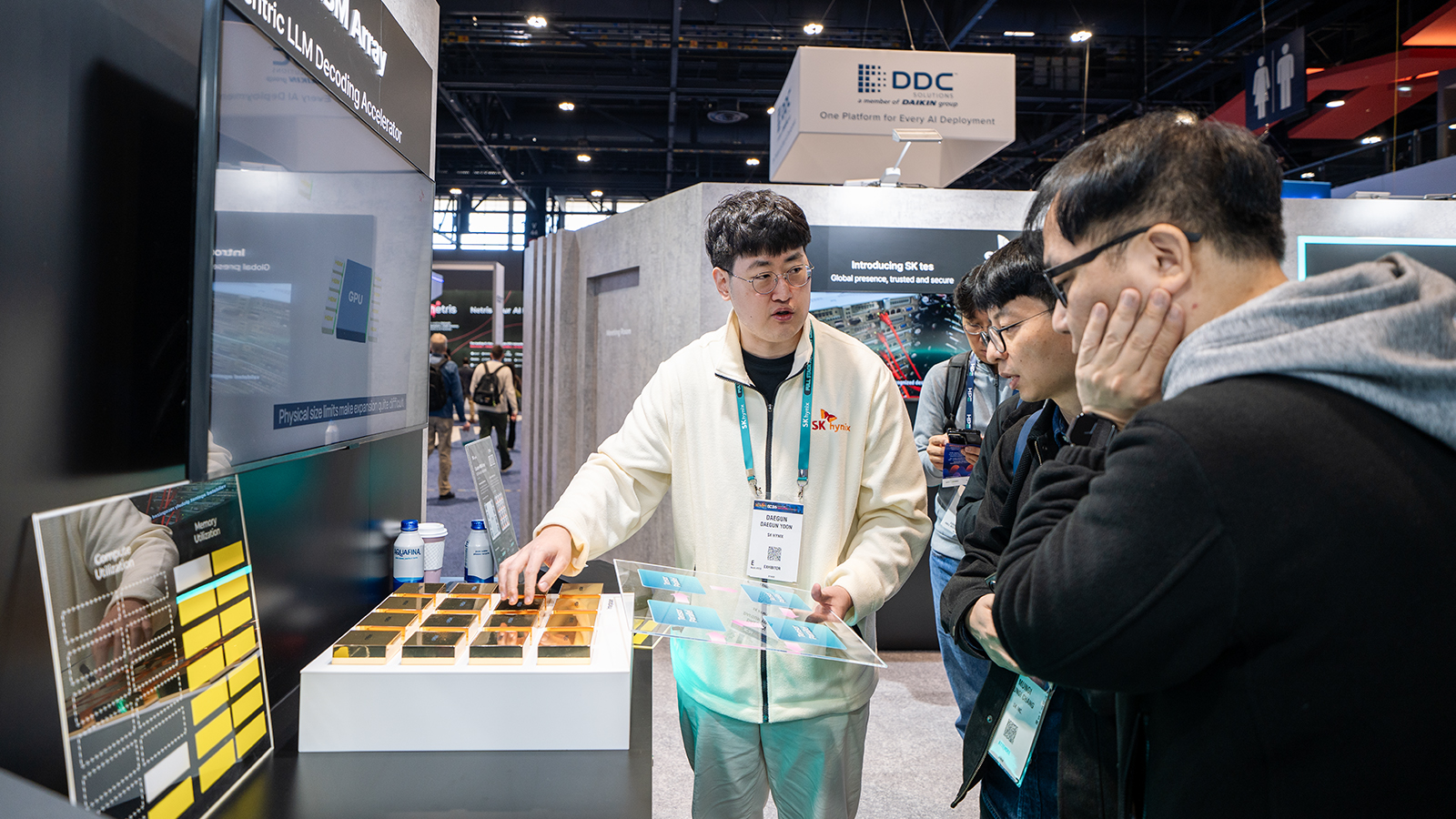
▲ Visitors looking closely at a model showing the structure of Custom HBM Array
The Custom HBM Array area included a video explaining the technology, a model of the product, and a brochure about the solution. Traditional GPU-based systems can connect only a limited number of HBM units. This limits how much their bandwidth can grow. They also use GPU resources inefficiently when generating answers during LLM decoding. Custom HBM Array is designed to solve these problems by connecting several cHBM* units that include computing functions. It is expected to respond faster, use less energy, and reduce delays caused by moving data compared with traditional GPU-based systems. Visitors showed strong interest. They carefully examined the inside of the product model, asked staff questions, and spent a long time looking at the display.
From HBM to eSSD: Memory Technology That Supports AI Infrastructure
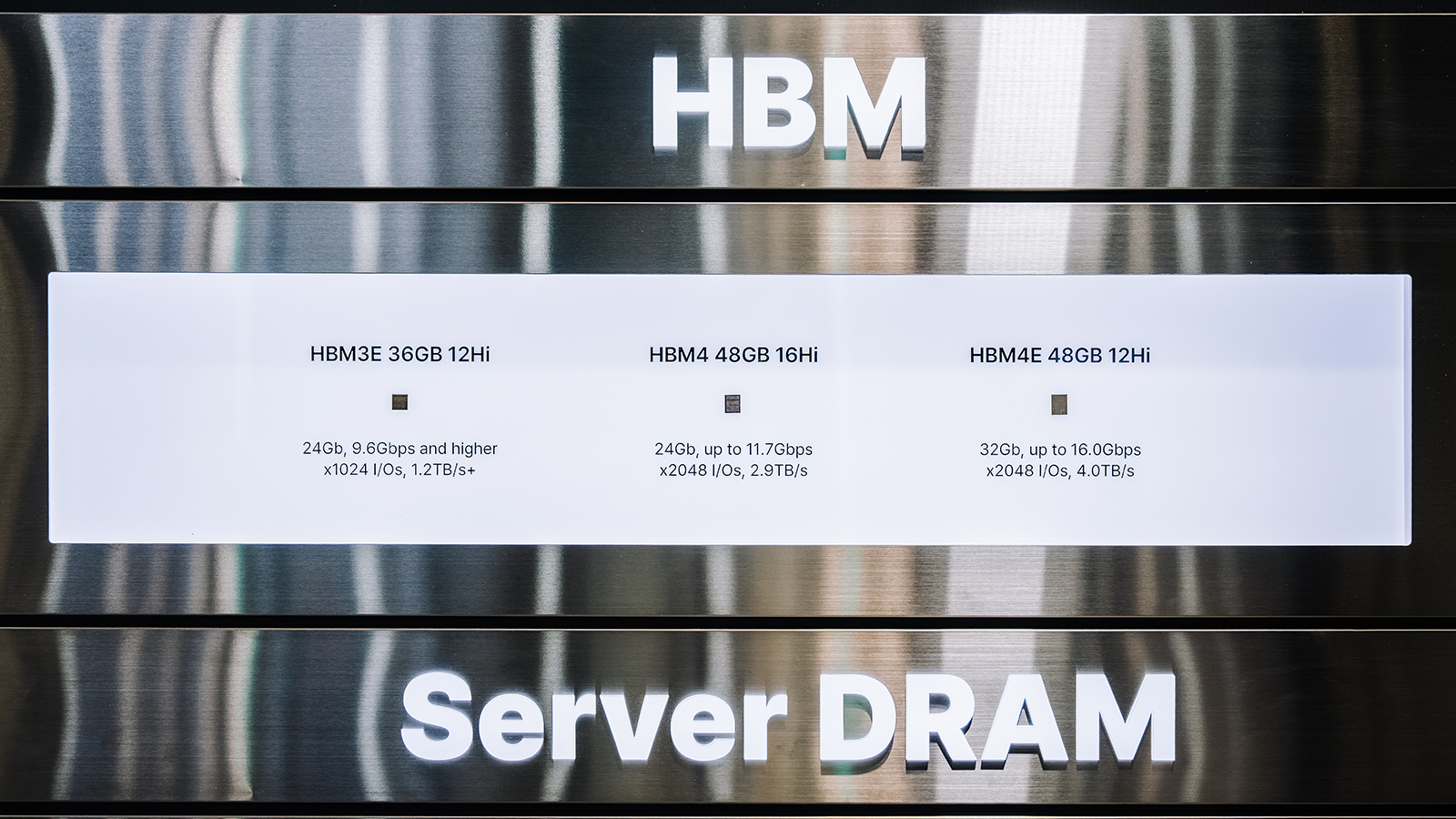
▲ SK hynix's main HBM products
In the product display area at the back of the booth, SK hynix introduced its main products for AI infrastructure. In the HBM area, the company displayed its next-generation HBM4E and HBM4 products alongside HBM3E, which currently leads the HBM market.
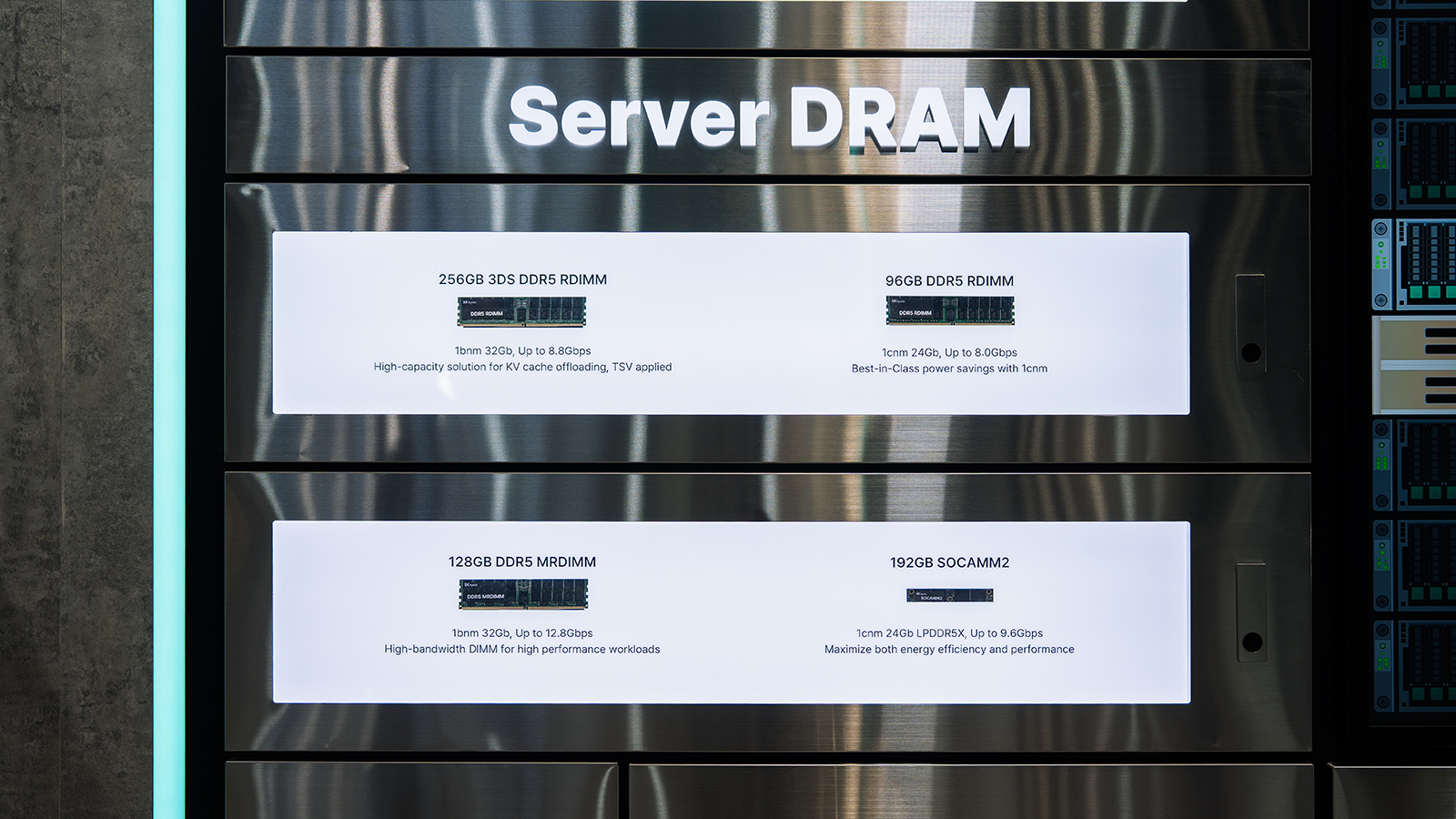
▲ SK hynix's main server DRAM products
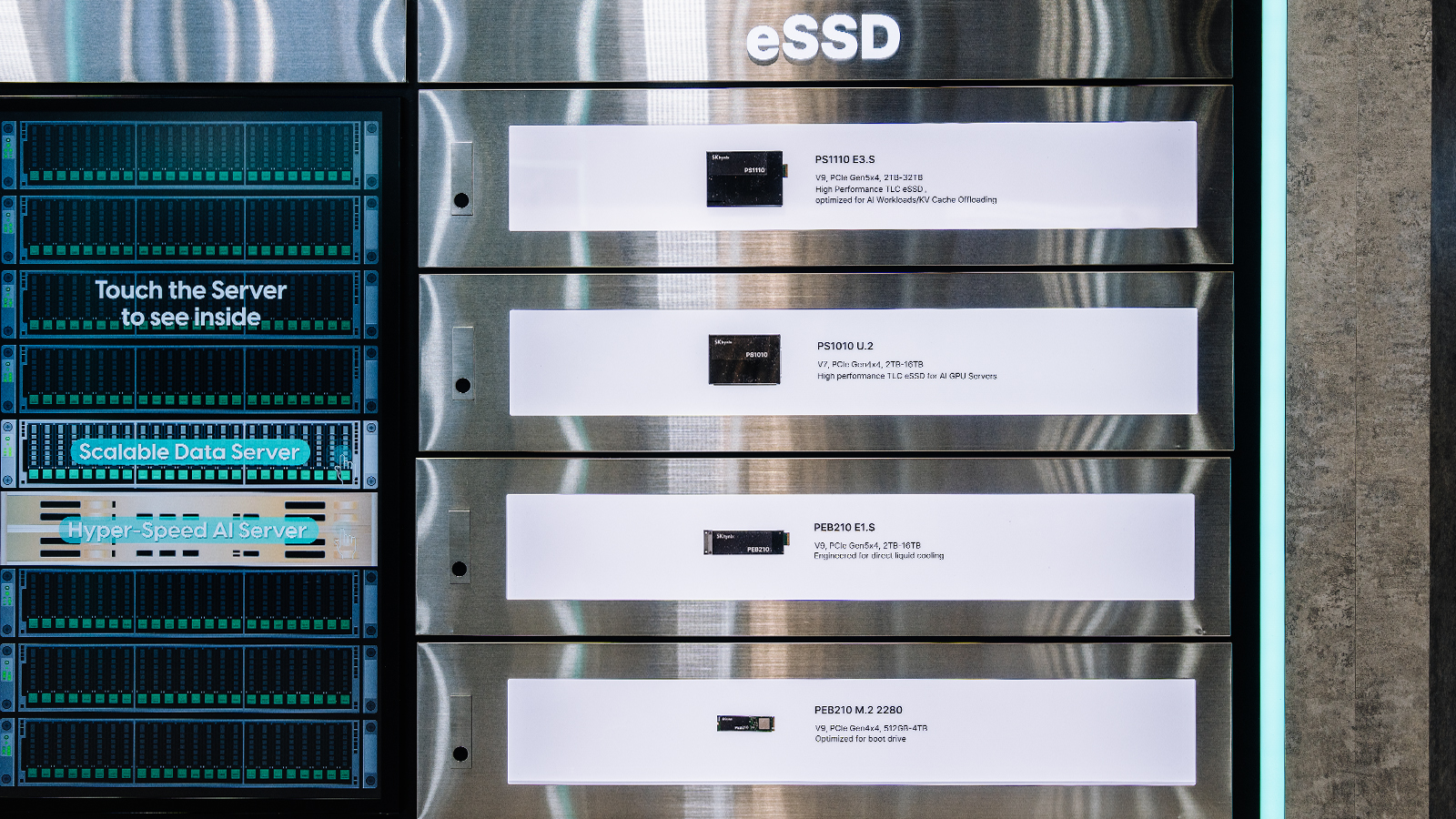
▲ SK hynix's main eSSD products
In the server DRAM area, SK hynix showed the 256GB 3DS* DDR5 RDIMM*, which offers the industry's largest capacity for AI workloads. It also displayed the high-bandwidth 128GB DDR5 MRDIMM* and the flexible 96GB DDR5 RDIMM. The 192GB SOCAMM*2 was also on display. Its new design helps save both power and space.
* RDIMM (Registered Dual In-line Memory Module): A type of DRAM module used in servers and workstations. It uses a register to pass signals and make the system more stable.
* MRDIMM (Multiplexed Rank Dual In-line Memory Module): A server DRAM module that increases bandwidth by using two memory ranks at the same time.
* SOCAMM (Small Outline Compression Attached Memory Module): A server memory module standard based on low-power DRAM. It is designed to save power and space.
In the eSSD area, two products attracted the most attention. The PEB210 E1.S supports Direct Liquid Cooling (DLC), while the PS1110 E3.S offers high storage capacity and low power use and follows the NVMe* E3.S standard. The display also included newer eSSD products such as the PS1010 U.2 and PEB210 M.2 2280. These products are designed to meet different customer needs and uses.
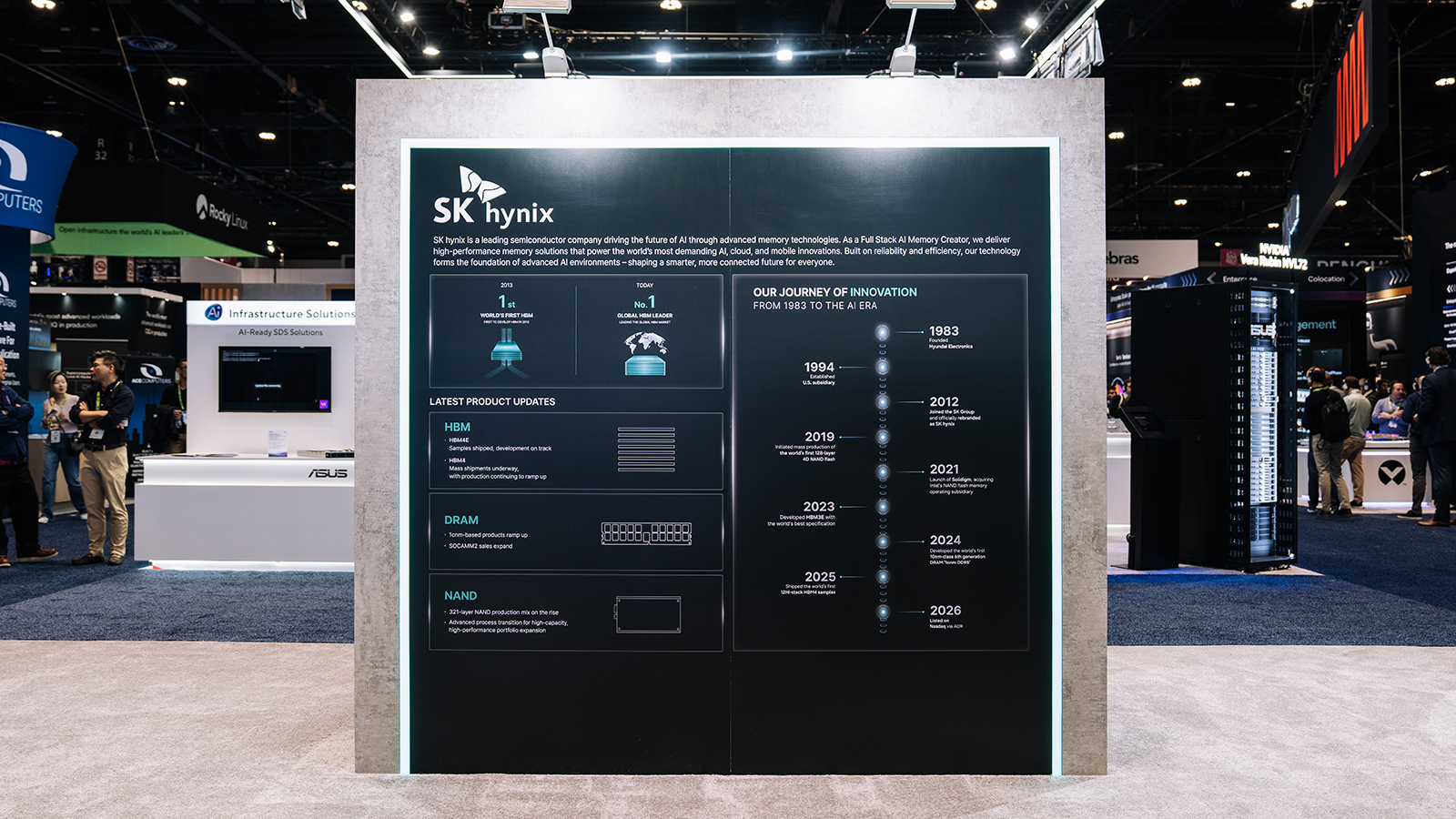
▲ The company introduction area showed SK hynix's history and vision, its HBM development, and the latest products
Behind the wall near the booth entrance was an area introducing the company. Graphics along the wall showed the history and vision of SK hynix. They also gave visitors a quick look at how the company has developed HBM and showed its latest products in HBM, DRAM, and NAND.
MARS: A Key Technology for the Age of Agentic AI
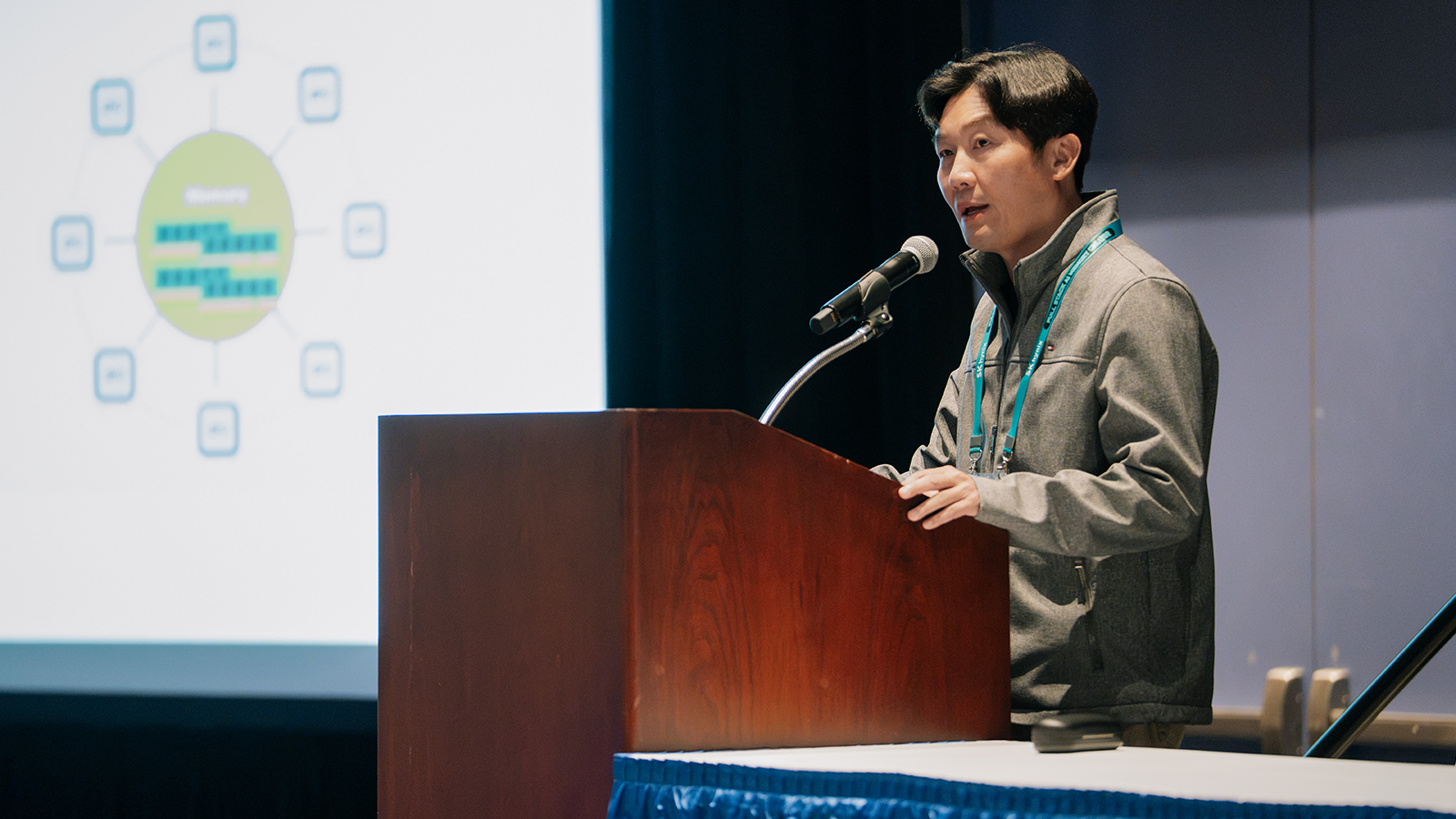
▲ Younghoon Min, Technical Leader of AI System Infra, giving his presentation
During the presentation session, Younghoon Min, Technical Leader of AI System Infra, gave a talk called "Enabling Agentic AI Serving with Disaggregated Memory Pools." He explained MARS, SK hynix's AI system design with memory at its center, in detail.
He focused on two important technologies in the MARS design: sharing and reusing KV caches through a CXL memory pool, and sharing tokens across a CPU rack. He explained that these technologies help CPUs and GPUs work more efficiently than with traditional methods. They can also greatly improve the performance of AI agents that handle several steps in a conversation or task.
SK hynix said that memory is becoming a key factor in the speed and efficiency of AI infrastructure. The exhibition gave the company a chance to clearly show its strengths in technology and its vision for AI memory. Looking ahead, SK hynix will continue working with its customers as a key technology partner to improve the performance of AI computing.