
AI virtual cell technology could reveal how genetic changes and drugs alter cells
November 19, 2026
By Amy Leifeste, Texas A&M University
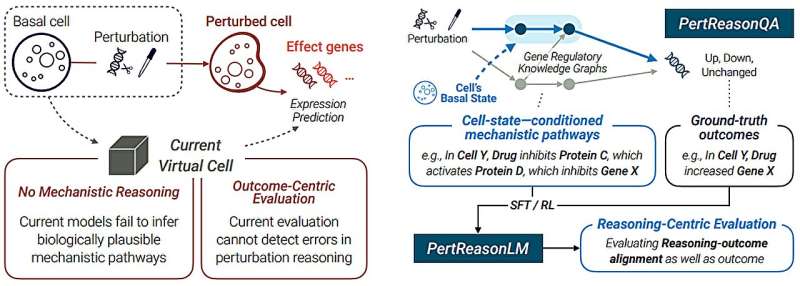
Today's artificial intelligence (AI) models can predict whether someone with a genetic change will develop a disease. But they cannot answer two important questions: Why did the disease happen, and how can we create a treatment?
To help answer these questions, researchers in the Department of Electrical and Computer Engineering at Texas A&M University are developing a new AI technology called a virtual cell. It can predict how changes in genes and the effects of drugs change the way cells work. It can also help explain the biological processes behind these changes.
Dr. Yang Shen, a professor of electrical and computer engineering, is helping lead the project. He supports postdoctoral researcher Dr. Dongkwan Kim and Ph.D. student Yiming Gao, who are leading the work. Ph.D. student Yining Yang is also helping the team.
The new system could help scientists better understand how diseases develop, find new targets for drugs, and create better treatments.
The team's current model, PertReason, has been accepted for presentation at the Conference on Neural Information Processing Systems (NeurIPS 2026). The research paper is available on the arXiv preprint server.
An earlier version of the paper was presented in July in Seoul, South Korea. It was part of the 3rd Workshop on Multi-modal Foundation Models and Large Language Models for Life Sciences, held during the International Conference on Machine Learning (ICML 2026).
Using electrical engineering to make discoveries in biology
Scientists have used ideas from electrical engineering to study biology before. But this team has taken a new step by using these ideas to discover what happens inside cells when they change.
Many older research methods focus on single parts of living things. PertReason allows researchers to follow how drugs and genetic changes affect networks of genes inside cells. By looking at more information together, researchers can better understand why certain biological changes cause disease and find more effective ways to treat it.
"In the past, much of our work focused on fundamental molecules of life, such as proteins," Shen said. "Now, our work extends beyond the molecular level to the cellular level. We're expanding the scale of what we study."
AI models, including large language models (LLMs), are an important part of Shen's research. His work helps make sure these models can explain their answers, can be trusted, and reach accurate conclusions.
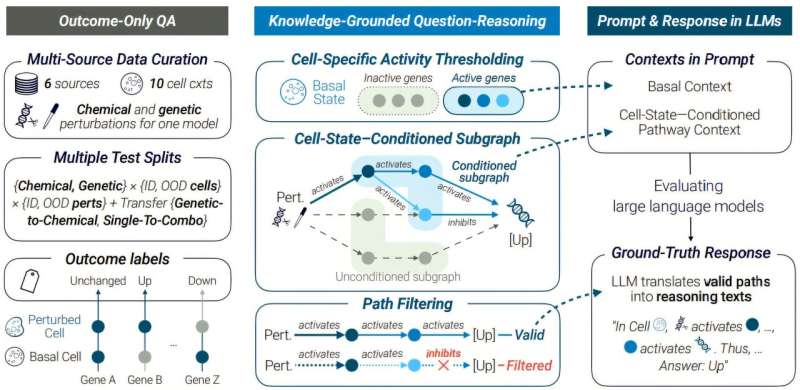
His team has created a test called PertReasonQA. It checks not only whether LLMs give correct answers but also whether their reasoning behind those answers is correct. This test helps researchers find cases where an AI model gives the right answer but uses the wrong information or reasoning to reach it.
The team has also trained an AI model to work through biological pathways. This helps the model make predictions that scientists can trust more.
A new way to understand and treat disease
Early in their research, Shen and his team began working with medical scientists who were treating real patients with breast cancer.
The team saw the difficulties these patients faced. Some patients first responded well to treatment but later suddenly became resistant to it. The researchers realized they needed to help solve this problem, not just study what happened.
"It's one thing if your AI model has nice numerical metrics, which demonstrate technical success. But it's another thing if your work can actually make an impact on people," Shen said. "We know that genetic changes might be responsible for cancer metastasis, but the natural question is why it starts and how it can be addressed."
The system could help scientists decide which biological pathways to study first. This could reduce the need for trial and error and help researchers focus on the pathways that seem most promising. It could save time and resources while helping scientists make new medical discoveries.
What's next for AI virtual cell technology?
After the success of their current model, Shen and his team plan to keep improving what it can do.
Texas A&M's powerful supercomputer, VISION, has recently arrived on campus. Shen plans to use it to improve AI virtual cell models and move toward creating virtual copies of the human body. These copies are known as "digital twins." They could help doctors make medical decisions.
"I'm looking forward to accomplishing our vision of creating multiscale digital twins for patients and developing personalized medicine," Shen said. "The goal is always to support clinicians and improve patient outcomes."
Now that their study has been accepted by NeurIPS, the team is continuing its work toward a long-term goal: using AI to discover new ways to understand and treat diseases with care designed for each individual patient.
Publication details
Dongkwan Kim et al., PertReason: A Knowledge-Grounded Benchmark and Framework for Cell-State-Conditioned Mechanistic Reasoning of Perturbation Effects, arXiv (2026). DOI: 10.48550/arxiv.2607.18777