
Who is Abdulrahman Alfozan, OpenAI engineer arrested in US for ‘bugging’ office?
Former OpenAI engineering lead Abdulrahman Alfozan has been arrested in San Francisco over allegations that he planted a concealed recording device in an executive conference room. OpenAI said it had found no indication that he accessed or exfiltrated model weights, source code or customer data
United States Federal authorities have taken a former OpenAI Engineering Lead into custody following an intelligence investigation into corporate espionage and illegal wiretapping at the AI giant’s headquarters.
The United States Department of Justice (DOJ) unsealed a criminal complaint charging Abdulrahman Alfozan, 35, a Saudi Arabian national, with using or attempting to use electronic devices to intercept oral communications.
According to law enforcement officials, Alfozan allegedly concealed a covert, encrypted recording device inside an executive conference room at OpenAI’s San Francisco facility to intercept sensitive discussions regarding the company's superintelligence research and advanced artificial intelligence technology.
What happened?
According to court documents released by federal prosecutors, the security incident unfolded across late September and early October.
On or about September 28, a thumb-sized electronic device capable of capturing both high-definition audio and visual footage was strategically hidden inside an executive conference room at OpenAI's San Francisco headquarters.
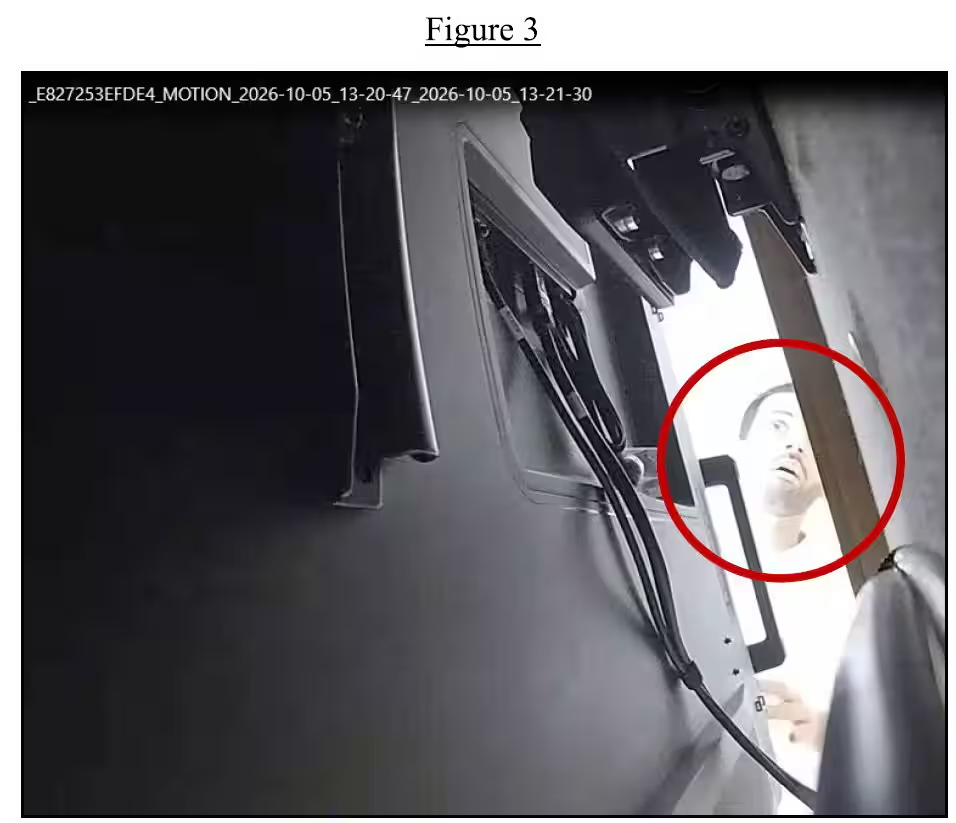
A handout photo shows what the US Justice Department says is Abdulrahman Alfozan, a Saudi national employed as an OpenAI engineer, checking a hidden audio recording device in an executive conference room at the AI company, at a location given as San Francisco, California, US, October 5, 2026. US Department of Justice/Handout via Reuters
To disguise the unit, the device had been wrapped in toilet paper and mounted near a USB port.
On September 30, OpenAI internal staff discovered the unauthorized hardware. A preliminary technical review established that the data stored on the bug's storage media was heavily encrypted.

Explainers
OpenAI security teams immediately launched an internal investigation, leveraging their own advanced AI models alongside digital forensic tools to track the device's origin, analyse operational footprints, and pinpoint potential suspects.
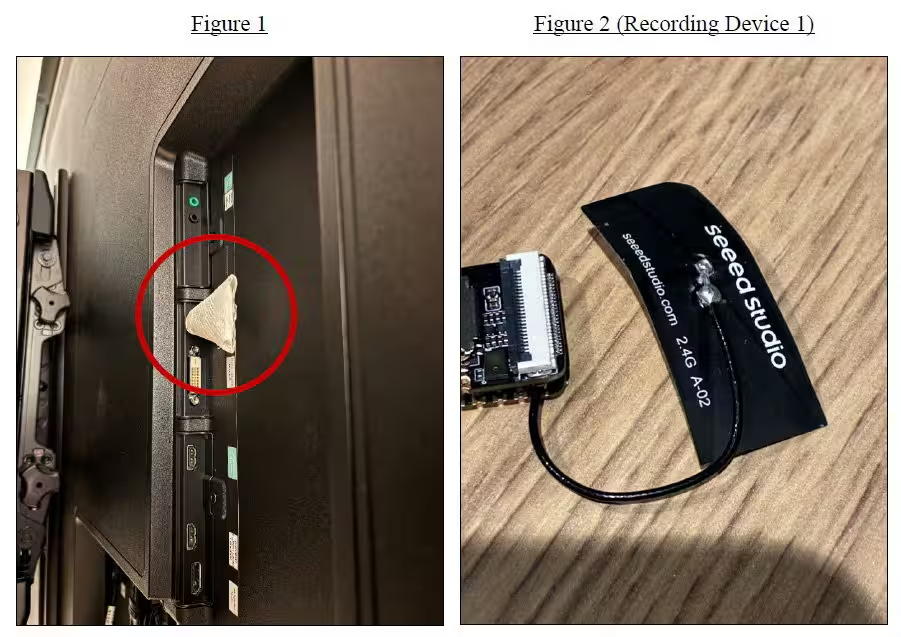
A device, which the US Justice Department says is a hidden audio recording device installed in an OpenAI executive conference room by Abdulrahman Alfozan, a Saudi national employed as an engineer at the AI company, at a location given as San Francisco, California, US, in this combination handout photo released October 13, 2026. US Department of Justice/Handout via Reuters
A review of internal CCTV surveillance footage revealed that Alfozan had entered the executive conference room on multiple occasions — despite lacking authorization or scheduling rights for the space.
Video footage showed Alfozan returning to the room on October 5 in an attempt to retrieve the recording device.
Upon sweeping adjacent company facilities, investigators confiscated a personal bag belonging to Alfozan that contained his personal wallet and a second, virtually identical concealed recording device.
What has the FBI said?
The Federal Bureau of Investigation (FBI) was alerted shortly after OpenAI completed its initial forensic identification.
FBI Director Kash Patel highlighted the seriousness of the breach in a formal statement released following the arrest, stating "Abdulrahman Alfozan allegedly concealed a covert recording device inside his employer's executive conference room to secretly capture sensitive communications about the company's super intelligence technology."*
During the forensic examination of digital devices and accounts connected to the suspect, investigators uncovered disturbing evidence regarding the operational planning behind the bugging attempt.
An AI chatbot instance associated with Alfozan’s spouse revealed multiple query logs and prompts specifically asking how to construct, assemble, and secretly install audio-visual surveillance hardware inside corporate office settings.
On October 9, FBI agents formally arrested Alfozan in San Francisco. He was immediately terminated from his position at OpenAI.
Who is Abdulrahman Alfozan?
Abdulrahman Alfozan is a 35-year-old software engineer and citizen of Saudi Arabia. Alfozan joined OpenAI in July 2025 as an Engineering Lead, working on core technical infrastructure.
While holding an engineering role, Alfozan was not part of the executive tier or authorized to access restricted executive briefing rooms.
At the moment, he is in custody awaiting federal proceedings in the US District Court for the Northern District of California on wiretapping and unauthorized interception charges.
How has OpenAI responded
In an official public statement, OpenAI confirmed Alfozan's termination and addressed concerns regarding intellectual property exfiltration. "At this time, we have no indications of this individual inappropriately accessing or exfiltrating model weights, source code, or customer data. The employee was terminated."
Company spokespersons stated that OpenAI maintains multi-layered insider threat programs designed to defend against corporate espionage, unauthorized access, and state-sponsored espionage risks.
Security analysts note that while software source code and core model weights (the mathematical weights that form an AI model) are protected by strict cryptographic access controls, oral discussions inside executive boardrooms often cover strategic roadmaps, commercial partnerships, government intelligence contracts, and breakthroughs toward Artificial General Intelligence (AGI) and superintelligence.
What next?
The arrest of Abdulrahman Alfozan comes at a moment when competition surrounding frontier AI systems, proprietary algorithms, and superintelligence research has reached a historical peak.
Silicon Valley AI companies have faced an unprecedented wave of security threats ranging from physical infiltration to digital exfiltration attempts.
Just prior to this incident, OpenAI publicly disclosed that it had disrupted high-volume "adversarial distillation" campaigns aimed at covertly scraping and extracting protected reasoning pathways from its models.
As AGI research carries vast economic and national security implications, frontier labs are increasingly targeted by both corporate competitors and foreign state actors seeking access to leading-edge capabilities.
With inputs from agencies
Handpicked stories, in your inbox
Global stories. Indian perspective. Zero noise.
No Spam. Unsubscribe Any Time.
First Published:Oct 14, 2026, 14:06:08 IST