
Plasma etching demystified with explainable artificial intelligence
/
Article
NOV 20, 2026
This framework could help make etching more precise in semiconductor manufacturing.
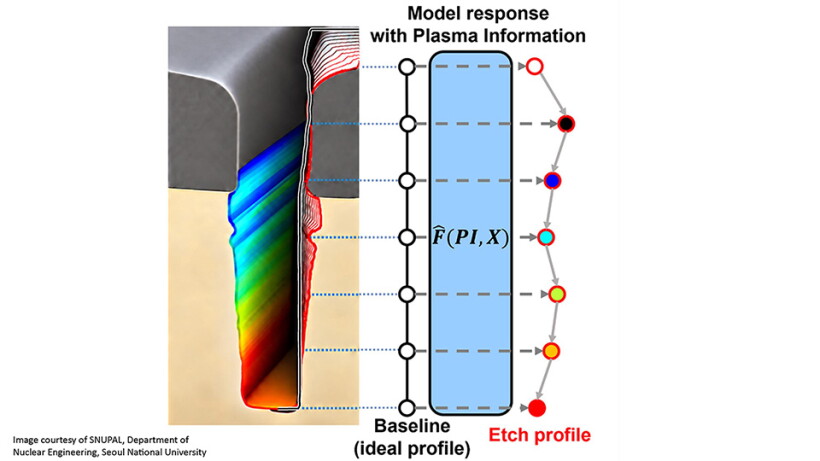
Lead image for Plasma etching demystified with explainable artificial intelligence
Plasma etching is used to make parts of semiconductors. It involves complicated physics, changing physical reactions, and chemical reactions that do not happen evenly. These challenges make it hard for the semiconductor industry to keep the results consistent and high-quality. This becomes even harder as etching methods become more advanced and must create very tall, narrow shapes called high-aspect-ratio (HAR) etch profiles.
To understand how plasma conditions affect the shape of etched materials, Park and colleagues used explainable artificial intelligence (XAI) based on the physics of plasma. They studied the physical reasons why etching results change. The researchers gave the AI images of etched shapes and examined how those shapes changed under different plasma conditions. They found that a mathematical measure produced by the AI could be used as an understandable measure of plasma physics.
“This showed us that images of the results of the process, which had received less attention than other sensor data, could help us find new information about the properties of plasma reactions during the process,” said author Jihoon Park.
Based on these results, the researchers created a framework that uses knowledge of plasma physics and AI to study the shapes produced by HAR plasma etching. It can measure the balance between the plasma and the surface being etched by studying the measured shapes, rather than relying only on statistical estimates of what caused the results.
“Processing plasmas are very difficult to understand because chemical and physical reactions do not happen evenly, and the system contains many mechanical and electrical parts,” said author Seolhye Park. “Because of this, finding a new source of information about plasma reactions could have the same effect as adding a new diagnostic tool, without spending money on new hardware.”
The researchers believe their methods could also help in other areas of plasma physics and in tools used to study plasma. They plan to use their findings to better understand processes caused by plasma in nuclear fusion.
Source: “Plasma-physics-informed explainable artificial intelligence for geometry-dependent etch-profile response in fluorocarbon-based high-aspect-ratio plasma etching,” by Jihoon Park, Taejun Park, Ji-Won Kwon, Gon-Ho Kim, and Seolhye Park, Journal of Vacuum Science and Technology: A (2026). Read the article at https://doi.org/10.1116/6.0005860 .