
Anthropic's IPO caps an explosive growth period for the AI startup, filled with contradictions
A mere five years before breaking the record for the biggest public stock offering ever, Anthropic began as a Silicon Valley startup when its founders left OpenAI because they had different ideas about how artificial intelligence should be developed.
- By KAITLYN HUAMANI - AP Technology Writer
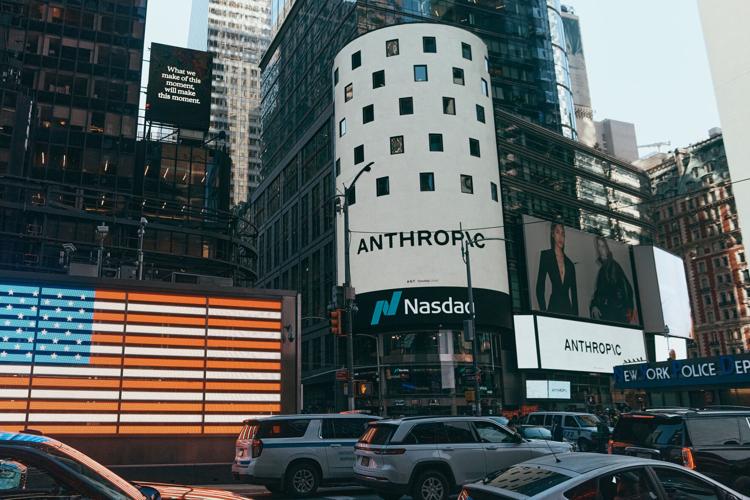
The Anthropic logo is shown on the Nasdaq MarketSite tower during the company's IPO in New York on Thursday, Nov. 19, 2026.
Andres Kudacki - FR170905 APDario Amodei, Anthropic's co-founder and CEO, stands in the center as he celebrates with his sister Daniela Amodei, the company's co-founder and president, who is just to his left. Other co-founders and colleagues also celebrate during the opening bell ceremony at Nasdaq MarketSite as part of Anthropic's IPO in New York on Thursday, Nov. 19, 2026.
Seth Wenig - APDario Amodei, Anthropic's co-founder and CEO, stands on the right, while Daniela Amodei, the company's co-founder and president, stands on the left. They react during the opening bell ceremony at Nasdaq MarketSite for Anthropic's IPO in New York on Thursday, Nov. 19, 2026.
Seth Wenig - APA mere five years before breaking the record for the biggest public stock offering ever, Anthropic began as a Silicon Valley startup when its founders left OpenAI because they had their own ideas about how to develop artificial intelligence.
Today, Anthropic has built the Claude chatbot and continues to say that human safety and well-being come first. At the same time, it has become one of the strongest voices warning that the same technology could cause a disaster.
One of the contradictions in Anthropic's short but eventful history became clear on Thursday. The company began trading on Wall Street and ended its first day with a market value of about $1.75 trillion.
Although the company still promises to put humanity's interests first, it now faces pressure from shareholders to make money from technology that its senior leaders have described as a possible threat to human existence.
Anthropic CEO Dario Amodei described the conflict between keeping AI safe and making it more advanced as one of the company's central challenges on Thursday.
In an interview with CNBC, he talked about how quickly AI is improving. One reason is that advanced AI models are helping build the next, more advanced versions of themselves. He compared this to creating a car that could travel 200 miles per hour when people had previously driven at 60 miles per hour. He said Anthropic was working to make this technology safe.
Amodei explained that the company was choosing to move more slowly than it technically could. Instead of trying to make AI systems improve as quickly as possible, it could spend time learning how to manage their growing abilities safely. The company would use the extra time and resources to build its models in the right way.
Anthropic's seven founders were Dario Amodei, his sister and company president Daniela Amodei, and five other former OpenAI employees. They left OpenAI because they wanted to build a company that placed greater importance on safety when developing artificial intelligence.
Anthropic has publicly promised to make safety and openness important parts of its work on AI models. However, people inside the company have raised concerns in recent months.
An Anthropic researcher resigned in September and criticized the safety practices of both Anthropic and OpenAI. Jacob Coxon, whose message led to widespread discussions about the speed of AI development, wrote that both companies were gambling with people's lives. He warned that some people working on AI believe it could threaten human life before the end of the decade.
Dario Amodei also responded with an essay calling for a worldwide slowdown in the development of the technology. He listed detailed plans for slowing progress and encouraging companies and countries to work together. He also supported having independent experts work inside Anthropic and other AI laboratories to check their systems.
However, the findings of at least one independent review supported Coxon's concerns. A recent report from the nonprofit Model Evaluation and Threat Research found that Anthropic was developing its systems about twice as quickly as it had a year earlier. Much of this increase was possible because the company was using AI itself to help with development.
Speaking at the Nasdaq opening bell on Thursday, Amodei said the company's most difficult safety work was still ahead.
He said the company would control the pace at which it trains and releases AI systems. It would take as much time as necessary to be confident that the systems were safe and would remain under human control.
Anthropic's promise to put humanity first has also made its founders wealthy.
Anthropic is a public benefit corporation. This means it has a legal duty to balance the interests of its shareholders with the good of the public. Companies with this legal structure rarely become publicly traded. Those that do are usually much smaller than Anthropic. As a result, the company is entering unfamiliar territory.
Anthropic has said it wants to build a future in which the benefits of AI are shared by everyone. However, its IPO has also created enormous wealth for its founders, employees and other investors.
Before the IPO, the two Amodei siblings each had a net worth of just over $14 billion, according to Forbes. By Thursday afternoon, Dario Amodei's net worth had reached $22.7 billion, while Daniela Amodei's had reached $22.8 billion.
The Amodei siblings and the other co-founders have said they plan to donate 80% of their company shares to charity. However, this promise is voluntary. Anthropic also has a program that lets employees promise to donate shares. The company matches those donations. Anthropic has also promised to give at least 10% of its stock to a public benefit fund.
Speaking to CNBC on Thursday, Daniela Amodei said the idea of becoming a public benefit corporation was important to the founders when they first created the company.
She said they wanted to build something that could create great economic value and have a major impact, while making sure that the company's structure required it to balance those goals with the responsibility to build things that help people.
In a filing with the Securities and Exchange Commission last month, Anthropic used 93 pages to explain the risks investors should understand. Among those risks was the possibility that advanced AI systems could create catastrophic or existential dangers for humanity.
Some people argue that Anthropic has openly explained how its own technology and the technology of its competitors could cause serious harm. They say the company is being very transparent about these dangers. But critics question why Anthropic spends so much time describing possible disasters while also presenting itself as the obvious solution because of its focus on safety.
A sketch on Saturday Night Live in September turned this contradiction into a joke. Cast member Jane Wickline played Dario Amodei and said: “Sam Altman, myself, all the major AI players, we have talked about this extensively, and we are all on the same page here: We do not condone what we are doing.”
The pretend interview on SNL ended with a line that appears to have struck a chord with people who doubt the industry's promises. The same words later appeared on a protest sign outside Anthropic's headquarters in San Francisco on Thursday: “I urge you to urge me to stop.”
Associated Press business writer Wyatte Grantham-Philips contributed.
Copyright 2026 The Associated Press. All rights reserved. This material may not be published, broadcast, rewritten or redistributed without permission.