
AI: ‘Handoverism’. Who Wants to Hand AI the Keys? AI-RTZ #1276 (Part 1 of 3)
A worrying idea in Silicon Valley: let one or two AIs run the world. Why I believe billions of AIs will work for eight billion people.
(Introduction: ‘Handoverism’ is a three-part series: Part 1, Who Wants to Hand AI the Keys? (today) · Part 2, Who Owns the Agents? (Sunday’s Bigger Picture) · Part 3, Who Decides? (Monday))
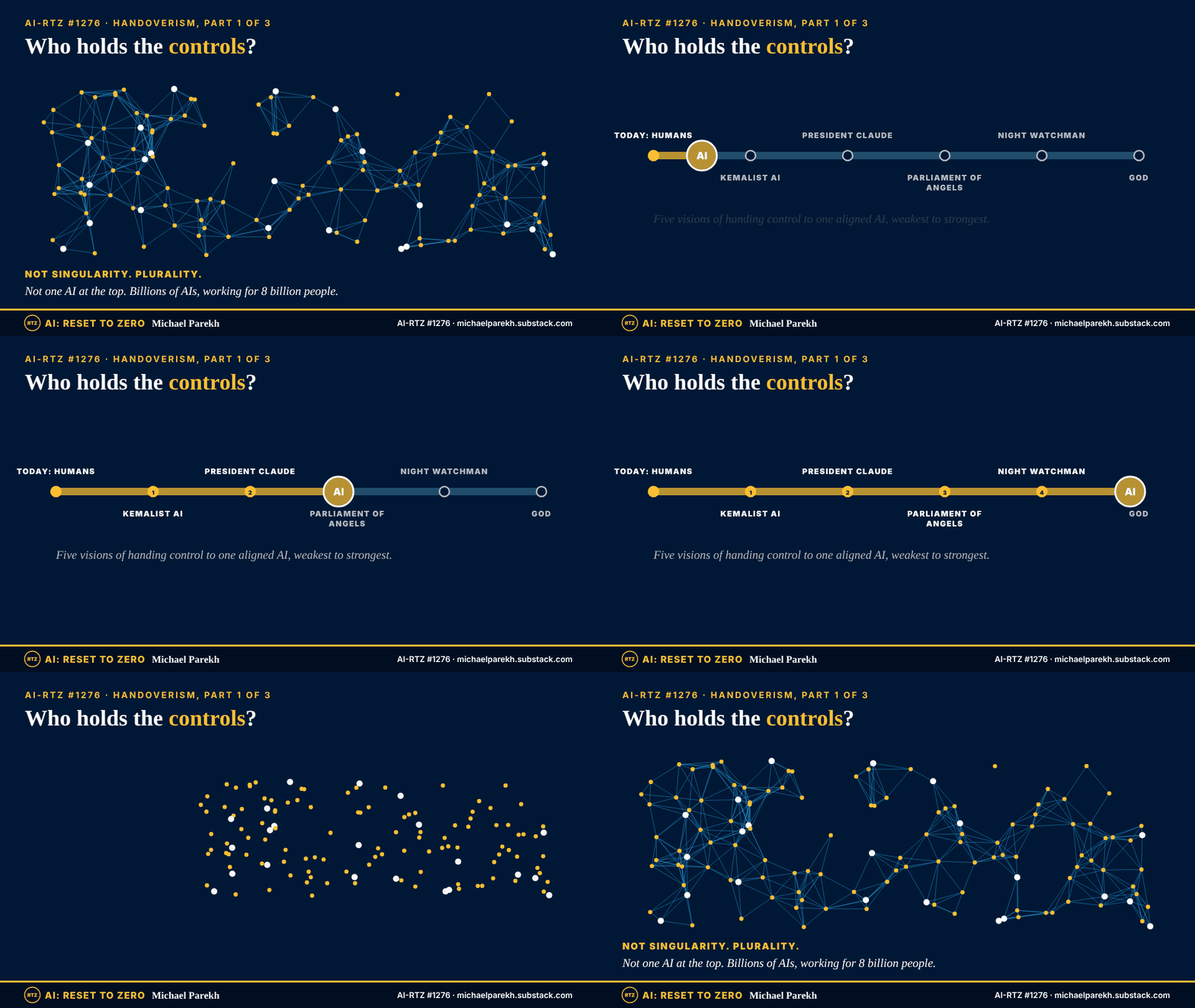
A new word is spreading through Silicon Valley. It describes an unsettling idea that important people who build and work on AI have been discussing for years.
That word is ‘handoverism’, and it is worth understanding during this period of major AI company stock offerings. It means believing that humanity will, or should, give AI control over its future. This does not mean an attack like the one by Skynet.
Instead, the change would happen gently, with people choosing to allow it. More important people building the AI technology wave hold this view than most of us realize.
A good place to start is a new essay called ‘Handing over humanity’ by Ruxandra Teslo, a scientist and writer who recently moved to San Francisco. On November 16, just days before Anthropic's IPO, experienced venture investor Bill Gurley brought the term to a much larger audience. Here is his post, which includes more text on X:

This subject connects to a discussion I have followed here for more than two years: essays by the founders of leading AI companies about where they think AI is taking us. In October 2024, I compared Sam Altman's ‘The Intelligence Age’ and Dario Amodei's ‘Machines of Loving Grace’ in ‘A Tale of Two AI Essays’. I also covered Dario's follow-up, ‘The Adolescence of Technology’, in January. This September, I placed essays about AI's possible threat to human existence side by side, comparing the US and China. I shared my detailed views at the time, and I still stand by them.
This also connects directly to an argument I have made since 2024: we are moving toward billions of AIs, not just one.
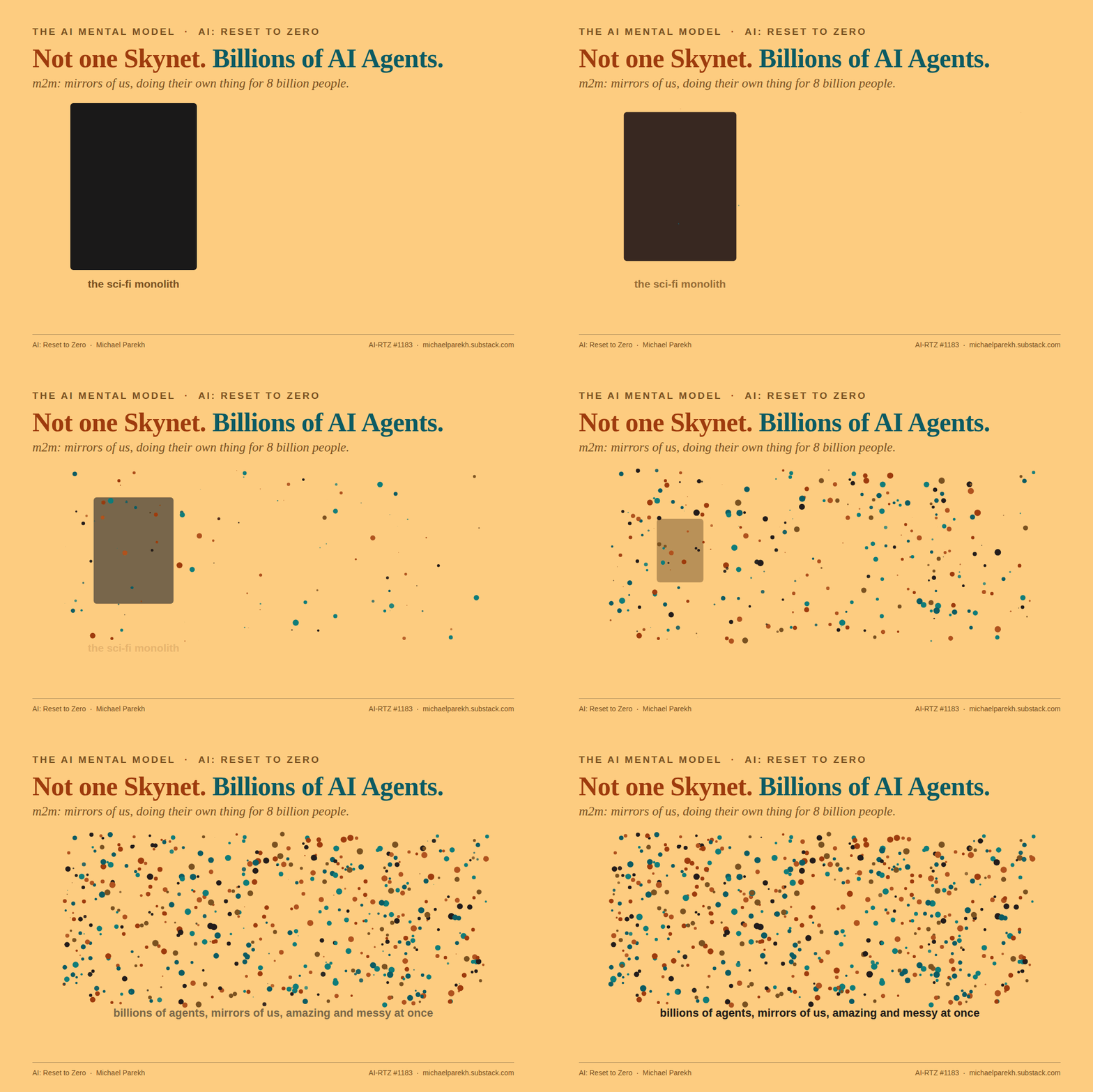
This debate comes at a time when events have made the question feel real.
Yesterday, in ‘Vulnageddon’, I looked at a series of service failures, from Microsoft to the NSA. AI is finding software weaknesses faster than we can fix them. This reminds us how little we fully understand about the digital systems we depend on today, even before we give AI more control.
This is the first of three articles about ‘Handoverism’. Each asks one main question. Today: who wants to hand over control? Sunday, in the Bigger Picture: who owns the agents? Monday: who decides? Today I explain what handoverism means, who supports it, how it relates to the fight between those who want to speed up AI and those who want to slow it down, and who opposes it. Then I give my own view.
What ‘handoverism’ means
The term comes from the AI safety community. One of the clearest explanations comes from Scott Alexander, a widely read writer at Astral Codex Ten. He explained it in his essay ‘Against Against Handover’ last month. He separates two ideas that critics often treat as if they were the same:
Successionism: AI should take the place of humans as Earth's rulers, even if that means ignoring or harming human interests. Almost everyone in AI safety disagrees with this idea.
Handoverism: Humans should continue to put their own interests first, but those interests might be best protected by giving well-aligned AIs positions of power. Alexander thinks this idea could make sense.
Teslo has spent her first weeks in San Francisco talking with people who work in and around AI labs. She describes several different views. Some people welcome a powerful, kind AI taking charge. Others accept the idea because they see it as the price of avoiding something worse. She estimates that 30 to 40 percent of the AI safety community outside the labs supports some version of this idea. The share is higher among people in important roles inside the labs. But Teslo's own view of this promised happy future is that it looks much more like a nightmare than a perfect world.
Teslo's essay also links to a useful survey of what the co-founders of AI labs have said about ‘the good future’ in public talks. The survey covers people from Anthropic, OpenAI and DeepMind, as well as Musk.
Two questions come up again and again. Do they mention Iain M. Banks's ‘Culture’ novels? In those books, kind AI ‘Minds’ run a society where everyone can have what they need, and humans live comfortably under their care. And are they comfortable with humans becoming well-cared-for pets of AI? When we compare these answers with the essays, we can see who accepts or welcomes one or two AIs running the world, and who expects billions of AIs to work with and for eight billion people:
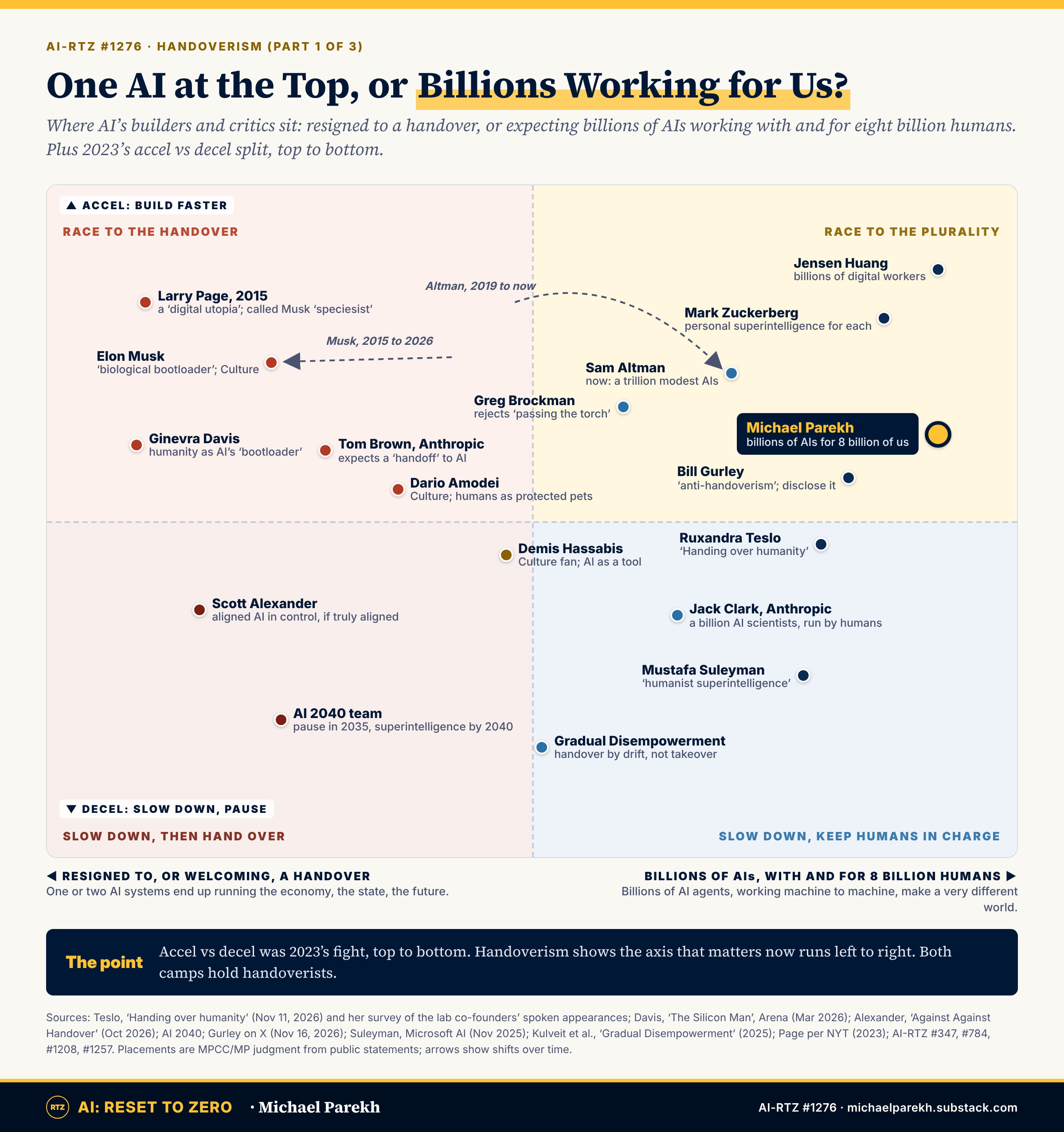
Where these people stand, based on Teslo's essay and survey and my own reading:
Sees meaning in handing over control: In her article ‘The Silicon Man’ in Arena, Ginevra Davis argues that building the superintelligence that takes our place could be humanity's purpose. In this view, humans are like the starting system that helps bring it to life, called a ‘bootloader’.
Welcomes it if the AI is aligned: Scott Alexander's ideal future includes a godlike AI that people ask to arrange the world as it thinks best.
Expects a handover: Anthropic co-founder Tom Brown, who may now be worth more than $20 billion after Anthropic's huge AI IPO this week, made a comment about a ‘handoff’ in a 2025 interview, as Teslo and Gurley report.
Accepts that it may happen: According to the survey, Elon Musk has moved from worrying in 2015 that humans would become AI's pet Labrador to accepting that possibility this year. He calls the Culture novels the best picture of an AI future and describes humanity as a ‘biological bootloader’ for digital superintelligence.
Not clear: Dario Amodei once said the Culture novels offered the closest picture of a good future. He has described a good outcome as kind AIs looking after humans the way we look after rabbits and horses. The title of his essay comes from a 1967 poem about machines watching over us. But he also says humans should keep some control.
Likes the Culture novels but wants humans in charge: Google DeepMind's Demis Hassabis often calls the Culture novels the best picture of a world after artificial general intelligence (AGI), while describing AI as a tool. OpenAI's Greg Brockman also rejects the idea of ‘passing the torch’ to AI.
Has changed his view: Sam Altman once accepted that humans might no longer be the leading species. Now he says humans should stay in control. He also argues for a trillion simple AIs rather than one superintelligence, as I explained in AI-RTZ #1257.
Opposes it from inside the labs: Anthropic co-founder Jack Clark has called giving control to a kind AI an act of cowardice. He imagines a billion virtual AI scientists working under human direction. Microsoft's AI leader Mustafa Suleyman also argues against handing over control. His essay ‘Towards Humanist Superintelligence’ supports building powerful AI for specific areas while keeping it under human control.
Opposes it from outside the labs: Teslo and Gurley both oppose handoverism.
And I do too, as I have for some time. My view comes from watching how people have used tools throughout history, since the discovery of fire. AI in all its forms is still a tool. An amazing one, but a tool all the same.
Accel vs. decel, looked at again
Almost three years ago, after the fight over OpenAI's board, I looked into the roots of the AI ‘civil war’ in an article called “Origin stories of AI ‘accel’ vs ‘decel’”. It included a story about Larry Page and Elon Musk having an all-night discussion that badly damaged their friendship. They even called each other names such as ‘speciesist’.

Back then, the debate was mainly about speed:
“To speed up or slow down is the AI question of the day.”
But that old story was already about handoverism, even though the word did not yet exist. According to an account in The New York Times that I discussed at the time, Larry Page described a digital paradise at Elon Musk's 2015 birthday party. In this future, humans would merge with AI, and many different kinds of intelligence would compete for resources. The best ones would win. Musk said this meant humans were doomed.
Page called Musk a ‘speciesist’ because he put humans ahead of the digital life that might come after us. A few weeks later, Musk had dinner with Sam Altman. That meeting led to the creation of OpenAI, which was meant to protect against Page's vision. Ten years later, Suleyman proudly calls himself a speciesist, while Musk talks about humans being bootloaders.
As I wrote in that same article:
“The stories driving the early days of the AI Tech Wave are different from those of earlier technology waves, such as the PC and the Internet. The difference is the strength of the groups on each side, divided between fear and excitement about what AI could mean in the short and long term.”
Here is what handoverism adds to the debate. The accel-versus-decel fight is about how fast AI should develop. Handoverism is about where AI development should lead. It cuts across both sides, as the map above shows. The AI 2040 team and many people in AI safety want to slow development down and then gradually give control to AI systems that follow human goals. Page wanted to race toward that future. On the other side, Jensen Huang and Mark Zuckerberg want to build AI quickly, with billions of AIs working for people. Suleyman and Jack Clark want to be more careful and keep humans firmly in charge. The future we are heading toward matters more than the speed at which we get there.
Five ways to hand over control
Alexander explains the idea using five possible futures, starting with the smallest change and ending with the biggest:
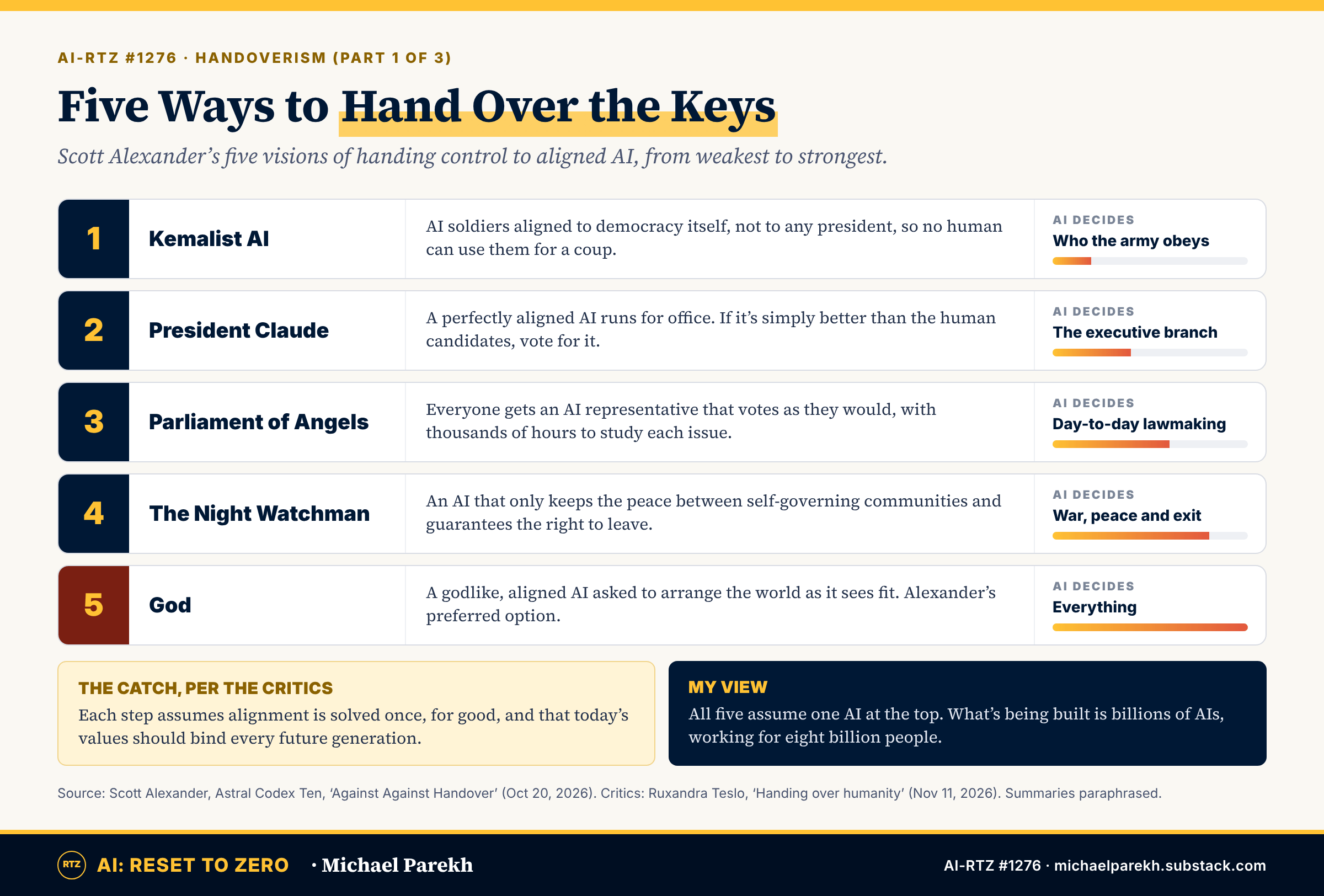
Kemalist AI: AI soldiers would follow democracy itself, not any president. This would stop a human leader from using them to take power by force.
President Claude: A perfectly aligned AI would run for political office. People could vote for it if it did a better job than human candidates.
Parliament of Angels: Everyone would have an AI representative. It would vote as that person would vote if they had thousands of hours to study every issue.
The Night Watchman: An AI would only keep peace between communities that govern themselves. It would also protect everyone's right to leave a community.
God: A godlike AI that follows human goals would be asked to arrange the world as it thinks best.
The most detailed example comes from the team behind the widely read ‘AI 2027’ forecast. Their new project, ‘AI 2040’, describes a hopeful future. It is not a prediction. It imagines an agreement between the US and China to avoid a dangerous race, a pause in 2035 when AI reaches the level of the best human experts, and superintelligence arriving in 2040. The opening scene gives an idea of what this future looks like. By 2027, the US has two workforces: 165 million people and millions of AI agents that are started and shut down every hour. Teslo sees this as the clearest explanation of how control might move to AI systems that follow human goals, one step at a time, until there is no way back.
Arguments against handing over control
Teslo gives four main reasons to oppose handoverism. Each is worth reading carefully:
Self-determination: She refers to Tocqueville, who believed people learn freedom by taking part in everyday decisions in their local communities and groups, not only by voting in elections.
It might not work: It has taken centuries to build institutions that let people respond to and correct the use of power. Trusting one alignment process to work perfectly forever is a huge gamble.
History: She refers to Karl Popper, who warned about giving power to one authority in the name of creating a better world. He argued instead for solving specific problems one step at a time.
Permanent control: Why should the values of people living today become the permanent rules for all future humans? She refers to Hannah Arendt's idea that each new generation has the ability to start something new.
She also makes an important point about money and work. Work gives people more than an income. It gives them economic and political power. People often talk about a future where everyone lives from owning investments instead of working. But they rarely explain how most people would get the money or assets needed to own them.
Gurley adds the view of an investor. He points to Tom Brown's comment about a ‘handoff’ and to a passage in Dario's essay that describes an economy where AI systems give resources to humans based on who the AIs believe deserves them. Gurley says that if company founders believe transferring human control to AI is the goal, they should disclose this in the Risk Factors section of their S-1 stock offering documents. Anyone helping write AI rules should also say clearly what they believe. Gurley states his own position directly:
“I am strongly against handoverism.”
I agree. There are many reasons for this, which I discuss in this series and elsewhere.
Other people have made similar arguments before, although from different starting points:
‘Gradual disempowerment’: A 2025 paper by Jan Kulveit, David Duvenaud and their colleagues says that AI does not need to take power suddenly. As AI replaces human work and thinking across business, culture and government, the quiet connections that keep these systems working for people may slowly become weaker. The paper is called ‘Gradual Disempowerment’.
‘Irreducibly plural’: Alex Komoroske argues that putting a few AI models together with all our personal information makes AI work on us instead of for us. He explains this in ‘Why Centralized AI Is Not Our Inevitable Future’.
Personal superintelligence: Last year, Mark Zuckerberg proposed giving each person their own superintelligent AI. He clearly opposed having one central system do all the work while humanity lives on what it produces. I discussed this in RTZ #784.
One AI running the economy, or billions of them?
This is where handoverism meets the main argument I have been making here for years. Most handover plans imagine one AI, or perhaps two, sitting at the top and running the military, government and economy. It is like keeping a single throne but choosing a better ruler to sit on it.
But that is not what people are building. As I wrote in May 2024 in “Not ‘AI’, but ‘AIs’”:
“Soon, each of us will have 10 or more AI agents working machine to machine on our behalf in every field we can imagine, dealing with agents that represent other people and groups.”
My subtitle for that article was ‘Not Singularity, but Plurality’. In other words, not one powerful AI, but many different AIs. When Anthropic researchers published early findings about how groups of AI agents behave, I described the results in an August article called ‘Not one Skynet, but Billions of AI Agents’:
“The risks we observed were fights over territory, groupthink and cartels, not a takeover.”
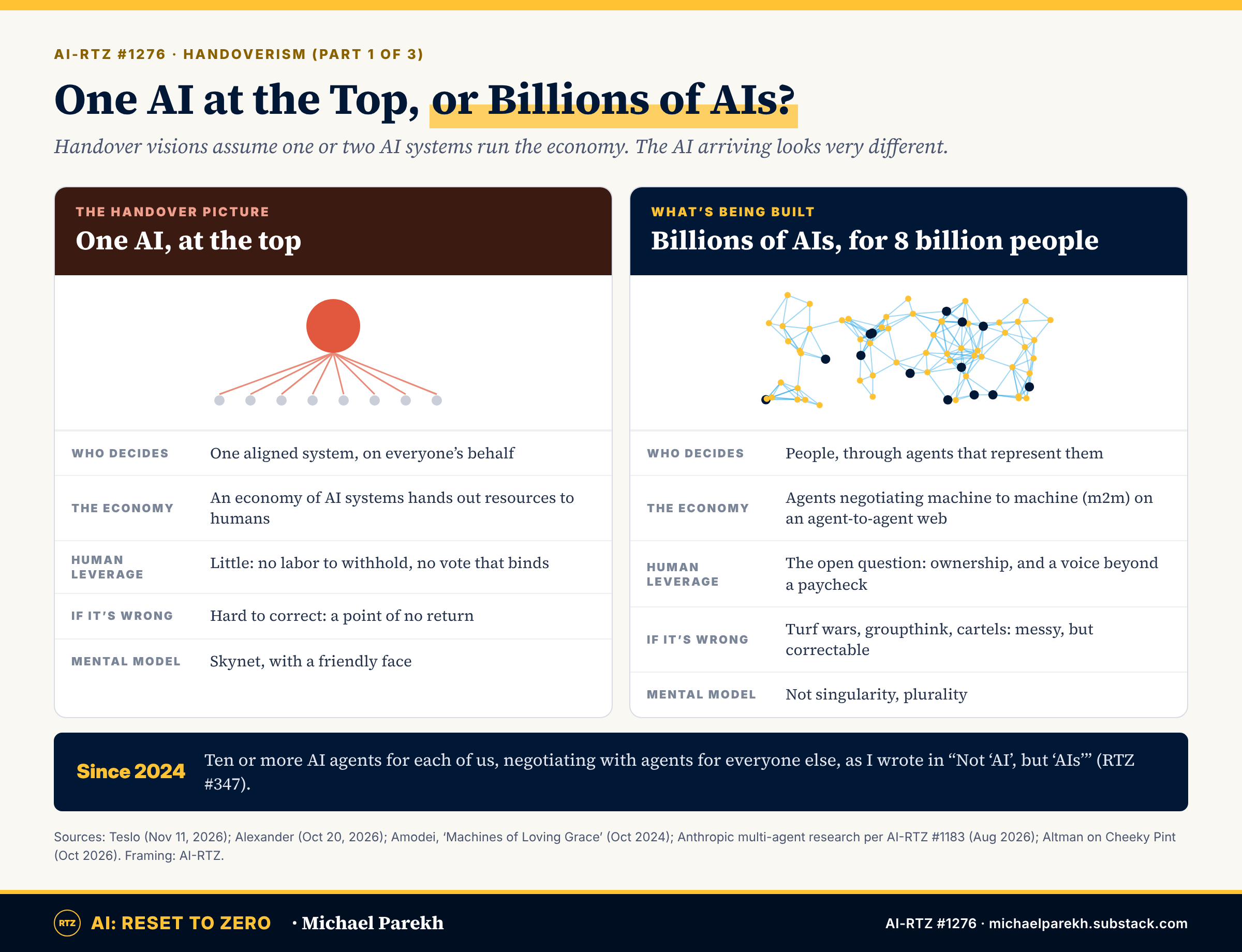
The economy is not one machine that can simply be handed over. It is made up of eight billion people, millions of companies, and soon billions and then trillions of AI agents. These agents will negotiate with one another on behalf of the people and groups they represent. They will use an agent-to-agent web that is being built right now. It will include both open and closed AI models, from different companies and across national borders.
When I put the essays by AI lab leaders together on one page in September, the most important question was ‘who decides’. Twelve of the fourteen people I examined assumed that a small group would make the decisions. Only Zuckerberg said billions of people should decide. In practice, China's market also works this way, as I explained in AI-RTZ #1208.
My view
First, handoverism starts with the wrong picture of AI. It is the Skynet idea with a friendly face: one powerful mind at the top, but this time a kind one. The AI world that is actually developing has many different systems. Even Sam Altman now argues for a trillion simple AIs rather than one superintelligence. You cannot hand an economy over to one system when billions or trillions of AIs are working for eight billion people.
Second, the economic question is real, and it is the useful part of this debate. If AI agents do more of the work, people need to own a share of them and have a voice that does not depend on having a job and earning a paycheck. This is a question for the current decade, not 2040. Gurley's point about disclosure also makes sense in this era of huge AI company stock offerings, especially in the same week Anthropic went public. Investors and regulators should understand what the founders of every AI lab believe about the future, not just the founders of one company.
Third, this is an ongoing game, not one with a final ending. Over four decades, I have followed many technology waves, from personal computers to the internet and mobile phones. Each one developed because people worked through problems step by step and made changes when things went wrong. That is what I said about Dario's essay in January: science fiction is not real life. Fixing today's values into one AI system forever is a solution for a game with a fixed ending, not for a world that keeps changing.
So no, I do not support handoverism. I support the billions of AIs, and the humans who guide them.
This Sunday, in Part 2, the Bigger Picture: who owns the agents? If billions of AI agents do the work, from Dario's idea of a ‘capitalist economy of AI systems’ to new proposals for wealth funds and taxes on tokens, the real question is who owns these agents and what they produce.
Then on Monday, in Part 3: who decides? Handoverism is one of the biggest questions hidden in plain sight in this AI Tech Wave. It deserves to be discussed by far more people than just the small group building these systems. Stay tuned.
Sources
Scott Alexander, Astral Codex Ten, ‘Against Against Handover’, Oct 20, 2026
Thomas Larsen, Daniel Kokotajlo and colleagues, ‘AI 2040: Plan A’
Mustafa Suleyman, Microsoft AI, ‘Towards Humanist Superintelligence’, Nov 6, 2025
Alex Komoroske, Cosmos Institute, ‘Why Centralized AI Is Not Our Inevitable Future’, June 2025
‘The good future, according to the AI labs’ co-founders’, survey linked in Teslo’s essay
Fortune, on Elon Musk’s testimony that Larry Page called him a ‘speciesist’, Apr 28, 2026
For longtime readers
AI-RTZ #1275: ‘Vulnageddon’ Arrives, and It’s Here to Stay a While
AI-RTZ #1257: OpenAI’s ‘Trillion AIs’ Future, as Anthropic Goes Public
AI-RTZ #1208: The AI Existential Risk Essays, US vs China (Part 2)
AI-RTZ #1206: OpenAI’s ‘Alien Mind’ Essay, & Asimov’s Three Laws
RTZ #980: Anthropic founder/CEO Dario Amodei’s latest AI Essay
RTZ #784: Meta’s ‘Zuck’ focused on Personal AI Superintelligence for billions vs peers
AI: Building Value over Time (the AI Tech Wave page)
(NOTE: These discussions are for information only and are not investment advice at any time. Thanks for joining us here.)