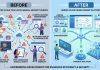
Workday Strengthens AI Governance with C1.ai Acquisition and Anthropic Partnership

Identity Governance for People and AI Agents
C1.ai connects to the systems businesses rely on, including email, CRM, code repositories, finance platforms and cloud infrastructure. It grants each person or agent appropriate access when needed and revokes that access when it is no longer justified.
The scale of the governance gap is central to Workday’s case. Many organisations still manage access across hundreds of applications through service tickets, spreadsheets and periodic reviews as employees join, change roles or leave. Autonomous agents add another layer of risk.
Research cited by C1.ai found that 95% of large US companies already use autonomous agents. Deloitte’s State of AI research found that only 21% have mature governance in place. Workday argues that, without clear controls and auditability, agents can create material security and compliance exposure.
Workday presents the acquisition as a natural extension of its existing role. Hiring, job changes and departures are already recorded as Workday events, giving the platform timely signals for adjusting access. By adding C1.ai, Workday intends to become what it calls “the identity governance layer for people, money, and agents”.
Giving Agent and People the Right Access

“Today’s companies run on a combined workforce of people and AI agents,” said Gerrit Kazmaier, Workday’s President, Product and Technology.
“With C1.ai, we’ll help secure that workforce by managing and enforcing exactly who – and what – has access to connected apps and systems. This gives each person and agent the right access at the right moment to make work easier, safer, and compliant.”
Alex Bovee, CEO and Co-Founder of C1.ai, said, “Enterprises can’t secure the AI era using yesterday’s IT tickets. Workday is the operational heart of the enterprise. By bringing C1.ai’s identity governance directly into that core, we’ll be able to manage access for every human and agent in real time. Making work faster without making it less secure.”
For customers, the intended benefit is more consistent access throughout the worker lifecycle. New hires could receive approved access from day one instead of waiting for individual tickets covering tools such as Slack, Jira and finance dashboards. Permissions could then change with each role and be removed promptly when someone leaves.
For AI agents, C1.ai would build on the Workday Agent System of Record. Extending visibility and management into control over what each agent can access across Workday and connected enterprise systems. That matters because a retired agent should not retain active credentials or permissions.
Workday expects the transaction to close in the fourth quarter of its 2027 fiscal year, ending 31 January 2027, subject to customary closing conditions.
Connecting Sana and Claude
Workday has also announced its partnership with Anthropic to connect Claude’s reasoning capabilities with Sana. Sana is Workday’s agentic experience and orchestration layer, and with governed HR and finance data in Workday.
Sana and Claude exchange information and tasks through the open Model Context Protocol (MCP). This allows work to continue across either environment while retaining relevant context and controls.
Within Sana, the focus is on complex, long-running processes. Workday says activities that previously took weeks, including compensation cycles and financial close, can run continuously in the background. Sana maintains process context from start to finish and creates task-specific workspaces, such as a live compensation grid or exceptions queue, without moving data out of Workday.
When a particular step requires drafting or reasoning, Sana can call Claude and share only the context needed for that step. While routing exceptions to a person for review.
Within Claude, employees can access Sana agents, analyse authorised Workday HR and finance data and take permitted actions. Workday states that every action remains subject to the customer’s existing permissions and audit controls. Claude displays only information the user is authorised to see.
Commercial Relationship
Joint customers will also be able to build agents in Claude using Workday Agent-Ready Tools. Workday says these agents will inherit the same governance, security and audit trail, with a single administrative connection rather than a new permission model or per-user configuration.
“Customers want the best domain AI agents for both their people and money. Furthermore, understand the business rules they run on and leverage the extraordinary reasoning in Claude,” said Kazmaier. “Together, Workday Sana and Claude unlock lawful AI across the enterprise to get real work done.”
The commercial relationship already operates in both directions. Anthropic uses Workday Financials and Workday HCM for its finance and people operations. Workday, meanwhile, has deployed Claude Enterprise, plans to begin using Cowork and uses Claude Code in product development. Workday Developer Agent also connects to Claude.
Enterprise Times: What this means for businesses
This has been a busy week for Workday in Las Vegas. Although the acquisition and partnership are separate, both support Workday’s ambition to become the control layer where organisations set and enforce rules for people, money and AI agents, regardless of where work takes place.
The announcements offer Workday’s answer to a difficult enterprise AI question. How can organisations expand the use of autonomous agents without turning those agents into security and compliance liabilities?
Taken together, the initiatives show Workday seeking to remain central as AI models become a primary interface for enterprise work. By allowing Claude to use Workday data while keeping permissions, approvals and business rules anchored in Workday, the company is positioning itself as a governance layer rather than trying to outcompete foundation-model providers.
C1.ai would extend that proposition from data and workflows to identity and access. The unresolved question is operational: whether customers experience a coherent governed environment or another pair of products that require integration, oversight and support.
The strategy is credible because it connects governance to systems Workday customers already use for workforce and financial processes.
Its success, however, will depend on execution: consistent policy enforcement across platforms, clear audit evidence, reliable revocation of access and transparent boundaries around the data shared with each agent. Those are the measures by which businesses should assess Workday’s claim to provide lawful, governed AI at enterprise scale.
Read more…