
‘Watch Your Head’ in AI. OpenAI, CoreWeave & ASML. ARD #184
…OpenAI’s new compute chief, CoreWeave’s ‘unlimited’ money hunt, ASML’s orders to 2030, and GTA VI.

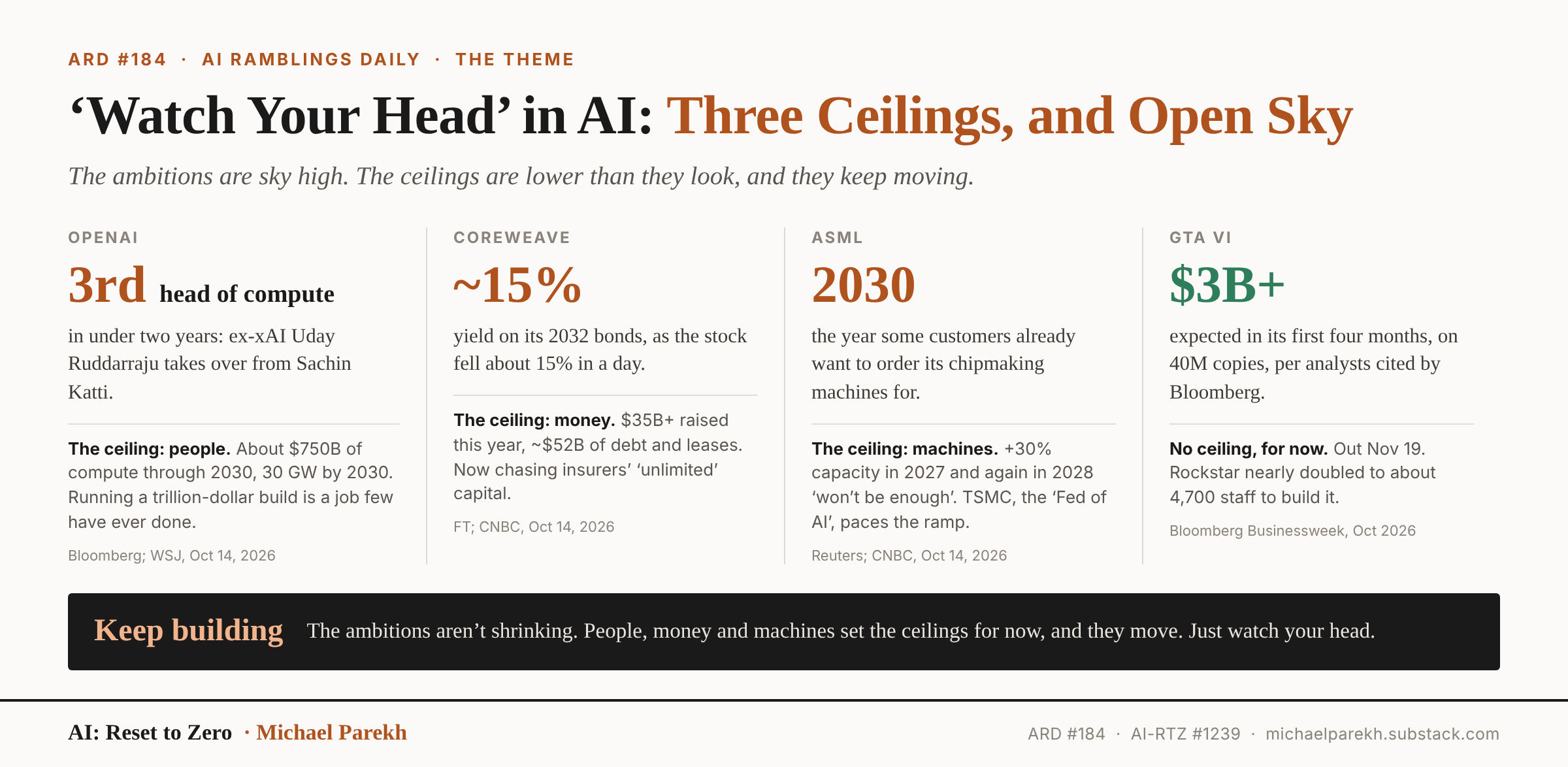
It is Wednesday, and today’s theme is ‘watch your head’, particularly on AI aspirations and the crazy execution challenges behind them. You know the sign: a low doorway. Keep moving, but mind the ceiling. In this AI Tech Wave, the ambitions are sky high. The ceilings are lower than they look sometimes, and they keep moving. All kinds of fluid events.
Three events today: OpenAI changing the head of its data center build, again; CoreWeave, the flagship neocloud, knocking on the trillions in insurance money, with its borrowing costs nearing 15 percent; and ASML, the maker of some of the most complex machines humans have ever built, with bullish news on its demand picture and its headroom. Then the Gadget AI, where GTA VI may be the one ambition with no ceiling at all.
(1) OpenAI names its third head of AI compute.
OpenAI has a new leader for its data center and compute business, per Bloomberg in ‘OpenAI Names Ruddarraju to Lead Data Center, Computing Unit’ and the WSJ in ‘OpenAI Computing Chief to Depart’. Uday Ruddarraju, a former xAI executive who joined OpenAI last year and became its CTO for compute in July, now leads its infrastructure and compute businesses, reporting to President Greg Brockman. He replaces Sachin Katti, who leaves after about a year and stays on as an adviser.
Katti came in to steady the Stargate build, which got off to a slow start after OpenAI failed to reach a joint deal with SoftBank and Oracle and struck separate deals instead. He locked in a 10 gigawatt data center lease with SB Energy, backed by an Nvidia financial guarantee. He is not the first to go: the executive behind Stargate left for Meta earlier this year, and another build-out leader left in August. That makes Ruddarraju, by my count, the third head of OpenAI’s compute ramp in under two years. And the stakes keep rising. OpenAI now projects about $750 billion of compute spending through 2030, up from about $600 billion earlier this year.
MP Take: this matters because OpenAI is one of the two frontier companies, with Anthropic, with the biggest aspirations for compute. Between the two of them, they are probably over half the demand for hyperscaler infrastructure, whether it is built by the neoclouds like CoreWeave and Oracle, or in partnership with a whole host of providers like Microsoft, Amazon, Google and others. It is a very volatile, extraordinary, detail-oriented execution challenge. OpenAI has to build the stuff at scale, source the stuff at scale and finance the stuff at scale, while Sam Altman travels the world reassuring everyone that the frontier models will be safe enough, and that the trillions in financing can be managed.
These numbers will continue to be fluid. OpenAI has the biggest compute game plan of its peers, 30 gigawatts by 2030, as I laid out in AI-RTZ #1204. Remember, every gigawatt typically means $50 billion or more of investment, so we are talking about big dollars: chips, finance, power, land, and partners with their own agendas. All of it up in the air ahead of a mega-AI IPO targeted for next year, with Anthropic potentially going out this year, and SpaceX already out since June. OpenAI’s infrastructure headwinds are probably the toughest out there, as I have noted since RTZ #792, because it does not have the seemingly unlimited free cash flow of a Google or a Meta. So it is hard on the people, up and down the organization, and these head changes are not that surprising.
Sources: Bloomberg, ‘OpenAI Names Ruddarraju to Lead Data Center, Computing Unit’ · WSJ, ‘OpenAI Computing Chief to Depart’.
For longtime readers: RTZ #874, ‘OpenAI’s ongoing mega AI deals, now with Broadcom’ · AI-RTZ #1204, ‘Anthropic’s $517B vs OpenAI’s $750B Compute Race’ · RTZ #792, ‘OpenAI’s Infrastructure headwinds are par for the course’.
(2) CoreWeave targets ‘unlimited’ insurance money.
CoreWeave is chasing insurers’ ‘unlimited’ pools of capital to fund its AI build-out, per the FT in ‘CoreWeave targets ‘unlimited’ insurance money to fund AI build-out’. Co-founder Brannin McBee, who leads its financing, wants more of CoreWeave’s chip-backed loans rated investment grade, and eventually the whole company, so it can tap insurers, who manage trillions. The numbers are big: over $35 billion raised this year across chip-backed loans, high-yield bonds, convertibles and share sales, about $52 billion of debt and lease obligations, and analysts expecting it to burn about $25 billion of cash this year.
Then, on Wednesday, the markets weighed in. CoreWeave’s 2032 bonds yielded 14.8 percent and its shares fell about 15 percent in a day, per CNBC in ‘CoreWeave shares tumble as bond yields near 15% on concern about AI borrowing binge’.
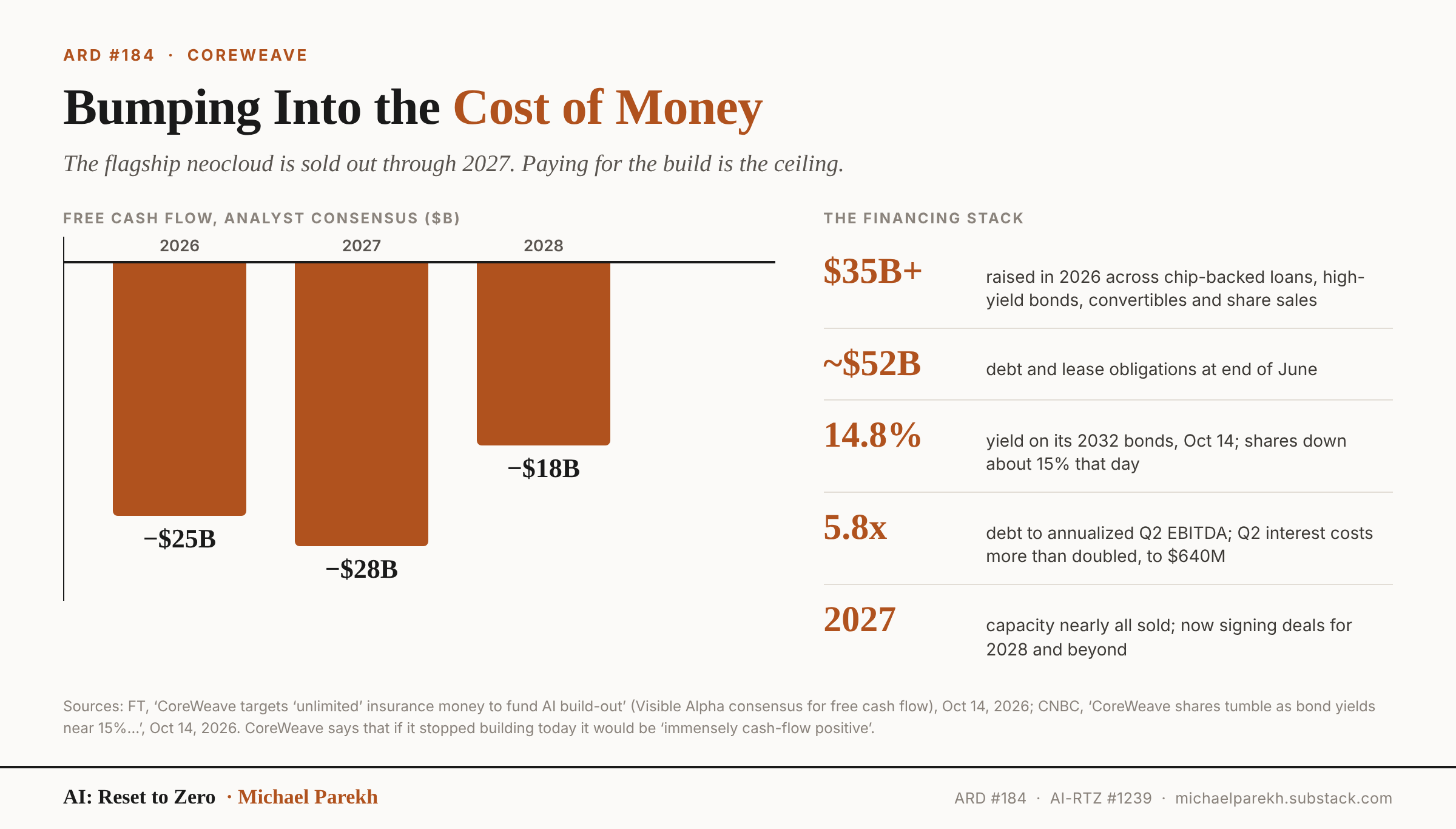
MP Take: watch your head. CoreWeave is bumping into the ceiling of the cost of money, which remains an issue for everybody. Remember, this is as its debt and equity demands keep climbing, as it builds for OpenAI and a whole host of other players, Microsoft and others. Oracle is going through its own version of this as well. It should be manageable for now, because its customers, the Microsofts, Metas and OpenAIs, will find ways to work with it. And the other core investor here is Nvidia, the kingmaker and banker for the industry as a whole, as I have tracked since RTZ #657 and most recently in AI-RTZ #1234, with a $500 billion financing program that CoreWeave says it is ‘actively’ looking at.
But the numbers are big, and the dynamics have to be managed, including the ceilings, as all of this gets a little tougher with the macro interest rate environment in the United States, in China and around the world, as I noted last week in ARD #180. CoreWeave says it has sold nearly all its 2027 capacity. The other side: critics worry about long data center leases against shorter customer contracts. If there is an overbuild, will customers renew?
Sources: FT, ‘CoreWeave targets ‘unlimited’ insurance money to fund AI build-out’ · CNBC, ‘CoreWeave shares tumble as bond yields near 15% on concern about AI borrowing binge’.
For longtime readers: RTZ #657, ‘Nvidia’s rocket fuel propulsion of CoreWeave’ · AI-RTZ #1234, ‘Nvidia, the AI Banker & its Next Generation’ · ARD #180, ‘More of the Same’ in AI. OpenAI vs Anthropic, AI Debt & Rates · RTZ #558, ‘Rise of the AI data center ‘Neoclouds’’ · AI-RTZ #1178, ‘The AI Compute Crunch at Ground Level’.
(3) ASML sees orders out to 2030, and not enough machines.
ASML said customers are already looking to place orders for its advanced chipmaking tools for 2029 and 2030, per Reuters in ‘ASML’s strong orders ease fears AI spending boom is running out of steam’, and CNBC in ‘ASML says it’s getting order interest through 2030 as profit smashes expectations’. ASML is the only maker of the extreme ultraviolet, or EUV, lithography machines TSMC needs to make the most advanced chips, and through TSMC, the chips for Nvidia, Apple and others. Third quarter net profit came in at €4.96 billion, well ahead of the €4.1 billion expected, and it raised its full-year sales outlook to €44 to €45 billion.
The catch is supply. In July, ASML said it would grow capacity 30 percent in 2027 and another 30 percent in 2028. Now CEO Christophe Fouquet says that will not be enough. So ASML will upgrade existing machines, sell faster new versions, and raise prices from 2027.
MP Take: remember, these machines are some of the most complex ever created by humans, $400 million plus apiece, as I explained in AI-RTZ #1226. They are so big they take several jumbo jets to ship, ASML makes fewer than a hundred of them a year, and there is incredible complexity in every component that goes into them, from the glass on up. They cannot be scaled up overnight. For now, the orders are coming through, despite the pacing of growth by one of ASML’s top customers, Taiwan Semiconductor, which I have long called the ‘Fed of Tech and AI’, in AI-RTZ #1108 and earlier. TSMC paces the industry overall, and with over half its revenues coming from Nvidia, Apple and companies like them, it has been relatively prudent about not getting ahead of its skis on orders, which affects how ASML sees its own order book.
All of this is important in the weeds for analysts like me. The signal is a positive one, but it points to the headroom in the orders for some of the most complex, most expensive machines out there, the ones that make the very components that make AI, AI. The other side: some analysts are already asking what happens in 2029, if this cycle turns. Let’s watch this space.
Sources: Reuters, ‘ASML’s strong orders ease fears AI spending boom is running out of steam’ · CNBC, ‘ASML says it’s getting order interest through 2030 as profit smashes expectations’.
For longtime readers: AI-RTZ #1226, ‘ASML, the $400 Million Machine behind every AI Chip’ · AI-RTZ #1108, ‘Taiwan Semi, ‘Fed of the global chip economy’, Speaks’ · RTZ #588, ‘Key role of ASML in AI tech wave’.
My overall take
MP Take: all three events today highlight the shifting headroom, and the heads, behind the ambitions and aspirations of the key companies in this AI Tech Wave. At OpenAI, the ceiling is people, for now. Running trillion-dollar builds is a job few have ever done, so there is a lot of learning and execution on the job, at scales that are very hard to imagine for most executives and businesses. At CoreWeave, the ceiling is the cost of money, near 15 percent, and those are high numbers on the debt side. And at ASML, the ceiling is the machines, these extraordinarily complex gizmos that cost $400 million plus apiece and take ages to put together. For now, the orders look pretty good.
So the ambitions aren’t shrinking. The ceilings are real, but they are moving, and everyone just keeps on building. Just watch your head.
Gadget AI: GTA VI, unlimited headroom.
Grand Theft Auto VI arrives November 19, and Bloomberg has the inside story of how Rockstar made it, in ‘The Making of Grand Theft Auto VI’, the first time Rockstar has talked openly about it. GTA is probably the biggest property across any media you can think of, TV, movies and music included.

The numbers, as Bloomberg cites them: analysts expect GTA VI to sell 40 million copies on PlayStation and Xbox, and bring in more than $3 billion in revenue in its first four months. A PC version is expected in early 2027, which will boost the numbers further. Its predecessor, GTA V, has sold 230 million copies, the bestselling non-mobile game of all time. The GTA VI trailer got 93 million views in its first 24 hours, a YouTube record for a non-music video, and has since passed 300 million. And GTA Online, the multiplayer version of GTA V, still brings in an estimated half a billion dollars a year, with a GTA VI online version expected in 2027.
The company: Rockstar is owned by Take-Two Interactive, and its power center is Rockstar North in Edinburgh, Scotland. When it shipped Red Dead Redemption II in 2018, Rockstar had 2,441 employees. Today it has 4,711, across 12 offices, far bigger than any rival studio. GTA VI took more than eight years, with two delays. Rockstar will not say what it cost, though it shot down a rumor that it topped the $1.5 billion cost of Dubai’s Burj Khalifa; Bloomberg estimates it may have cost more than double the $500 million most publishers try to stay under. And a lot of complex AI went into building its world, the traditional kind, not ChatGPT, so its two main characters can live their lives together in the open world.
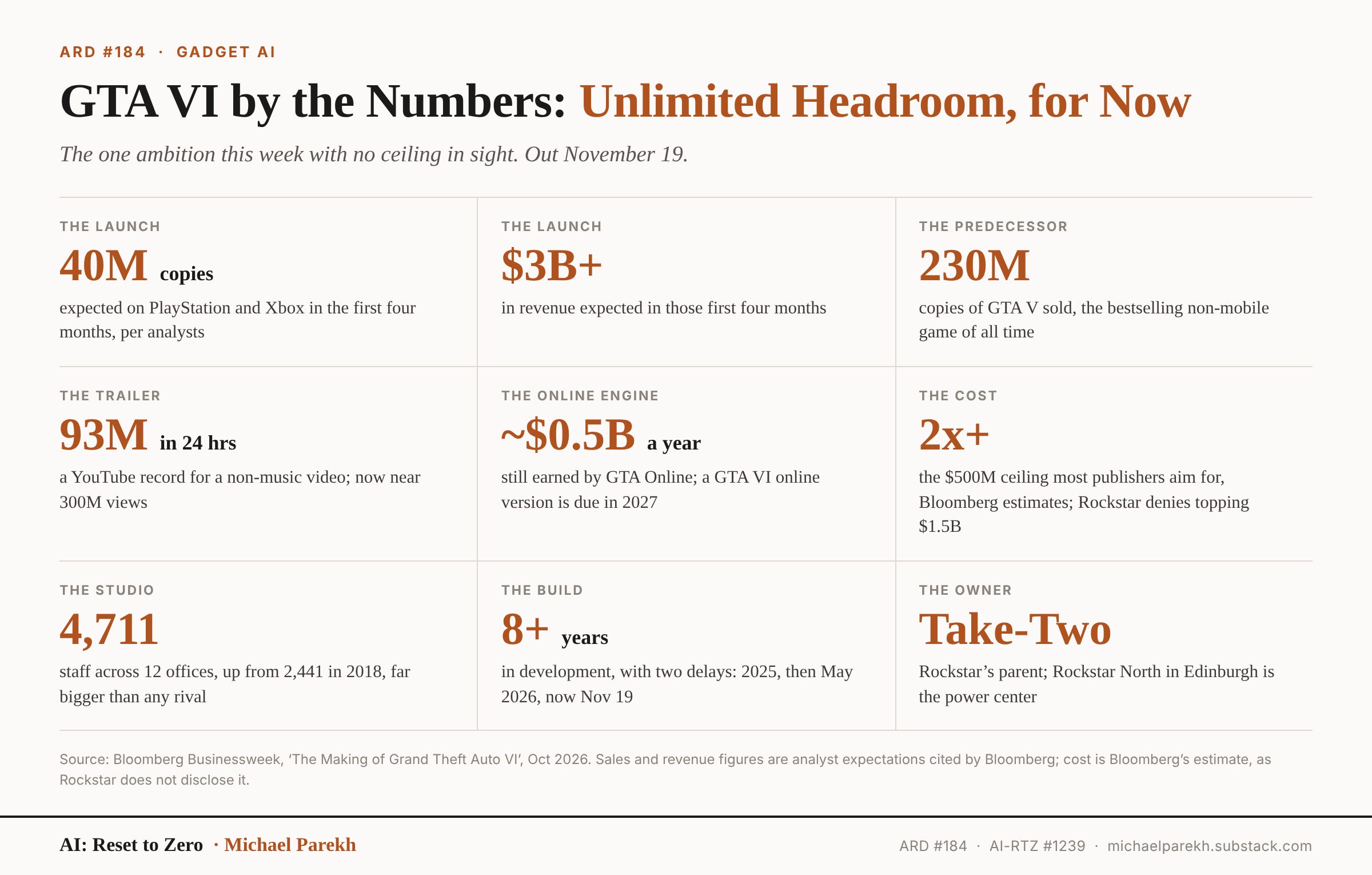
MP Take: watch your head? Not here, for now. Rockstar looks to have unlimited headroom for its game, or so it seems right now. GTA is one of my favorite games of all time, and Rockstar’s other open-ended game, Red Dead Redemption, one and two, set in the Wild West, is right up there. As I said in ARD #149, GTA has become a universe of its own. This is a pretty exciting business case study, of something that works across the world. And there will be iterations, especially in the online versions, one would presume, with more AI in the mix.
Sources: Bloomberg, ‘The Making of Grand Theft Auto VI’.
For longtime readers: ARD #149, ‘GTA 6, Rockstar’s Universe of its Own’ · AI-RTZ #1145, ‘RAMageddon’ really here to stay.
Q&A
What is the most attractive aspect of GTA games for me?
It is a metaverse unto itself. A whole live world, with hundreds if not thousands of computer characters, what are called NPCs, and that makes it very alive. Mark Zuckerberg used to talk about the metaverse, and even renamed his company for it. But Rockstar’s games, GTA and Red Dead Redemption, are the closest things we have to a true metaverse experience, whether by yourself in the campaign, or socially with friends and a whole host of other players online. It is like stepping into a Star Trek holodeck, for as much time as you want.
What is the biggest downside?
Which takes us to the downside: it is an unlimited time sink, if you let it be. You have to budget your time with this thing carefully, especially those of us who are a little older and don’t have as much unlimited time as we used to. So watch your clock, and your head, when it comes to your other responsibilities.
Clips from today
ASML’s Orders Out to 2030
ASML makes the lithography machines behind the most advanced chips, and it is seeing orders strengthen out to 2030, with not enough machines to go around.
MP Take: these are some of the most complex machines humans make, $400 million plus apiece, shipped in several jumbo jets, fewer than a hundred a year. They cannot be scaled up overnight.
ASML’s Capacity Ceiling
ASML planned to grow capacity 30 percent in 2027 and again in 2028. Now it says that won’t be enough.
MP Take: the orders are strong despite the pacing by its top customer, TSMC, the ‘Fed of Tech and AI’, which has been prudent about not getting ahead of its skis. A positive signal, with a ceiling.
GTA VI’s Blockbuster Numbers
The GTA VI trailer got 93 million views in its first 24 hours, now over 300 million. GTA Online still brings in about half a billion dollars a year, and Rockstar has nearly doubled to about 4,700 staff.
MP Take: watch your head? Not here, for now. Rockstar looks to have unlimited headroom.
GTA, the Real Metaverse
The most attractive part of GTA games for me: a metaverse unto itself, a whole live world full of computer characters.
MP Take: Rockstar’s games, GTA and Red Dead Redemption, are the closest thing we have to a true metaverse. Like stepping into a Star Trek holodeck.
Today’s AI-RTZ #1239, ‘Publishing’s ‘Voluntold’ AI Revolt, a Case Study for Every Industry’ is on what I call the ‘voluntold’ phenomenon: AI adoption being pushed down through the enterprise by top management. The publishing case study is worth studying because it applies to almost every industry deploying AI. The key takeaway: this tech wave is very different from, say, the PC wave, which was bottom-up, organic adoption, with people figuring out for themselves how to use computers for word processing and spreadsheets and pushing that through their organizations. AI is being pushed down, and people are being voluntold to adopt it. A lot of implications, culturally and organizationally.
AI Ramblings Daily on AI-RTZ is here to think through AI and reset. Together.
Tomorrow, ARD 185 and AI-RTZ #1240.
Thanks for joining us, AI Curious Folk. Stay tuned.
Full Source Reading
The heads
The cost of money
The machines
Gadget AI
The back catalogue
AI-RTZ #1239, ‘Publishing’s ‘Voluntold’ AI Revolt, a Case Study for Every Industry’
AI-RTZ #1226, ‘ASML, the $400 Million Machine behind every AI Chip’
AI-RTZ #1204, ‘Anthropic’s $517B vs OpenAI’s $750B Compute Race’
AI-RTZ #1108, ‘Taiwan Semi, ‘Fed of the global chip economy’, Speaks’
ARD #180, ‘More of the Same’ in AI. OpenAI vs Anthropic, AI Debt & Rates
RTZ #874, ‘OpenAI’s ongoing mega AI deals, now with Broadcom’
RTZ #792, ‘OpenAI’s Infrastructure headwinds are par for the course’

(NOTE: The discussions here are for information purposes only, and not meant as investment advice at any time. Thanks for joining us here.)