
AI writes it and AI evaluates it...a letter of self-introduction disappearing from the U.S. recruitment market
Doubles the number of applicants per recruitment notice in 4 years
Personnel manager "The era of self-introduction letter is over"
Human trust is important, such as letters of recommendation and face-to-face exchanges
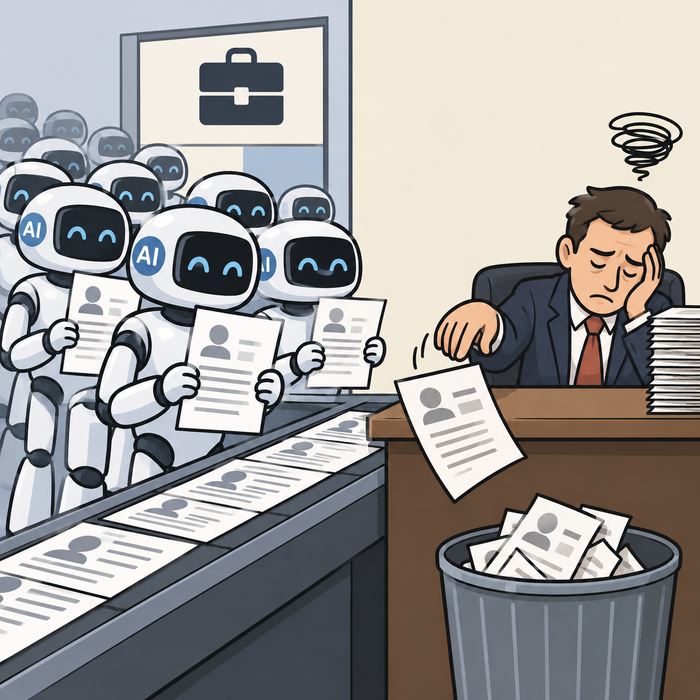 사진 확대
Artificial intelligence (AI) is shaking its position in the U.S. job market. This is because AI makes it easier for anyone to write plausible self-introductions, and its value as a means of judging the competence and sincerity of applicants is falling. Companies are moving to evaluate applicants through recommendations from trusted people or direct exchanges instead of self-introduction letters.
The Washington Post (WP) reported on the 14th (local time) that the role of self-introduction letters in the U.S. job market is rapidly decreasing in an article titled "Did AI Finally Kill Self-introduction Letters?" The debate that self-introduction is an outdated hiring practice has existed even before the advent of AI, but the change has accelerated due to the spread of Generative AI.
The biggest change is that it has become easier to write a cover letter. In the past, applicants had to spend considerable time and effort organizing their experiences and strengths in line with companies and jobs. But now, you can create a high-quality cover letter just by entering your resume and job posting into AI.
Judd Kessler, a professor of business economics and public policy at the University of Pennsylvania, told the WSJ, "Now it is easier to write a good self-introduction letter as well as write a self-introduction letter," adding, "A well-written self-introduction letter is not a factor that differentiates it from other applicants, but a basic condition."
AI is also increasing the number of applicants flocking to the job market. According to a recent survey by LinkedIn Research, the number of applicants per job posting in 2026 doubled compared to similar job postings in 2022. This is because it has become easier to fill out and submit applications to various companies using AI.
Corporate human resources managers are having a hard time reviewing the increased applications. There was not enough time to read the cover letter carefully. Johnny Taylor, chairman and CEO of the American Human Resource Management Association (SHRM), asserted, "The letter of self-introduction is completely dead and will not come back to life." "There are so many applications that I can't afford to read beautifully," he said.
Some companies are even leaving AI to review documents submitted by applicants. Applicants are submitting AI-made self-introductions to job postings written by AI, and AI from companies is even evaluating them. In other words, human intervention in the hiring process is decreasing.
Confusion among applicants is also growing. Pelumi Ogunrana, a 36-year-old corporate finance expert working in the Chicago area, said she even heard cases of submitting resumes and self-introductions with traces of the chatbot's modification. "Some recruiters say it's worth writing a letter of self-introduction, and others don't need it," he said. "It's difficult because no one gives me the answer."
However, the letter of self-introduction has not become completely meaningless. Recruitment experts explain that the self-introduction letter with personal experience and authenticity, which is distinct from the uniform sentences made by AI, still works.
Experts predicted that activities that AI cannot replace will become more important in the recruitment process than self-introduction letters in the future. Examples include customized recommendations written by people who know the applicant directly or activities to attend industry events and meet with corporate officials in person. Professor Kessler predicted that companies will become more dependent on other data that can confirm the applicant's interest and efforts. "This cannot be done by AI agents on behalf of applicants," he said. "It is not something that can be done equally for all companies." [Silicon Valley correspondent Wonho-seop]