
Anthropic reports adjusted earnings ahead of IPO, AI development costs remain a concern.
The company behind the chatbot Claude is experiencing remarkable business growth in the artificial intelligence (AI) race.
Figures revealed at the investor meeting prior to the listing showed that Anthropic was not only rapidly expanding its revenue but also beginning to signal improved profitability.
However, behind these positive results lies a commitment of hundreds of billions of dollars to computing infrastructure, raising the question of whether the rate of monetization will keep pace with the cost of AI development.
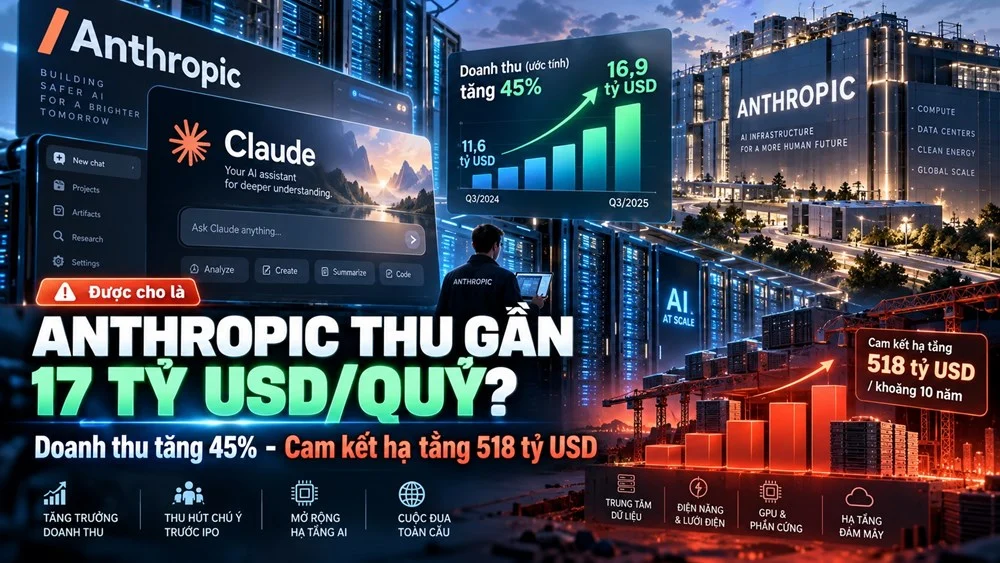
With revenue increasing 45%, Anthropic is now reportedly operating at an adjusted profit.
According to information revealed by an investor who attended a meeting with Anthropic's leadership in San Francisco on October 14th, the company's revenue for the third quarter of 2026 reached approximately $16.8 billion, a 45% increase compared to the $11.6 billion recorded in the second quarter.
Previously, Anthropic's first-quarter revenue was reported to be $4.7 billion. Thus, in just two quarters, revenue has increased more than 3.5 times, reflecting the rapid commercialization of the company that develops the Claude AI model line.
Notably, Anthropic reportedly informed its investor group that the company achieved adjusted profitability in the third quarter. This is a positive sign, as many AI companies are still incurring significant losses to maintain technological growth and expand market share.
However, it is necessary to distinguish adjusted profit from profit determined according to conventional accounting standards. Adjusted figures may exclude certain expenses or accounting elements, and therefore are not sufficient to conclude that a business has achieved net profit or generated sustainable positive cash flow.
As of the time the information was released, Anthropic had not issued an official response regarding the aforementioned figures. The company also had not publicly released its third-quarter financial report, preventing investors from fully verifying revenue, expenses, profits, and cash flow.
Nevertheless, the revealed figures show that the AI business is rapidly evolving. While in the early stages businesses primarily focused on developing models, attracting users, and demonstrating technological capabilities, now the ability to generate revenue from products and services has become the decisive factor in determining business value.
Anthropic is one of the companies benefiting from the growing demand for AI in businesses. Its Claude product line is developed to support word processing, data analysis, programming, task automation, and many other professional tasks.
In addition to applications for direct users, Anthropic also provides technology to businesses and developers through application programming interfaces (APIs), as well as cloud computing platforms from its partners.
These are commercialization channels that allow AI businesses to generate revenue based on actual usage, rather than solely on the number of registered accounts.
However, revenue growth is also beginning to show signs of slowing down in terms of rate. After more than doubling from Q1 to Q2, Q3 revenue is estimated to have increased by 45%. This doesn't necessarily mean demand for AI is weakening, but it shows that maintaining such extremely high growth rates will become increasingly difficult as businesses scale up.
The $518 billion infrastructure commitment raises the question of profitability.
Behind the rapid revenue growth lies the exceptionally high cost pressure that Anthropic faces in maintaining its position in the AI race.
According to previously disclosed financial information, Anthropic has committed at least $518 billion over a decade to cloud computing services, processing power, and infrastructure to support AI development.
Notably, approximately 80% of the committed value falls under the category of obligations that are difficult or impossible to cancel, or must still be paid even if the business does not fully utilize the computing capacity it has purchased.
This creates long-term financial pressure because the company needs to continue expanding revenue and optimizing infrastructure utilization to meet agreed-upon payment obligations.
Among its major partners, Anthropic plans to spend at least $111.1 billion on Google, approximately $110 billion on Amazon, and $31.4 billion on Microsoft under long-term agreements. The company also has equipment leasing obligations worth approximately $161.2 billion related to Broadcom.
These payments are spread over many years, encompassing various contractual obligations and forms of infrastructure provision. Therefore, it is inconceivable that Anthropic spent the entire $518 billion or had to pay this amount in a single year.
Nevertheless, the scale of the commitment suggests that the AI race is entering a phase requiring massive financial resources. Developing increasingly powerful models demands a large number of specialized chips, data centers, cooling systems, power, and continuous operation capabilities.
Costs are incurred not only during the training of new models but also throughout the user service process. Each processing request, especially complex tasks such as programming, analyzing lengthy documents, or operating automated AI, consumes computing resources.
Attracting more customers can increase revenue for businesses, but it's crucial to ensure sufficient processing capacity to meet demand. This is a significant difference compared to many traditional software types, where the cost of serving an additional user is often considerably lower.
This pressure was clearly reflected in Anthropic's business results. In 2025, the company's revenue increased twelvefold, reaching nearly $4.6 billion, but it still recorded an operating loss of over $8 billion, according to figures adjusted to exclude certain write-downs on financial obligations.
The large gap between revenue and costs indicates that a rapidly growing market size does not necessarily translate into stable profitability.
Furthermore, Anthropic's business model is notable for the multiple roles played by major partners like Google and Amazon. They act as investors, computing power providers, distribution partners, and developers of directly competing AI products.
This relationship gives Anthropic access to large-scale capital, infrastructure, and customers, but it also creates the risk of dependence on businesses whose business interests do not always align.
If computing costs rise, chip supplies become limited, or partnership conditions change, Anthropic could face pressure on profits even as revenue continues to grow.
Therefore, what investors need to evaluate is not just how much revenue increases, but also the profit margin, the efficiency of using each USD spent on computing, and the ability to generate cash flow after meeting infrastructure obligations.
An IPO aiming for a valuation of over $2 trillion: A test for the AI wave.
These new financial details emerge as Anthropic prepares for its initial public offering (IPO), with a valuation target reportedly exceeding $2 trillion.
If this valuation is achieved, Anthropic would become one of the world's most valuable technology companies upon its IPO. However, this is only an ambition mentioned during the IPO preparation process, not the valuation established by the stock market.
According to plans discussed by investors, Anthropic's listing could take place after the US midterm elections in November 2026. The official timing will depend on market conditions, the completion of the necessary paperwork, and the company's decision.
The fact that Anthropic is expected to go public before its rival OpenAI makes this IPO particularly noteworthy. This could become one of the first tests of investors' ability to accept the enormous valuations of companies specializing in developing advanced AI models.
In recent years, the AI boom has driven a massive influx of capital into businesses involved in chip manufacturing, data center development, cloud computing, and software development.
However, financial markets are also beginning to question the payback period. Infrastructure investments worth hundreds of billions of dollars will only be profitable if the demand for AI continues to grow, customers are willing to pay, and operating costs are controlled.
For Anthropic, the revenue growth disclosed in the third quarter is an advantage when approaching potential investors. But to convince the market to accept a valuation of over $2 trillion, the company will need to demonstrate its ability to sustain profitability for many years, not just achieve positive results in one quarter using an adjusted methodology.
Another factor is the increasingly fierce competition. Besides OpenAI, corporations like Google, Meta, and many other AI developers are constantly introducing new models, increasing efficiency and reducing costs. As technological capabilities between products narrow, businesses may have to compete more intensely on price, reliability, and integration into customers' real-world operations.
Anthropic is also pursuing a safe AI development strategy, viewing it as part of its approach to building trust with businesses and users. However, the research, assessment, and risk management of increasingly complex AI systems require significant investment.
Therefore, the upcoming IPO is not simply a matter of how much capital an AI company can raise. More importantly, it will be an opportunity for the market to assess whether large-scale AI development companies have come close enough to a sustainable and profitable business model.
Revenue of $16.8 billion in a single quarter, if confirmed, would demonstrate Anthropic's very rapid commercialization pace. But the infrastructure commitment of at least $518 billion over a decade also serves as a reminder that strong growth alone is not enough to guarantee financial success.
As expectations for AI grow, investors may become more interested in actual returns, cash flow, and the ability to recoup their investment, rather than just looking at revenue growth rates. This will also be a test of the sustainability of the ongoing global wave of AI investment.