
Anthropic’s performance is “good but not good enough”: revenue growth slams on the brakes under 'adjusted profit' metrics!
Anthropic reported Q3 revenue of $16.8 billion, up nearly 50% quarter over quarter, and posted "adjusted profitability"—yet the market remains unimpressed. The key concerns are: monthly growth has plummeted from a previous 33% to single-digit levels; the year-end $100 billion target now faces a shortfall of tens of billions; token prices have tumbled to historic lows; and the divergence between volume and price is becoming increasingly pronounced. Can this "good but not good enough" performance sustain the company's $2 trillion IPO valuation?
AI unicorn Anthropic posted a third-quarter earnings report that looked impressive on the surface but ultimately disappointed the market.
According to a Thursday report by the UK's Financial Times, Anthropic disclosed at a closed-door pre-IPO investor day in San Francisco that its third-quarter revenue reached $16.8 billion, up nearly 50% from $11.5 billion in the second quarter, while also posting "adjusted profitability" and positive cash flow.

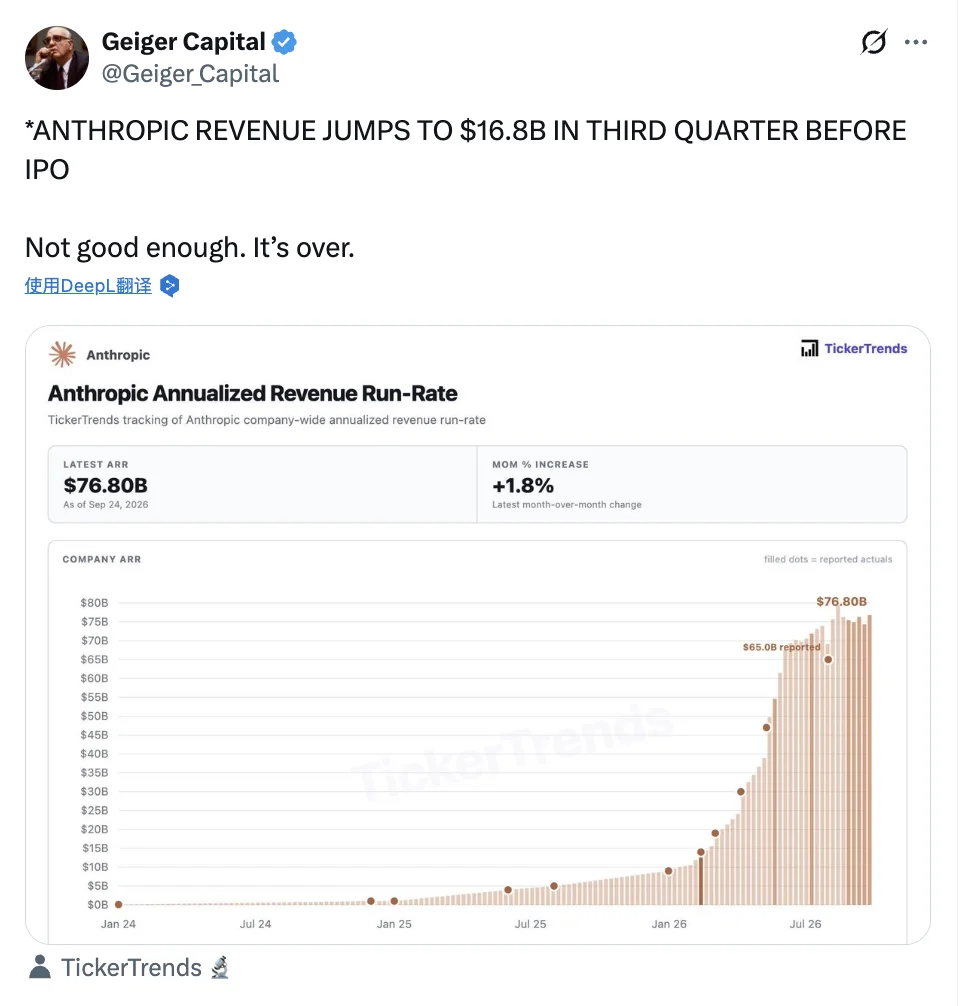
The underlying concern behind the numbers lies in the sharp deceleration of growth. According to ZeroHedge's calculations, Anthropic's annualized revenue run rate had already reached $65 billion as of late July this year, yet the quarterly data imply that the monthly growth rate has plummeted from a previous compound monthly pace of roughly 33% to just 3.4%–6.6%. If this trend persists, the company's full-year annualized revenue would top out at around $89 billion, leaving it approximately $10 billion short of the market's earlier consensus expectation of exceeding $100 billion by year-end.
This means that, for Anthropic to achieve its stated goals, its quarterly growth rate would need to rebound to 10%–13%—a scenario that unfolds against the backdrop of its token price hitting an all-time low and intensifying competition in the open-source model space.
A Sharp Slowdown: From a Monthly Growth Rate of 33% to Single-Digit Growth
The key to understanding this performance lies in reconstructing the true trajectory of monthly growth.
Anthropic typically calculates its annualized run rate by multiplying its most recent monthly revenue by 12. Based on this approach, a $65 billion run rate as of the end of July implies that July's monthly revenue was approximately $5.4 billion. Working backward from the third-quarter total of $16.8 billion, August and September combined would account for roughly $11.4 billion in revenue, corresponding to a month-over-month growth rate of only about 3.4%.
Even under a more lenient assumption—treating the $65 billion as the instantaneous run rate on July 31 rather than the July average—the July revenue would be approximately $5.2 billion, and the implied monthly growth rate for August and September would be no more than 6.6%. Based on this calculation, Anthropic's annualized run rate at the end of the third quarter would fall in the range of $69 billion to $74 billion.
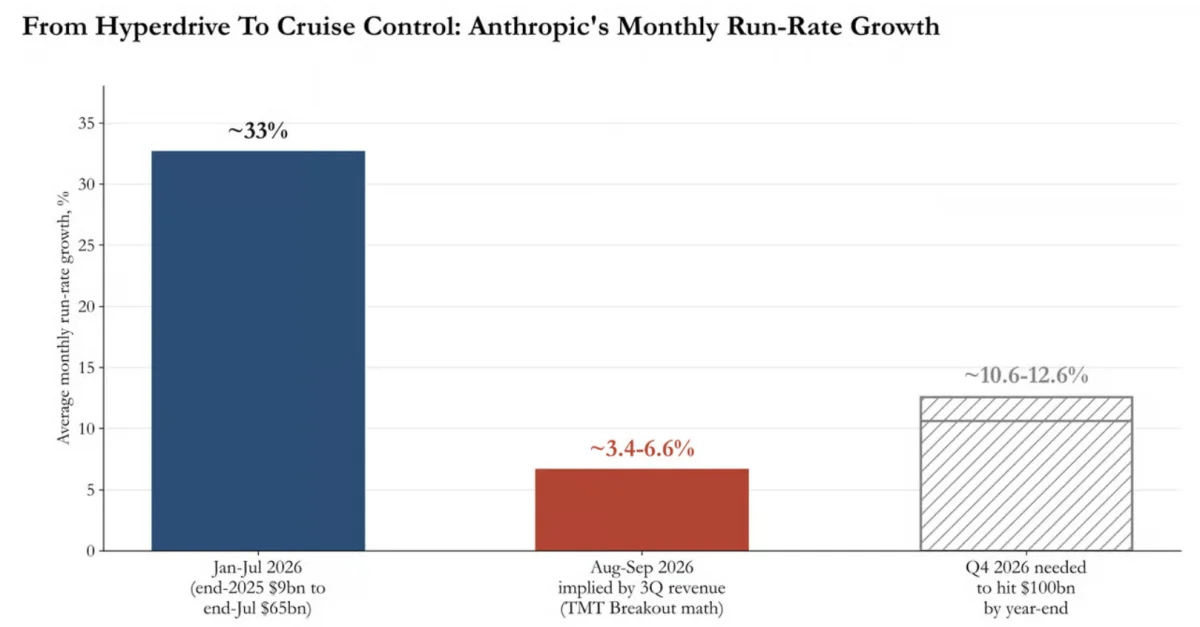
This stands in stark contrast to the growth trend observed in the first half of this year. Starting from an annualized run rate of roughly $10.8 billion at the end of 2025, Anthropic's figure surged to $65 billion by the end of July, reflecting a monthly compound growth rate of approximately 33%. However, by August and September, this growth rate had decelerated to single-digit levels.
"Adjusted Earnings": Profit marked with an asterisk
Anthropic's earnings announcement will attract the most attention and, quite rightly, the most footnotes.
The Financial Times report did not disclose which items were adjusted under the "adjusted" figures; the full GAAP financial data is expected to be released around October 25, alongside the S‑1 registration statement. According to a confidential version of the prospectus previously reported by Reuters, Anthropic recorded a net loss of approximately $42 billion in 2025, with about $34 billion attributable to financing‑related accounting expenses, an operating loss exceeding $8 billion, and capital‑expenditure commitments for computing power and infrastructure over the next decade totaling at least $518 billion—roughly 80% of which are irrevocable.
Moreover, the revenue measurement itself is also controversial. According to Goldman Sachs' TMT team, Anthropic uses a metric akin to "total revenue"—that is, it includes all customer spending generated through cloud partners and then treats partner fees as costs—making its top-line figures appear more favorable than OpenAI's net-revenue approach, while also rendering the calculation of "adjusted" profit margins highly dependent on specific accounting practices.
With the largest-ever computing‑power bill still yet to come due—indeed, according to Microsoft's commitment, charges won't begin until November—and with the IPO window on the verge of opening, relying solely on adjusted quarterly earnings is still far from establishing a credible track record of profitability.
Token prices have hit a historic low, with price–volume divergence emerging as the central contradiction.
The structural root cause of the slowdown in growth points to the continued decline in token prices.
According to data from the Ornn Anthropic Token Price Index, the price of Anthropic's token has fallen to a historic low. Meanwhile, the latest token‑usage metrics from Ramp AI show that, despite AI adoption continuing to grow rapidly—consistent with Jevons' paradox—actual spending on AI has either remained flat at best or even contracted. The underlying reason is the expanding market share of open‑source models, which has driven down overall token prices.
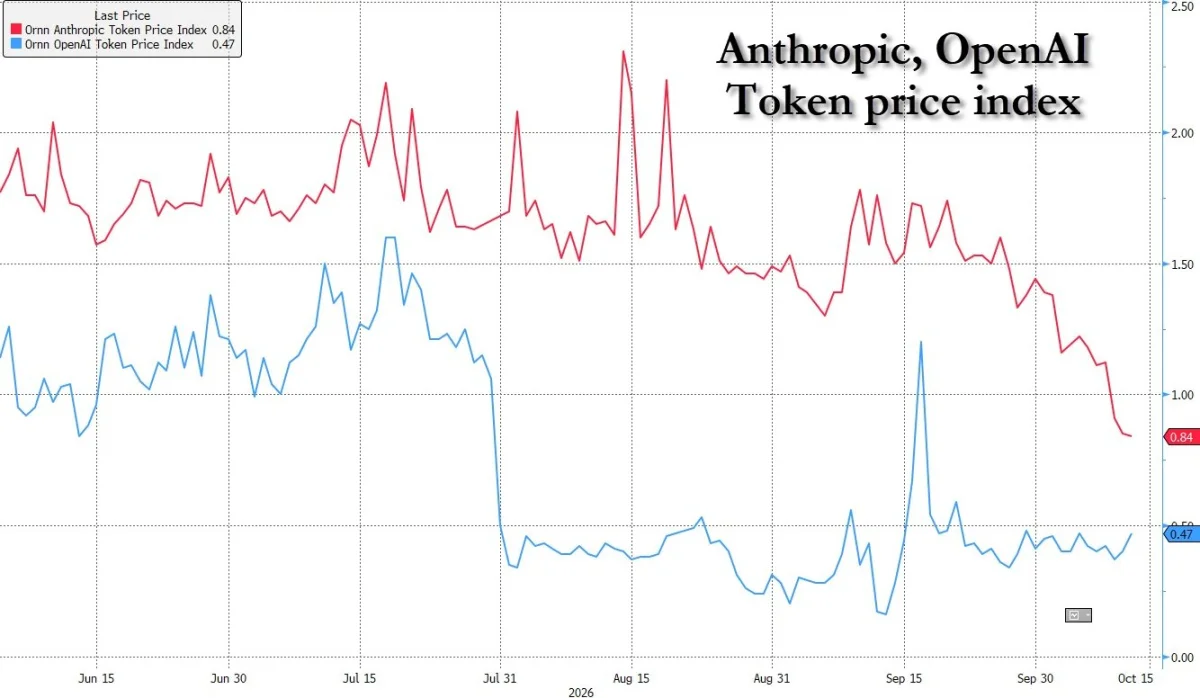
This divergence between volume and price represents the core strategic dilemma facing Anthropic: the token's price is declining faster than the company can translate higher usage into revenue growth. If the slowdown in growth from August to September occurred while prices were still relatively resilient, then a renewed acceleration in the fourth quarter will have to rely on achieving substantially higher usage levels even after the price has been halved—a fundamentally different business dynamic.
Meta, Google, and China's open-source large models are flooding the cutting-edge market at steep discounts, further squeezing Anthropic's pricing flexibility.
For AI trading: good, but not good enough.
Whether this performance can sustain the broader AI investment narrative depends on the metrics used.
According to Goldman Sachs' trading desk, citing Brad Gerstner's framework, top AI labs need to raise their combined annualized run rate from roughly $100 billion in July to $180–200 billion by year-end to maintain the integrity of AI trading. Based on third-quarter trends, Anthropic would be around $89 billion by year-end; adding OpenAI's own year-end target of approximately $70 billion, the two together would total about $159 billion—still below the threshold set by Gerstner—and that figure even combines a gross-revenue metric with a net-revenue one.
From a valuation perspective, based on an IPO valuation of $2 trillion, Anthropic's implied multiple stands at roughly 27 times its trailing‑nine‑month run rate and about 22 times its December‑trend earnings, a notable contraction from the roughly 47‑times revenue multiple estimated by Breakingviews two weeks ago. This is the bullish rationale investors heard at Investor Day.
However, the market had already voted with its feet the day before the earnings release: the S&P 500 fell 1.11%, the Nasdaq 100 dropped 2.02%, and sentiment in AI-related sectors took a "stepwise plunge." Emerging cloud-computing stocks tumbled more than 12% in a single day, CoreWeave's share price slid over 15%, and the five-year default probability implied by its CDS market has risen to 63%.
Quarterly revenue of $16.8 billion, adjusted earnings, and positive cash flow are sufficient to keep the November IPO plan on track. However, the stark shift from a month-over-month growth rate of 33% to single-digit growth, coupled with the need for an accelerated fourth-quarter performance to hit the year-end $100 billion target, will be the real questions the market must address following the public filing of the S‑1.
Editor/lambor